

Journey 6 · Keepers of the Lamp of Faith
Saint Jerome
A servant of God’s word in a cave at Bethlehem
Feast day September 30
Tap to step inside
Saint Jerome
A servant of God’s word in a cave at Bethlehem
Map of a life
This life told in 5 chapters
Begin the journey OpeningOpening1 min
 Chapter 1 of 5The fiery temper of a young man from Stridon1 min
 Chapter 2 of 5A fever in the desert of Chalcis and a strange dream1 min
 Chapter 3 of 5The Pope’s secretary and the storms of Rome1 min
 Chapter 4 of 5Thirty-four years in a cave at Bethlehem1 min
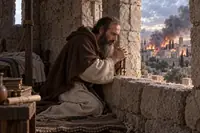 Chapter 5 of 5His rest beside the manger of Bethlehem2 min
Feast day
Saint Jerome
Some places may celebrate on a slightly different day.
September 30
Patron of
- Translators
- Librarians and Scripture scholars
Often depicted with
- A lion
- A cardinal’s red robe
- A book and a pen
Opening
Opening
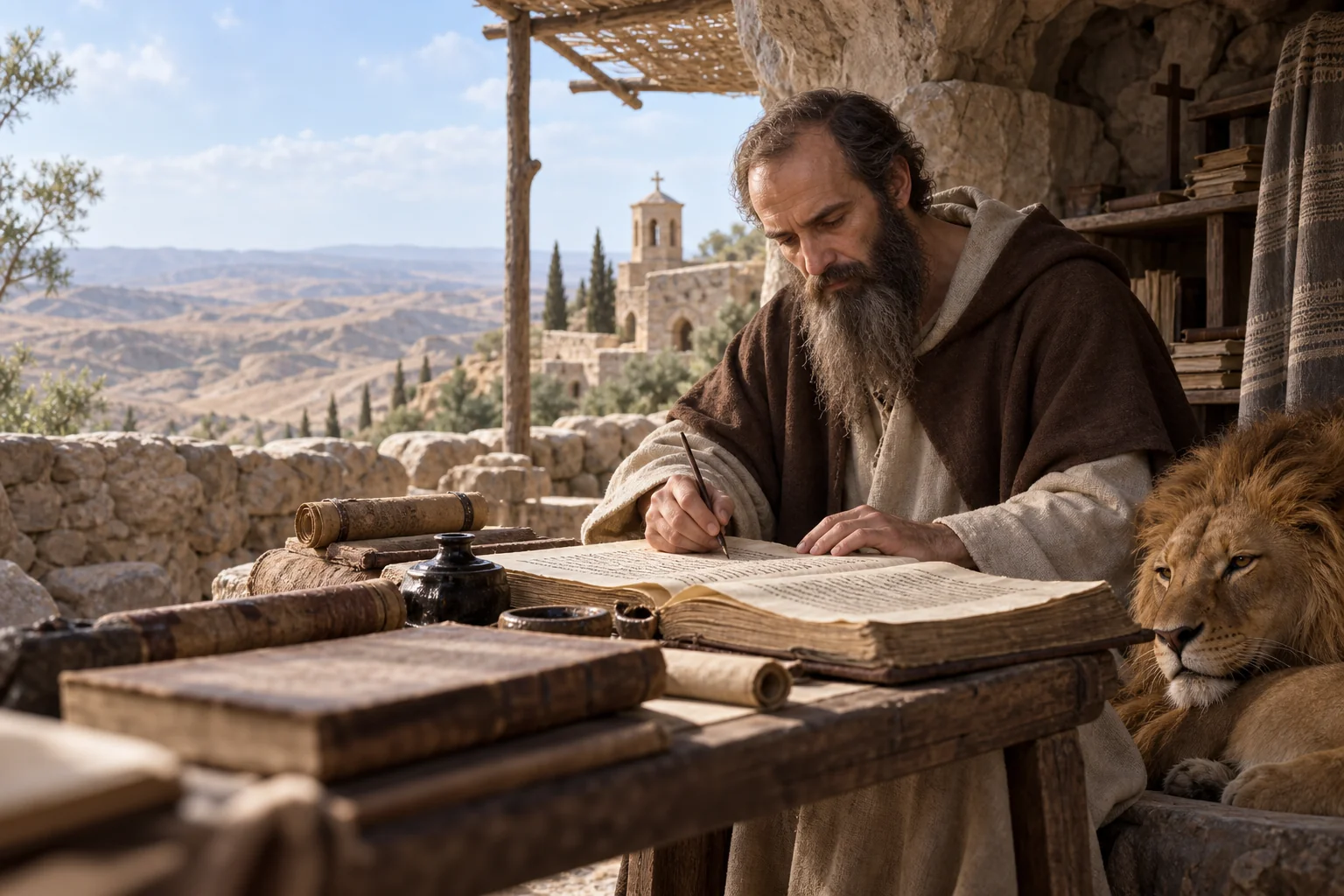
In a cold natural cave beside the Grotto of the Nativity in Bethlehem, on snowy winter nights at the end of the fourth century, a thin, white-haired old man sat hunched over a flickering oil lamp. Around him lay piles of parchment books in Hebrew, Greek and Aramaic. In one hand he held a quill, in the other a sharp stone, so that whenever drowsiness or temptation came over him, he could strike his chest hard with the stone to stay awake.
That old man was Saint Jerome (Eusebius Sophronius Hieronymus), the greatest biblical scholar in the history of the Church.
He spent more than thirty years in that cave at Bethlehem on a task no one had attempted before: translating the whole Bible from its original languages into the everyday Latin of his time. The result, known as the Vulgate (the “common” version), nourished the faith and liturgy of the Western Church for more than fifteen centuries.
And he left us words that have never been forgotten:
“Ignorance of Scripture is ignorance of Christ!”
Chapter 1 of 5
The fiery temper of a young man from Stridon
Jerome was born around 347 in the town of Stridon, in Dalmatia, now on the border between Croatia and Slovenia, into a wealthy Christian family.
At twelve, his parents sent him to Rome to study grammar, rhetoric and philosophy under Aelius Donatus, the most famous grammarian of the time. In Rome, Jerome soon showed an extraordinarily sharp mind, mastering classical Latin and Greek.
But the splendid capital also had its temptations, and when the long hours of study were over, the young man fell into its pleasures like so many others.
Still, his conscience gave him no peace. On Sundays the young student would go with friends down into the dark, damp catacombs beneath Rome to visit the tombs of the martyrs. Standing there in the darkness among the dead, he trembled, sensing how empty the world was and how just God’s judgment would be. In 366, at nineteen, he was baptized in Rome.
Jerome was a man of strong character: brilliantly learned, but with a temper as hot as fire, blunt to the point of harshness, and never willing to give way to what was wrong. With a pen as sharp as a razor he attacked without mercy the hypocrisy, laziness and moral corruption of clergy and laity alike.
That prickly temperament made him countless enemies all his life, and he needed harsh daily penances to rein in his old self. Perhaps no saint in the Church’s history was so admired for his learning and so complained about for his temper. Yet his faults, which he never hid, do not lessen him; they bring him closer to us: a saint who was not perfect, but who never stopped fighting to become holy.
Chapter 2 of 5
A fever in the desert of Chalcis and a strange dream
After finishing his studies, Jerome traveled to Trier and Aquileia, where he fell in with circles of devout Christians.
In 373 he decided to make a pilgrimage to the East. When he reached Antioch in Syria, he fell dangerously ill. In the delirium of fever, Jerome had a vision that changed his whole life.
He saw himself brought before the dazzling court of the Supreme Judge. A majestic voice asked: “Who are you?” Jerome answered, trembling: “I am a Christian!” But the Judge said sternly:
“You lie! You are a disciple of Cicero, not a disciple of Christ; for where your treasure is, there your heart is also!”
He was flogged at once, and released only when he vowed never again to love worldly books more than the word of God.
When he woke, the marks of the lashes still stung on his skin, and Jerome gave up all worldly ambition then and there.
He went alone into the barren desert of Chalcis, east of Antioch, a place known as “the land of death”. For five years, from 374 to 379, he lived as a hermit among snakes and wild beasts, living on roots and water, his skin burned black by the desert sun.
Yet in the empty desert, memories of the dancing girls of Rome still rose up and burned in his mind. To fight those fierce temptations of the flesh, Jerome found an unusual remedy: he asked a Jewish convert to teach him Hebrew, a language of tangled grammar and harsh sounds.
He wrote:
“Whenever the fire of desire flared up, I buried myself in learning dry, difficult Hebrew vocabulary... And that hard work became a shield protecting my soul!”
Who could have guessed that those hours of wrestling with a hard language in the lonely desert would lay the foundation for the greatest work of his life: translating the Bible directly from the Hebrew, something no Latin scholar before him had dared to do.
Chapter 3 of 5
The Pope’s secretary and the storms of Rome
In 379 he was ordained a priest by Bishop Paulinus of Antioch on condition that he could keep his hermit’s life. Afterwards he went to Constantinople to study Scripture under Saint Gregory of Nazianzus.
In 382 Jerome returned to Rome, where Pope Damasus I soon recognized his outstanding gifts. The Pope made him his secretary and gave him a task that would make history: revising the old Latin translation of the New Testament, the Vetus Latina, which by then circulated in far too many faulty versions.
In Rome, alongside his translation work, Jerome became spiritual director to a group of devout noblewomen on the Aventine Hill, led by Saint Paula and her daughter Eustochium. He taught them Hebrew and Greek, and guided them in reading Scripture and in living lives of poverty and charity.
But his outspoken pen angered the clergy and nobility of Rome. He openly mocked the luxury, vanity, greed and flattery of the city’s priests. They hated him for it and spread vile slanders about his pure friendship with the devout noblewomen.
In 384, when Pope Damasus I died, Jerome lost his only protector and was completely isolated.
In August 385 he shook the dust of Rome from his feet, boarding a ship to leave the city he called “the new Babylon”, and returned to the East for good.
Chapter 4 of 5
Thirty-four years in a cave at Bethlehem
In 386 Jerome and Saint Paula settled in Bethlehem, where Jesus was born. With Paula’s money they built a monastery for men, three convents for women and a free hostel for pilgrims.
For himself, Jerome chose a natural cave just north of the Grotto of the Nativity as his cell and library. It is part of a network of underground caves, and pilgrims today can still follow a narrow passage from the Nativity grotto into the stone room where he worked. He lived and labored in this cold cave for thirty-four years, until his last breath.
It was here that his great work, the Vulgate, was born. Instead of translating the Old Testament from the Greek Septuagint, the Version of the Seventy, as the Church was then used to doing, Jerome took a bold, revolutionary step: he insisted on translating it directly from the original Hebrew, the Hebraica Veritas, “the Hebrew truth”.
He paid Jewish scholars to tutor him at night, and traveled all over Palestine to study the geography of the Bible. His Latin was clear and precise, yet plain, so that even the poor could read and understand it.
This enormous work took fifteen long years, from 390 to 405. Alongside it he wrote a long series of commentaries on Scripture, historical works and defenses of the faith.
He taught his disciples:
“Read Scripture constantly; never let the holy book leave your hands... Love Scripture, and wisdom will love you!”
Chapter 5 of 5
His rest beside the manger of Bethlehem
His last years were full of sorrow:
- in 404, his faithful co-worker Saint Paula died;
- in 410, Rome was sacked by the Visigoths, and he wept with grief;
- in 416, a band of thugs from the Pelagian faction attacked and set fire to the monasteries at Bethlehem, forcing him to flee into a fortified tower to save his life.
His body was completely worn out, his eyes dim and his voice hoarse. He could only lie on a wooden plank, pulling himself up with a rope to say his prayers.
On September 30, 420, Saint Jerome died peacefully in the cave at Bethlehem, at the age of seventy-three. He was buried beneath the floor of the Church of the Nativity, near where he had labored over every page of Scripture, beside the tombs of Saint Paula and Eustochium. Some seven hundred and fifty years later, around 1165, in the time of the Crusades, Crusader knights carried his remains to Rome, where they are still venerated in the Basilica of Saint Mary Major. The cave and the empty tomb are still there in Bethlehem, a reminder that this great man lived and worked for thirty-four years right beside the place where the Word became flesh.
Pope Boniface VIII declared him a Doctor of the Church in 1298, together with Saint Augustine, Saint Ambrose and Saint Gregory the Great. The Church celebrates him on September 30 each year.
In sacred art he is often painted holding a quill, with a stone and a skull beside him as reminders of penance, and a lion lying at his feet. The story goes that he once gently pulled a thorn from a wild lion’s paw, and the beast became his faithful companion and protector.
Saint Jerome’s lasting gift to us is this: the word of God is the source of life that nourishes Christian faith.
Don’t let your Bible gather dust on the shelf, he tells us. Open it and read it humbly every day, because every page of Scripture is a love letter from God in heaven to each of His children on earth.
The end of the story
You have walked with Saint Jerome to the end of the story.
A few images stay with you:
In the cave at Bethlehem, the old man laboring over the Bible kept a sharp stone at hand to strike his chest whenever drowsiness or temptation came.
In a delirious fever at Antioch, he was brought before the Judge and heard the rebuke: "You are a disciple of Cicero, not a disciple of Christ!"
In the lonely desert of Chalcis, to drive out memories of the flesh, he buried himself in dry Hebrew grammar, which became the foundation of the greatest translation of his life.
Stay in silence
You understand why he told his disciples to love Scripture: he gave a whole life of hardship to bring God’s word within reach of even the poorest.
Ignorance of Scripture is ignorance of Christ!
Let us pray
Saint Jerome,
you spent your whole life in a cave at Bethlehem translating the Bible so that people could read the word of God.
Teach me to love Scripture and read God’s word every day, for as you said: ignorance of Scripture is ignorance of Christ.
Pray for those who translate and explain God’s word. And help me, as you did, to fight my own quick temper.
Amen.
Sources
- Feast dayAuthor’s edited profile
- Patron ofPatronages and symbols, version 1.1
- Often depicted withPatronages and symbols, version 1.1
- Reflectionvatican.va
- Reflectionvatican.va
Meet the next one
 Journey 6