

Journey 1 · Those Who Met the Lord
Saint Thomas
Faith that passes through wounds
Feast day July 3
Tap to step inside
Saint Thomas
Faith that passes through wounds
Map of a life
This life told in 5 chapters
Begin the journey
Feast day
Saint Thomas
Some places may celebrate on a slightly different day.
July 3
Patron of
- India
- Architects and builders
- Those who doubt and are searching for faith
Often depicted with
- A builder’s square
- A spear
- Placing his hand in the side of the risen Lord
Opening
Opening
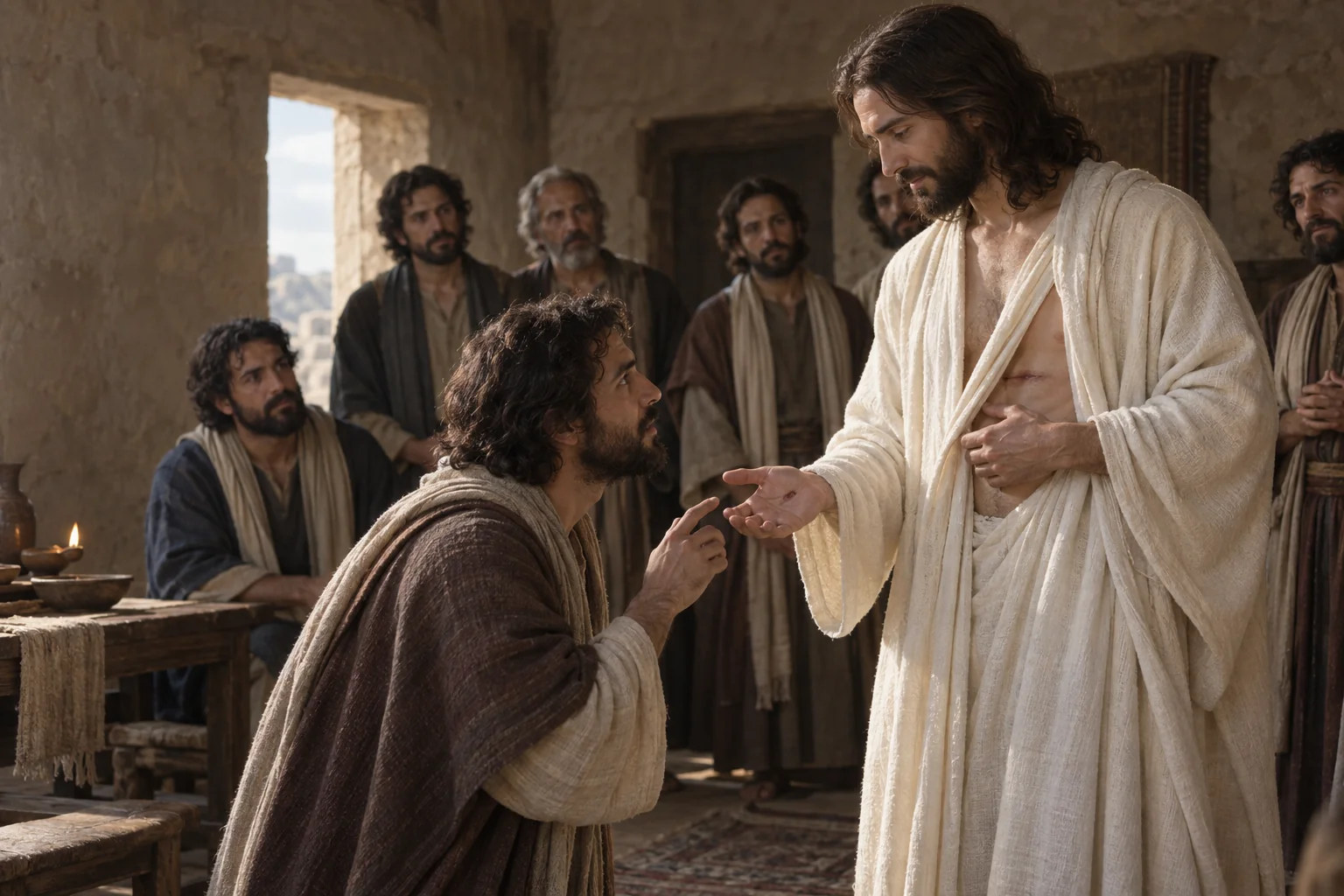
In the days after that first Easter evening, the other disciples in the locked room kept repeating the same words to him, their eyes shining with joy: “We have seen the Lord!” But Thomas just sat there, carrying a heavy stone in his heart that no one could lift. He answered stubbornly:
“Unless I see the mark of the nails in his hands, and put my finger into the nail marks and my hand into his side, I will not believe.”
He had no wish to rush into a shallow comfort. His Master’s body had truly been beaten to pieces, truly been nailed to a cross, truly been laid in a cold stone tomb. The pain was so great that he no longer dared believe anything that sounded too easy, too beautiful.
Then Jesus came, while the doors were still locked tight. He walked straight up to Thomas and invited him to come close and touch those very wounds. That encounter set off one of the deepest professions of faith in the whole Gospel:
“My Lord and my God!”
Chapter 1 of 5
A man ready to walk into danger
Thomas was one of the Twelve Apostles. The Gospel often calls him by another name: Didymus, Greek for “twin” — but no record tells us who his twin was, or why he bore that name. His hometown, family, birth and age are entirely absent from Scripture.
The most vivid traits of his character are drawn very clearly by Saint John. When news came that their friend Lazarus was gravely ill and had died in the village of Bethany in Judea, Jesus decided to go back there. The other disciples were alarmed and tried to stop him, because only a few days earlier the people there had tried to stone him to death.
While everyone else was still hesitating, Thomas turned to his friends and said bluntly:
“Let us also go, that we may die with him!”
Those words paint a Thomas entirely different from the “doubting” label later generations pinned on him. Here is a man who loved his Master so fiercely that he was ready to risk his life and walk into death with him. That courage was real, even if his outlook at the time was steeped in gloom, as if he had already decided this journey could only end in death.
People still call him “Doubting Thomas”; the nickname has entered everyday speech in many languages for anyone who is skeptical and slow to believe. But if we read carefully everything the Gospel records about him, it is a somewhat unfair label. Before he was the doubter in the locked room, he had been the only one in the group who dared to urge the others to go and die. His doubt, in the end, did not come from a shallow soul lacking faith. It came from a heart that had loved too deeply and been hurt too badly to easily believe anything that might disappoint it once more.
Chapter 2 of 5
A question at the Last Supper
At the Last Supper, when Jesus tried to comfort the disciples, saying he was going to prepare a place for them, and “you know the way to where I am going,” Thomas was again the one who bluntly interrupted, not pretending to understand: “Lord, we do not know where you are going; how can we know the way?”
When he did not understand, he said plainly that he did not understand. He did not nod along just to save face in front of the others. And thanks to Thomas’s honest, rather clumsy candor, the whole world got to hear one of Jesus’ best-loved sayings:
“I am the way, and the truth, and the life. No one comes to the Father except through me.”
Jesus did not give him a map with directions. He gave him himself. The road to true life is not a route marked out stage by stage; it is a person to cling to with one’s whole life, even if that road was about to pass through the dark night of the Cross before reaching its end.
Chapter 3 of 5
The empty space of an absence
On the evening of Easter Day, when Jesus appeared and wished peace to the disciples trembling behind locked doors, Thomas was not there. Scripture never explains why he was absent at that crucial moment. Perhaps, too grief-stricken by his Master’s death, he had quietly slipped away from the group to bear his pain alone.
When he came back and heard the others exclaim joyfully: “We have seen the Lord!”, he brushed it aside at once, curtly. That stubbornness reveals a bitter distance between other people’s testimony and the still-raw wound in his own heart. Scripture does not praise this stubbornness, but neither does it erase it from the Apostle’s life to make him look better. There are times when a person’s faith is shaken so violently that it cannot keep up with the joy flooding the people around them.
What is precious, though, is that for the eight days that followed, Thomas stayed with the disciples, and did not leave for good, though he felt out of place. The community did not drive out its doubting brother; and Thomas, though his heart did not yet believe, could not bring himself to abandon his brothers. It was right in the heart of a community still able to be patient and wait for one another that he had the chance to meet the Lord again.
Those eight days cannot have been easy for Thomas. Every day he still had to eat, sleep and pray alongside brothers who kept repeating a joy he could not share. Nothing is lonelier than living among a rejoicing crowd while your own heart still holds all its doubt and pain. But that very persistence in staying — not withdrawing, not isolating himself completely — is what kept the door open for the encounter to come.
Chapter 4 of 5
Wounds still open on the risen body
Jesus appeared, wished them peace, then turned straight to Thomas, avoiding nothing:
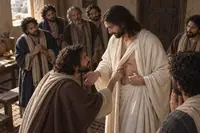
“Put your finger here, and see my hands. Reach out your hand and put it in my side. Do not be unbelieving, but believe.”
He knew every struggle tearing at Thomas’s heart, and he did not leave him to sink in the darkness of doubt. Scripture never records whether Thomas actually put his finger into those nail marks. Perhaps, faced with a love so generous, all his earlier demands for proof suddenly became completely unnecessary. Thomas could only fall down, choking out:
“My Lord and my God!”
The glorious risen One is the very One who was crucified. Those marks were neither erased nor hidden. Jesus carried his wounds with him into eternal glory, as lasting proof of a love that gave itself completely.
Jesus added:
“You have believed because you have seen me. Blessed are those who have not seen and yet believe!”
That blessing reaches far beyond the four walls of that upper room, touching each of us today — those who have never seen the Lord in flesh and blood with our own eyes, yet who receive the Apostles’ testimony and believe in Him and love Him.
Chapter 5 of 5
Footsteps toward the East
According to the ancient tradition of the Eastern Churches, especially of the Christian community in India — who to this day proudly call themselves Saint Thomas Christians — after Pentecost he took a merchant ship across the sea and landed at Cranganore on the Malabar coast of southwest India, around the year 52. Tradition tells that there he preached both to the Jews who had settled earlier and to the local people, founding seven communities of faith scattered across Kerala; many churches bearing his name still stand and are in use today. He was martyred at Mylapore, near today’s city of Chennai, around the year 72, and the tomb venerated as his is still kept in a church there.
Though these dates and details belong to a sacred tradition kept and handed down by generations of believers, and have not been fully verified by modern historians, they still show us something worth pondering: the flame of faith of the Apostle who insisted on touching the nail marks before he would believe turned out to be one of the flames that spread farthest, burning brightly in some of the most distant lands of ancient Asia — thousands of kilometers by sea from Jerusalem.
The Church celebrates Saint Thomas the Apostle on July 3 each year.
For anyone going through dark nights of doubt in their faith, for anyone carrying the raw wounds of loss or disappointment, the life of Saint Thomas is a great comfort. Christian faith has never required us to deny or hide our own wounds. It only invites us to bring those very wounds and lay them before the risen Lord, as Thomas did.
Thomas’s short prayer —
“My Lord and my God!”
— can become a prayer each of us whispers every day: I give my whole life to You, Lord, even on days when my heart still trembles, still feels weary, still does not quite dare to believe.
The end of the story
You have walked with Saint Thomas to the end of the story.
Perhaps you will always keep:
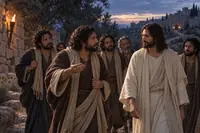
In the locked room, he said plainly: "Unless I see the mark of the nails... I will not believe."
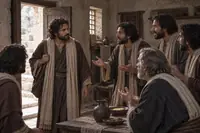
Eight days of staying with his brothers, his doubt still whole, leaving no one.
The Lord came and invited him to touch those very wounds — and all he could do was cry out: "My Lord and my God!"
Stay in silence
Looking back, you see: Thomas did not doubt because he was shallow, but because he had loved too deeply and been hurt too badly to believe easily once more. Faith passes through wounds; it does not avoid them.
The Lord does not need us to pretend our doubts are gone — He only needs us not to walk away.
Let us pray
Saint Thomas,
you said plainly: "Unless I see the mark of the nails, I will not believe." But for eight days you stayed with your brothers. And when you touched the Lord’s wounds, you cried out: "My Lord and my God!"
Pray for those who doubt, for those who have been hurt after trusting. Let them not walk away, but stay in the community until the day they meet the Lord.
And each time I look up at the Cross, let me speak to the Lord as you did.
Amen.
Sources
- Feast dayAuthor’s edited profile
- Patron ofPatronages and symbols, version 1.1
- Often depicted withPatronages and symbols, version 1.1
- Reflectionvatican.va
- Reflectiongutenberg.org
Meet the next one
 Journey 1