

Journey 1 · Those Who Met the Lord
Saint Bartholomew
Known before he could speak
Feast day August 24
Tap to step inside
Saint Bartholomew
Known before he could speak
Map of a life
This life told in 4 chapters
Begin the journey
Feast day
Saint Bartholomew
Some places may celebrate on a slightly different day.
August 24
Patron of
- Tanners
- Armenia
Often depicted with
- A knife (recalling his martyrdom)
Opening
Opening
Among the Apostles, there are some to whom Scripture gives many pages, telling every word and every great event of their lives. Others appear only in passing, strangely quiet, as if they had chosen to stand behind their louder brothers. Bartholomew is one of these: a humble name in the list of the Twelve, a faithful presence the Church has remembered down the centuries, and a name that tradition carried far away to the lands of the East.
Drawing near to him, we learn a precious lesson: to accept even the silences of history. A life given to God does not have to be measured by how many glorious pages of biography later generations manage to write. Sometimes it is quiet, steady faithfulness before God that is most precious, even if few remember the name.
Chapter 1 of 4
One of the Twelve
Bartholomew is named by the evangelists Matthew, Mark and Luke, and by the Acts of the Apostles, in the list of the Twelve — always there, but only as a name, with no story of his own. In Aramaic the name means “son of Talmai”; in other words, it comes from his father rather than being his own personal name. The New Testament records nothing of his age, trade, hometown or childhood.
The only thing certain is that he belonged to the disciples Jesus himself chose during the years of his public preaching — called to stay with the Master, and sent out by him. After the Lord ascended to heaven, his name is still mentioned among the brothers gathered in prayer in Jerusalem, and after that the New Testament falls silent about him.
Alongside those brief lines, a long tradition of the Church has always identified Bartholomew with the figure named Nathanael, described in some detail in Saint John’s Gospel. The identification rests mainly on his close bond with the Apostle Philip: in the Synoptic lists, Bartholomew’s name always comes right after Philip’s, and in John’s Gospel it is Philip who brings Nathanael to meet the Lord. Though the New Testament never says outright that the two names belong to the same person, the moving story of Nathanael’s meeting with Jesus has long been part of devotion to Saint Bartholomew, a cherished inheritance that fills in some of Scripture’s silence about him.
The way the two names were joined also reminds us of something: many figures in Scripture have more than one name. Some bear a name taken from their father, like Bartholomew; some take another name on entering a new stage of life, as Simon was renamed Peter. That a person can be known by several names, depending on who is telling the story and in what setting, is itself a reminder that what Scripture records is only a tiny part of a real person, far more alive than the few lines that remain.
Chapter 2 of 4
A doubt that was not despised
When Philip came running joyfully to announce that he had found the Messiah, Jesus of Nazareth, Nathanael shot back a prejudiced question, without troubling to be polite:
“Can anything good come from Nazareth?”
The question sounds rather rude, nothing like what we usually picture from a future saint. It shows a low opinion of a poor region, and skepticism toward news that sounded too good to be true. Yet Philip did not argue back; he only gently invited his friend:
“Come and see.”
And Nathanael got up and went. He did not let his first prejudice wall up his heart. Perhaps this is the most precious thing about him: honesty sometimes begins very simply, by daring to say plainly what you do not yet believe, and then finding the courage to take one more step and see the truth for yourself, instead of staying stuck in your first prejudice.
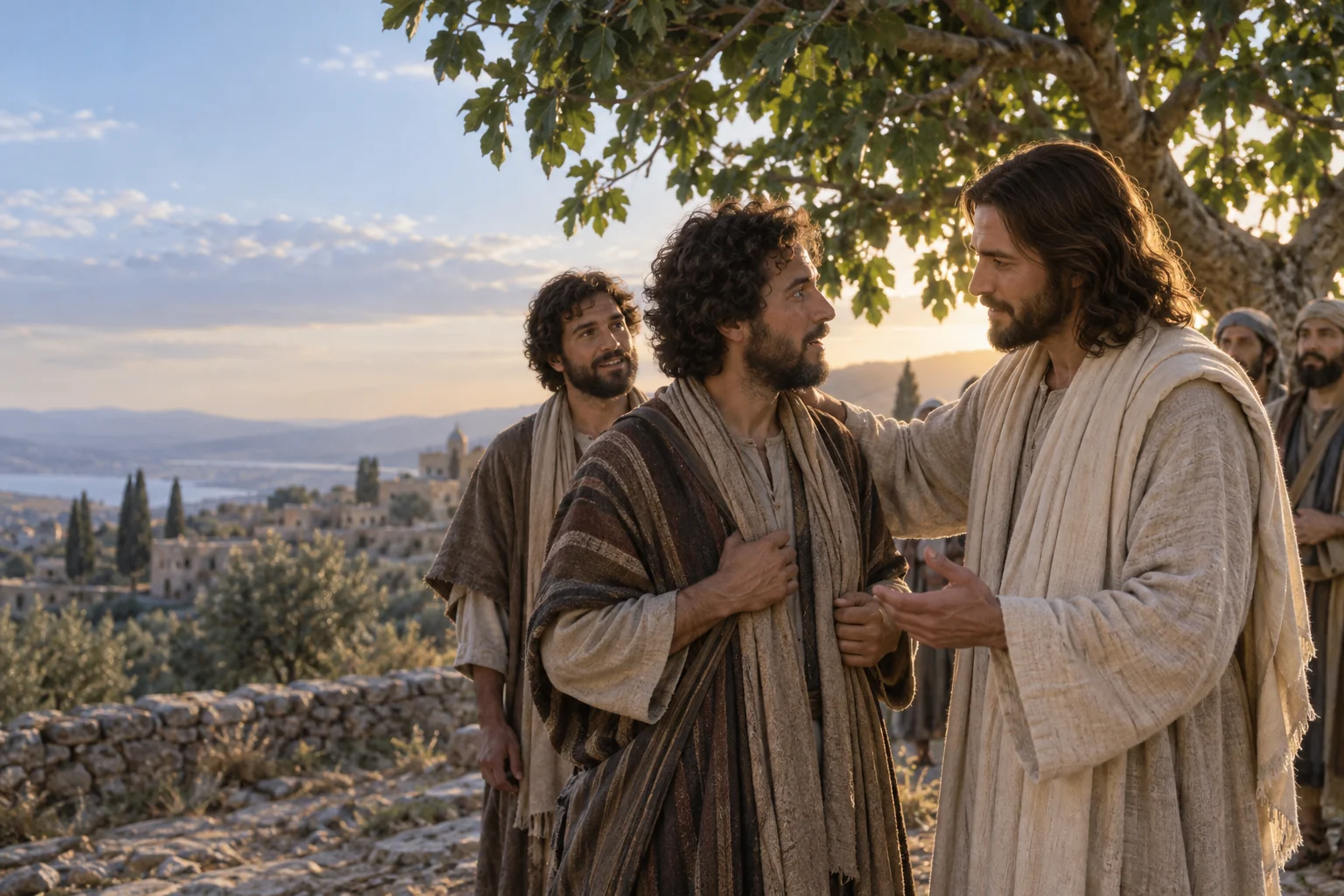
As soon as he saw Nathanael approaching, Jesus smiled and spoke about him before he could open his mouth:
“Here is truly an Israelite in whom there is no deceit.”
Nathanael was stunned and asked: “How do you know me?” Jesus looked him straight in the eye and answered:
“Before Philip called you, when you were under the fig tree, I saw you.”
Scripture never says what Nathanael was doing under that fig tree. Was he praying alone? Sighing over troubles no one else knew about? Or quietly speaking to God in his heart, unknown to anyone? What happened beneath those green leaves remains a secret between him and God. What shook him to the core was realizing this: he had been known by God, seen and loved by Him, long before he had said a single word.
In the Jewish world of that time, the fig tree was often planted right in the courtyard or beside the synagogue, its broad leaves wide enough for a person to sit hidden in the shade to read, meditate or pray alone, away from the harsh sun and away from the curious eyes of passers-by. Many Jewish teachers of the time even advised their students to find a fig tree to sit under while studying the Law, since its shade was thought to quiet the mind. If Nathanael really was in such a private moment, one he was sure no one could see, then the fact that Jesus named that very detail shows all the more clearly that there is no hidden corner of a person’s inner life beyond the loving gaze of God.
Chapter 3 of 4
From a doubting question to a profession of faith
His doubt melted like morning mist in the sun. At once Nathanael made his profession of faith:
“Teacher, you are the Son of God, you are the King of Israel!”
Jesus smiled and answered:
“Do you believe because I told you I saw you under the fig tree? You will see greater things than that! You will see heaven opened, and the angels of God ascending and descending upon the Son of Man.”
An encounter that began in suspicion and prejudice opened up an entirely new horizon, linking earth with heaven. But the Lord’s promise also makes clear that this was only the beginning. The disciple still had many hard days to walk with his Master, and his faith would be tested again and again, above all in the darkness of the Cross.
John’s Gospel mentions Nathanael once more, on the Easter morning by the Lake of Tiberias, and tells us he came from Cana in Galilee, the very village where the Lord worked his first miracle, turning water into fine wine at a wedding feast. He was among the seven disciples who rowed out with Peter to fish all night and caught nothing, and then met the risen Lord waiting for them on the shore. If tradition is right that he is Nathanael, Bartholomew sat down with them and shared the warm breakfast the Master himself had prepared over the glowing charcoal. The Lord does not abandon those who come back empty-handed after a long night of failure.
Chapter 4 of 4
Remembered in distant lands
Beyond those few details of Scripture, the life of the Apostle Bartholomew leaves no historical timeline that can be verified stage by stage. Ancient missionary traditions link his footsteps to distant lands like India, Armenia and the countries of the East, lands that in those days were a feat merely to reach, let alone to stay and preach in for many years. These memories, handed down without written records from the time, still suggest that the seed of the Gospel he sowed may have spread far beyond the borders of the Roman Empire.
The image of his martyrdom, especially the tradition that he was flayed alive for the name of Christ in Armenia, has left a deep mark on Christian art over the centuries. In old paintings and statues he is often shown holding a knife, recalling that terrible sacrifice, perhaps one of the most painful martyrdoms told of any Apostle. Even Michelangelo, painting the fresco of the Last Judgment in the Sistine Chapel, portrayed Bartholomew holding his own flayed skin in his hand, a detail that still makes visitors shudder when they look up.
No record from the time preserves the details of his execution, yet in every age the Church has reverently honored the martyrdom handed down to us. Precisely because the way he died is told as so painful, Saint Bartholomew later became the patron of tanners, bookbinders and those who suffer from skin ailments: a link both homely and moving between the pain he bore and the very ordinary pains of later generations.
The Church celebrates Saint Bartholomew on August 24 each year.
His name reminds us of a great comfort: God does not despise the doubts and sincere questions that rise from the depths of the human heart. We do not need to put on a mask of piety before we dare come near the Lord. Come to Him just as you are, awkwardness, prejudices and all.
Under some fig tree, or in the most hidden corners of a hard-working life, at times when no one sees or understands you, remember this: the Lord saw you long ago. He knew you, He loved you, and He is still patiently waiting for you to turn your steps toward home.
The end of the story
You have walked with Saint Bartholomew to the end of the story.
What you will remember most:
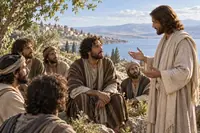
A doubtful remark blurted out without a second thought: "Can anything good come from Nazareth?"
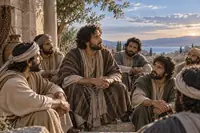
A simple invitation in reply: "Come and see." And he got up, and went.
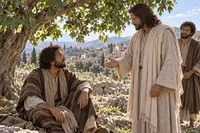
The Lord calling him by name before he could open his mouth: "Before Philip called you, when you were under the fig tree, I saw you."
Stay in silence
Looking back, one thing remains: Bartholomew left almost no story of his own in Scripture. But his honest doubt opened the way to one of the most beautiful encounters in the Gospel.
God does not despise a heart that still doubts — He only waits for it to find the courage to come and see.
Let us pray
Saint Bartholomew,
you doubted: "Can anything good come from Nazareth?" But when you heard the invitation "Come and see", you still got up and went. And the Lord had already seen you under the fig tree.
Do not let me close my heart because of my own prejudices. When I doubt, give me the courage to come and see.
Remind me that the Lord knew me before I could say a word, and that He is still waiting for me.
Amen.
Sources
- Feast dayAuthor’s edited profile
- Patron ofPatronages and symbols, version 1.1
- Often depicted withPatronages and symbols, version 1.1
- Reflectionvatican.va
- Reflectiongutenberg.org
Meet the next one
 Journey 1