

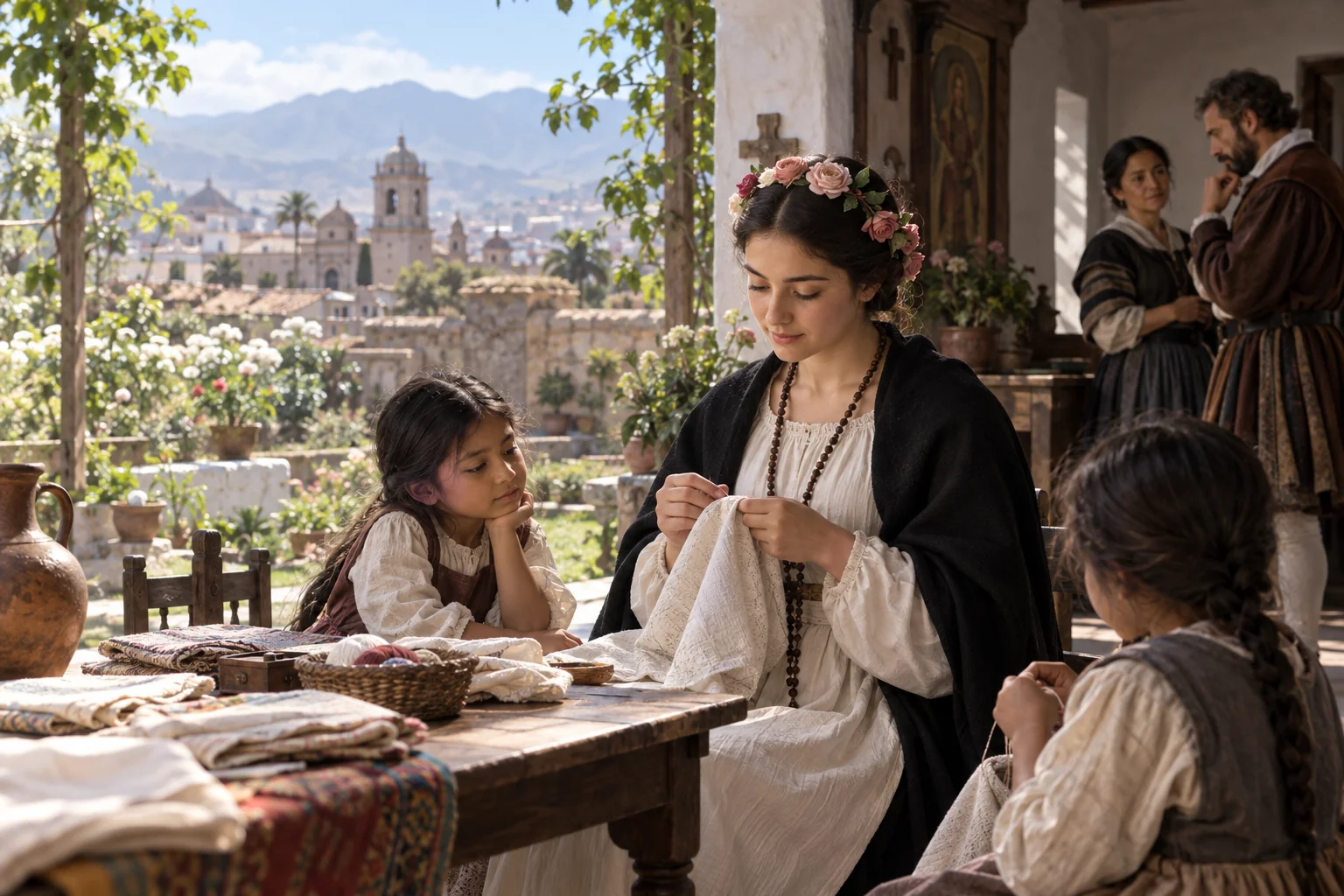
Journey 7 · Going Far, Standing Firm
Saint Rose of Lima
A rose blooming in a garden of poverty
Feast day August 23
Tap to step inside
Saint Rose of Lima
A rose blooming in a garden of poverty
Map of a life
This life told in 6 chapters
Begin the journey OpeningOpening1 min
 Chapter 1 of 6A child named Rose1 min
 Chapter 2 of 6The fight to keep her virginity1 min
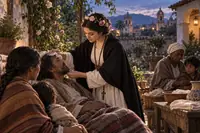 Chapter 3 of 6A wooden hut and a silver crown of thorns1 min
 Chapter 4 of 6Fifteen years in the dark night of faith1 min
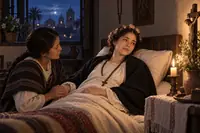 Chapter 5 of 6The triumphant hour of the rose1 min
- Chapter 6 of 6The first saint of the New World1 min
Feast day
Saint Rose of Lima
Some places may celebrate on a slightly different day.
August 23
Patron of
- Latin America and the Philippines (proclaimed in 1669)
- Peru
- Gardeners and florists
- Many young women’s associations in Vietnam
Often depicted with
- A wreath of roses on her head
- An anchor
- Holding the Child Jesus
Opening
Opening
Lima, in Peru, at the end of the sixteenth century was a splendid city, overflowing with gold and silver plundered from the native people’s mines, where the lavish feasts of the colonial nobility drowned out the groans of thousands of slaves. There a breathtakingly beautiful young noblewoman chose to go against the current.
She refused rich and distinguished suitors, cut off her long, shining hair, rubbed hot pepper on her face to spoil her worldly beauty, and with her own hands built a small, simple wooden hut in a corner of the garden behind the house. In that quiet corner of the garden, she made her life a burnt offering of love for the Cross, embroidering day after day to support her poor parents, and opening her door wide to care for the Indians and Africans who lived in misery.
That young woman was Rose of Lima (Rosa de Lima), the first flower of holiness in the Americas to be canonized by the Church. She is honored as patroness of the Americas, of Peru and of the Philippines. Her life shows that in a land full of greed and violence, one small soul closely united with Christ crucified can make compassion and purity bloom for a whole continent.
Chapter 1 of 6
A child named Rose
Isabel Flores de Oliva was born on April 20, 1586, in the city of Lima, capital of Peru, then a colony of the Spanish Empire. Her father, Gaspar Flores, was a poor soldier of Spanish noble descent; her mother, María de Oliva y Herrera, was born in Peru. She was the fourth of thirteen children in a large family.
When the little girl was only a few months old, lying in her cradle, a native woman who helped in the house looked at her chubby, rosy, radiant face and exclaimed in amazement:
“The baby’s face is as beautiful as a blooming rose!”
Touched by the words, her mother began calling her Rosa, Rose. When she was confirmed in 1597 by the holy Archbishop Turibius of Mogrovejo, himself later canonized, he made that name official: Rose.
As a child, Rose was gentle and obedient, with a deep inner life from an early age. Reading the life of Saint Catherine of Siena, the famous fourteenth-century Dominican tertiary, she was fired with the desire to imitate her. At only five, of her own accord, the little girl made a private vow of virginity to Jesus, a rare decision at that age, which she kept all her life.
When she was twelve, the family fell into serious financial trouble because of her father’s losses in the silver mines, a risky business but also the main source of income for the Spanish colonists in Peru at the time. The whole family was reduced to poverty. Without complaining, young Rose rolled up her sleeves to help her parents: by day she grew fresh flowers in the garden to sell at the market, and by night she sat by an oil lamp working fine lace until late, earning every coin she could to support her aging parents and her younger brothers and sisters. Her skillful hands put her whole love for God into every stitch.
Chapter 2 of 6
The fight to keep her virginity
When Rose reached adolescence, her beauty drew many of the richest young noblemen of Lima. Many distinguished families came bearing fine gifts to ask for her hand. Her mother and family pressed her hard, with angry words and even beatings, to force her to marry a rich man and rescue the family from poverty.
But Rose’s heart already belonged completely to her invisible Bridegroom. To put an end to every attempt at courtship, she took drastic steps: she cut off her beautiful long black hair with her own hands; rubbed hot pepper on her eyes and the skin of her face until it blistered and broke out in sores; and soaked her delicate hands in quicklime to make the skin rough and coarse. She told her mother in tears:
“Mother, this beauty belongs to a passing world; I want only to please Jesus alone!”
For ten long years, Rose patiently bore her mother’s harsh reproaches and beatings. She remained a most devoted daughter, caring for her parents’ every meal and every night’s rest, but her resolve to give herself to God never wavered. Finally, in 1606, at twenty, seeing that his daughter would not be moved, her father let her follow God’s call. On August 10, 1606, at the friary of Santo Domingo in Lima, Rose formally received the habit of the Dominican Third Order, living a consecrated life in the world after the example of Saint Catherine of Siena, whom she had admired since childhood.
Chapter 3 of 6
A wooden hut and a silver crown of thorns
Because of her family’s poverty and her duty to support her aging parents, Rose could not enter an enclosed convent as she longed to. With her brother Hernando, she built a small hut of wood and branches with her own hands in a corner of the garden behind the house. The hut was just big enough for a narrow plank where she lay and prayed.
In that solitary place, Rose lived an extraordinary life of penance. She fasted almost all year round, eating only a little dry bread and water, never meat or fish. Her bed was a wooden plank strewn with sharp shards of pottery and knotty pieces of wood. To unite herself with the Passion of Jesus, she made herself a thin silver crown with thirty-six sharp nails fixed inside, pressing into her scalp. She covered that crown of thorns with a red silk band and a wreath of fresh roses on the outside, so that people would see only a pretty wreath of flowers, with no idea that her head was bleeding painfully every day.
Yet that life of penance did not make her gloomy or eccentric. Rose’s face always shone with a peaceful smile and Easter joy. She loved nature and talked to the birds and insects in the garden as if they were friends. Every evening at sunset, people saw a flock of little birds swoop down to the hut and sing along with the young woman’s psalms of praise to God. She also turned a small room in her parents’ house into a charitable infirmary. There, with her own hands, she bathed, bandaged and spoon-fed elderly, sick Indian women and African slaves abandoned by their masters. She saw them as the suffering image of Christ Himself.
Chapter 4 of 6
Fifteen years in the dark night of faith
Behind the sweetness of her mystical visions lay a terrible inner battle that lasted fifteen long years: Rose fell into a deep “dark night of the soul.” She felt completely abandoned by God; temptations to emptiness and despair, and violent attacks of the devil, besieged her mind.
Many theologians and clergy of the time, suspecting that she was under diabolical illusions, summoned her before strict commissions of inquiry. But her deep humility and her wise answers, inspired by the Holy Spirit, led the most learned theologians of the University of San Marcos (one of the oldest universities in the Americas, founded in 1551) to acknowledge with admiration that this young religious was being guided directly by God Himself.
In 1615, when a fleet of Dutch Protestant pirates sailed into the bay of Callao, threatening to bombard and plunder the city of Lima, the people fled in panic. Rose ran straight into the church of Santo Domingo, lay prostrate before the altar of the Blessed Sacrament, stretched out her arms in the shape of a cross, and vowed she was ready to shield the tabernacle with her own body, preferring to be torn to pieces rather than let the Eucharist be profaned. According to the tradition still handed down today, when the pirates burst into the church, they saw only a young woman who seemed to be ablaze, holding the monstrance tightly in her hands, a sight that so terrified them that they turned and fled back to their ships. The warships weighed anchor in panic and withdrew, and Lima was spared by a hair’s breadth.
Chapter 5 of 6
The triumphant hour of the rose
In her last three years, her body worn out by penance and illness, Rose moved, on the advice of her spiritual directors, to live in the home of a devout noble family, that of Gonzalo de la Maza, a royal official who revered her deeply. There, tuberculosis and arthritis caused her great suffering. On her sickbed, she kept whispering a prayer of love:
“Lord, increase my sufferings, but at the same time increase the love in my heart!”
During the night of August 23 to 24, 1617 (the feast of Saint Bartholomew the Apostle), at thirty-one, sensing that the hour of meeting her Bridegroom had come, Rose smiled radiantly at the image of Jesus and spoke her last words:
“Jesus, Jesus, be with me...!”
Then she died peacefully.
Her funeral was like nothing South America had seen before: all the government bodies, the viceroy’s court, the bishops and hundreds of thousands of people of every class — from white nobles to black slaves and native Indians — poured in to bid a tearful farewell to their beloved daughter. The burial had to be postponed for several days because the stream of people coming to pay their respects never stopped. She was solemnly buried in the church of Santo Domingo in Lima.
Chapter 6 of 6
The first saint of the New World
Pope Clement IX beatified her on April 15, 1668. And on April 12, 1671, Pope Clement X canonized Rose of Lima, the first saint of the Americas to be canonized by the Church and the first born in the Western Hemisphere. Tradition says that when the Pope asked for a sign before the canonization, a sudden shower of roses fell, deepening devotion to the saint who bore the name of that flower.
In 1669 she was proclaimed principal patroness of all Latin America and of the Philippine islands. The Church celebrates her on August 23 each year; her feast was formerly kept on August 30. In Vietnam, Saint Rose of Lima is a well-loved saint, chosen as patroness by many parishes and children’s associations and by tens of thousands of Catholic women.
Saint Rose of Lima leaves us a lasting message:
“Apart from the Cross, there is no other ladder by which to climb to Heaven!”
From a beautiful young woman ready to ruin her own beauty to keep her vow, to the young woman standing between the pirates’ guns and the tabernacle, she reminds each of us: do not look for an easy, comfortable life of faith. Dare to accept the small sacrifices of every day with ardent love, because it is from the sharp thorns of those very sacrifices that the rose of God’s love spreads its fragrance through the world.
The end of the story
You have walked with Saint Rose of Lima to the end of the story.
There are three images you cannot pass by:
To put an end to every proposal of marriage, she cut off her beautiful hair with her own hands and rubbed hot pepper on her face until the skin blistered, telling her mother: "I want only to please Jesus alone!"
She made herself a silver crown with thirty-six sharp nails pressing into her scalp, then hid it under a wreath of fresh roses so that no one would know her head was bleeding.
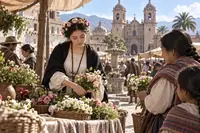
When Dutch pirates sailed on Lima, she ran straight into the church, held the monstrance tightly, and vowed to die rather than let the Eucharist be profaned — and the enemy ships turned and fled.
Stay in silence
You understand why she is called the first rose of the Americas: from the thorns of small sacrifices every day, a holy fragrance spread across a whole continent.
Apart from the Cross, there is no other ladder by which to climb to Heaven!
Let us pray
Saint Rose of Lima,
you quietly bore sacrifices no one knew about, and dared to hold the Body of the Lord tight when enemies came against the city.
Teach me to make small sacrifices out of love for God, while keeping a cheerful face.
Pray for the poor and the sick you cared for in your home, and for the peoples of Latin America.
Amen.
Sources
- Feast dayAuthor’s edited profile
- Patron ofPatronages and symbols, version 1.1
- Often depicted withPatronages and symbols, version 1.1
- Reflectiondominicos.org
- Reflectiondominicanen.org
Meet the next one
 Journey 7