

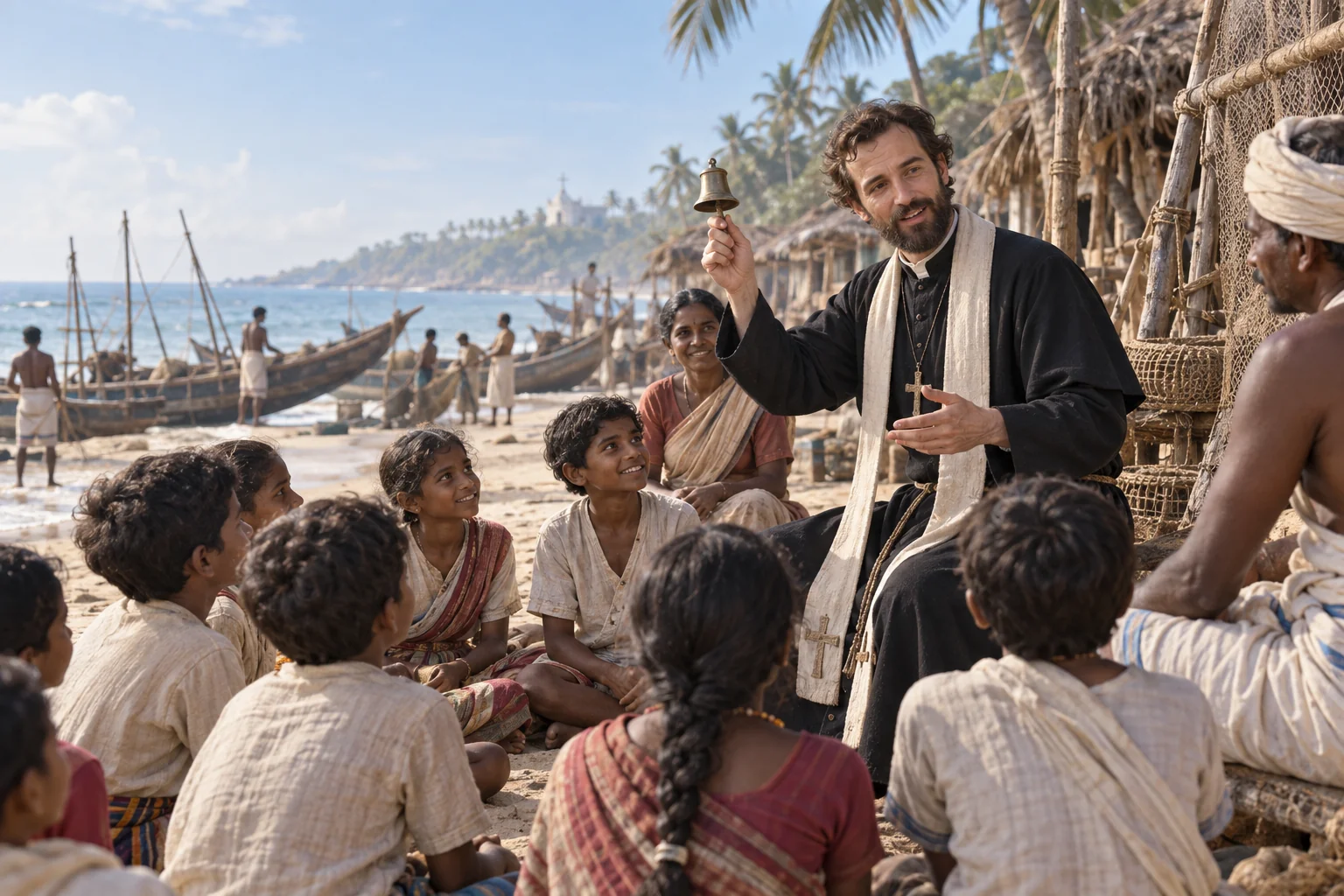
Journey 7 · Going Far, Standing Firm
Saint Francis Xavier
A fire blazing on the shores of the East
Feast day December 3
Tap to step inside
Saint Francis Xavier
A fire blazing on the shores of the East
Map of a life
This life told in 7 chapters
Begin the journey OpeningOpening1 min
 Chapter 1 of 7The proud nobleman of Navarre1 min
 Chapter 2 of 7A roommate’s fateful question1 min
 Chapter 3 of 7“Here I am, send me!”1 min
 Chapter 4 of 7A little bell on the Fishery Coast2 min
 Chapter 5 of 7Through storms to the Moluccas and the Land of the Rising Sun1 min
 Chapter 6 of 7An unfinished dream on the island of Shangchuan2 min
 Chapter 7 of 7An incorrupt body and the Patron of the Missions2 min
Feast day
Saint Francis Xavier
Some places may celebrate on a slightly different day.
December 3
Patron of
- The missions (proclaimed by Pius XI in 1927)
- Japan, India
- Many parishes in Vietnam
Often depicted with
- A mission cross
- A crab holding a crucifix
- A flame on his chest
Opening
Opening
On a bleak, cold beach on the island of Shangchuan, off southern China, on a freezing winter night in 1552, a forty-six-year-old European man, wasted to skin and bone, lay huddled in a tattered straw hut. The north wind off the sea whistled through the gaps in the bamboo.
A raging fever was consuming his body. He turned his sunken eyes to the gap in the hut, gazing toward the coast of mainland China, faint on the far horizon. His hands clasped a small crucifix tightly to his chest, and his cracked, bleeding lips whispered his last words in his beloved childhood tongue, Basque:
“Jesus, Son of David, have mercy on me... Mother Mary, have mercy on me... In You, O Lord, I have trusted; let me never be put to shame!”
The man dying alone on that empty beach was Francis Xavier (Francisco de Jaso y Azpilicueta), the greatest missionary since the Apostles themselves. In just eleven years in the Far East, he sailed more than a hundred thousand kilometers on creaking wooden sailing ships, set foot on the shores of India, Sri Lanka, Malacca and the wild Moluccas, and was the first to plant the Cross in Japan, the Land of the Rising Sun. His own hands baptized tens of thousands of converts, and he opened the way for millions in Asia to come to Christ.
Chapter 1 of 7
The proud nobleman of Navarre
Francisco de Jaso y Azpilicueta was born on April 7, 1506, in the ancient castle of Xavier, in the kingdom of Navarre in northern Spain. His father, Don Juan de Jaso, was a distinguished doctor of law and chief counselor at the royal court; his mother, Doña María de Azpilicueta y Xavier, was a noble heiress of high standing. He was the youngest of six children in a noble family.
When Francis was nine, war broke out and the kingdom of Navarre was annexed to Castile. The castle of Xavier was partly destroyed, the lands confiscated, and his father died in sorrow soon afterward. Growing up as the family’s fortunes declined, the young man nursed a burning ambition: not to choose a soldier’s career like his older brothers, but to use the highest learning to restore his family’s name and wealth.
In 1525, at nineteen, Francis left the family castle and set off for Paris to study at the Sorbonne, the most renowned university in Europe. There he earned his master’s degree in philosophy with distinction in 1530 and began teaching Aristotle’s philosophy at the Collège de Beauvais. Francis was a dashing, handsome young man, tall, an excellent high jumper and a brilliant speaker. Scholars and noble students praised him to the skies. A brilliant future, a prestigious professor’s chair, perhaps a richly endowed bishopric: all seemed already within the grasp of the twenty-four-year-old.
Chapter 2 of 7
A roommate’s fateful question
It was at the Collège de Sainte-Barbe in Paris that Francis was put in the same room as an older student: Íñigo de Loyola, the future Saint Ignatius. At first, the young nobleman was cold and disdainful, mocking Ignatius’s austere, poor, devout way of life. But Ignatius, with extraordinary patience and charity, never gave up. He often went to Francis’s philosophy lectures, helping him attract more students and find financial support for his teaching.
Whenever the two were alone together in their room, Ignatius would look deep into Francis’s eyes and repeat a question from the Gospel that shook him to the core:
“Francis, what does it profit a man to gain the whole world and lose his own soul?”
(Mt 16:26). The question struck like a sledgehammer, blow after blow, at the wall of the young professor’s pride. For many months it burned in Francis’s mind, robbing him of food and sleep. Little by little he saw how empty the applause he had craved really was.
At last Francis bowed his head and surrendered to God’s grace. On August 15, 1534, he made his vows with Ignatius and their companions on the hill of Montmartre. That September he made the thirty days of the Spiritual Exercises under Ignatius’s guidance, casting off all his ambitions for fame to give his whole life to Christ. On June 24, 1537, he was ordained a priest in Venice.
Chapter 3 of 7
“Here I am, send me!”
In 1540, King John III of Portugal wrote urgently asking Pope Paul III to send two Jesuit priests as missionaries to Portugal’s new colonies in India. Saint Ignatius chose two men, one of them Father Bobadilla. But just before the day of departure, Father Bobadilla suddenly fell ill with a high fever and could not go.
Time was short; the fleet was about to weigh anchor at Lisbon. Saint Ignatius turned to Francis Xavier, who was sitting in his room writing letters, and said: “Francis, this is your task!” Without a moment’s hesitation, without asking for time to pack, the thirty-four-year-old priest jumped up and answered with a radiant smile:
“Yes, Father, here I am, I am ready to go!”
He had time only to mend his old black cassock himself and embrace his spiritual father in farewell. The two close friends, who had laid the foundations of a whole religious order together, never saw each other again on earth.
On April 7, 1541, on his thirty-fifth birthday, Father Francis Xavier boarded the ocean-going ship Santiago in the port of Lisbon. He carried the title of Apostolic Nuncio given him by the Pope, but refused every comfort due to that rank: he slept on the deck with the sailors, cared for the seasick himself, washed clothes for the sick, and shared his meager food with the slaves on board. The voyage around the Cape of Good Hope lasted thirteen long months full of storms and disease. On May 6, 1542, he set foot on the quay of Goa, the capital of Portuguese India.
Chapter 4 of 7
A little bell on the Fishery Coast
In Goa he began by trying to reform the lax morals of the Portuguese colonists themselves. He went into the hospital to care for lepers and into the prison to comfort the inmates. But his real mission lay among the Paravas, on what was called the Fishery Coast or Pearl Fishery Coast, at the southern tip of India. The people’s name, “Parava,” came from the old Tamil word “paravai,” meaning the sea.
Tens of thousands of poor pearl divers lived there. About ten years before Francis arrived, the Parava community had asked the Portuguese for help against Arab traders competing for their fishing grounds, and in return nearly twenty thousand of them had been baptized en masse under an agreement more political than religious. As a result they were Christians in name only: no one had taught them the faith, and they lived in ignorance and under cruel exploitation.
For three long years, from 1542 to 1545, Father Francis Xavier lived wholly among those poor people. He ate rice with dried fish as they did, drank plain water, and slept on the burning sand or on a torn mat in a palm-leaf hut. In one hand he carried a little bell, ringing it through every lane to draw children and adults to him. He translated the Our Father, the Hail Mary, the Creed and the Ten Commandments into Tamil and set them to folk tunes so that even the illiterate could sing and remember them. He taught the children to sing the catechism, then sent them home to teach their parents.
He worked with tireless zeal, baptizing thousands of people every day. He wrote back to Saint Ignatius in Rome:
“There are days when my arm is so tired I cannot lift it, from baptizing so many people, and my voice gives out from repeating the prayers and the catechism so many times!”
According to many witnesses of the time, God worked astonishing miracles through him, healing the paralyzed, the deaf and the mute, and raising several people from the dead to strengthen the faith of the new converts.
He also wrote fiery letters to the professors and students of the Sorbonne in Paris, where he had once studied:
“How many times I have thought of running straight to the universities of Europe, above all to Paris, and shouting into the ears of the scholars who are more taken up with learning than with charity: How many souls here are being lost for lack of someone to proclaim the Gospel, while you are absorbed only in seeking empty academic honors!”
Chapter 5 of 7
Through storms to the Moluccas and the Land of the Rising Sun
From 1545 to 1548, the fire of mission drove him on across the sea to Malacca, in present-day Malaysia, and deep into the Moluccas, the Spice Islands of present-day Indonesia. He went even to the wild islands of Moro, home to notorious cannibal tribes that the traders shunned in terror. When friends begged him not to go to that land of death, he answered firmly:
“If these islands had gold, silver and fragrant wood, the traders would risk their lives to come; so why should the souls here not be worth as much as gold and silver, for a disciple of Jesus to dare risk his life to save them?”
In 1547, in Malacca, he met Anjirō, a young Japanese fugitive searching for peace of soul. That meeting kindled in him a great new dream: to bring the Gospel to the Land of the Rising Sun. On August 15, 1549, exactly fifteen years after the vows at Montmartre, Father Francis Xavier, two Jesuit companions and Anjirō landed on the shore of Kagoshima in Japan. He was the first Christian missionary ever to set foot in Japan.
For more than two years in Japan, from 1549 to 1551, he faced a completely different culture: a highly civilized people who valued honor and reason, quite unlike the tribal communities he had met in India or the Moluccas. He learned Japanese, wore a kimono to fit local custom, and patiently engaged Buddhist monks and samurai lords in conversation. He walked hundreds of kilometers through freezing winter snow all the way to the capital, Kyoto, to ask to see the Emperor. By his holiness and sound reasoning, he laid a firm foundation for the Church in Japan, baptizing more than two thousand people. That young Church would later give heroic martyrs in the brutal persecutions of the seventeenth century. He praised them:
“The Japanese are the greatest consolation of my heart... They are the people with the noblest sense of honor and virtue of all the pagan peoples I have ever met!”
Chapter 6 of 7
An unfinished dream on the island of Shangchuan
Leaving Japan, Francis saw the key to Asia: Japanese culture and thought had been deeply shaped by China. He was convinced:
“If we can win China for Christ, the whole of Asia will turn to the Gospel!”
But at that time the Chinese empire under the Ming dynasty kept its doors tightly shut: any foreigner who dared set foot on its soil faced execution or life imprisonment in a dark dungeon.
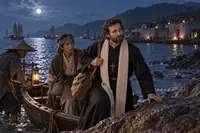
Defying every danger, in August 1552 Father Francis boarded the ship of his friend Diogo Pereira to the desolate island of Shangchuan (Thượng Xuyên), about fourteen kilometers off the coast of Guangdong. He used all the money he had left to hire a Chinese merchant to take him secretly by small boat across the water to land in Guangdong in the dead of night. He was ready to be thrown into a dark prison, as long as he had the chance to proclaim the Gospel to the Emperor of China. But the merchant took the money and vanished, leaving him stranded on the barren island. Winter set in, and one by one the Portuguese trading ships weighed anchor and left the island to avoid the storms, until only he remained, with a young interpreter named Antonio.
At the end of November 1552, a severe malarial fever struck him down. He was taken into a windswept straw hut by the sea. A sailor cut his arm with a knife to let out the bad blood, following the crude medicine of the day, and he fainted from loss of blood. For two weeks, lying barely alive amid the freezing cold, hunger and thirst, the knight of God did not utter a word of complaint. He prayed without ceasing for the land of China, where he had never set foot. At dawn on December 3, 1552, Saint Francis Xavier died peacefully, his eyes fixed on the mainland of China, a crucifix clasped tightly in his hands. Antonio, the only witness, buried him in a rough wooden coffin filled with white lime on the sand of the island of Shangchuan.
Chapter 7 of 7
An incorrupt body and the Patron of the Missions
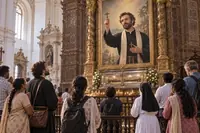
Ten weeks after the burial, when the coffin was opened for inspection before taking the remains to Malacca, the sailors found something astonishing: Saint Francis Xavier’s whole body was still intact, like a man in a deep sleep, the flesh still soft, with no smell of decay at all. The remains were later carried in solemn procession to the city of Goa, India, in 1554. From 1594 to 1605, the Basilica of Bom Jesus was built in Goa, a magnificent late Renaissance building, as his permanent resting place. Nearly five centuries later, the remains still lie there in a splendid silver casket with glass sides, where millions of the faithful, and also people of other faiths from all over the world, come to venerate them each year; and once every ten years the remains are solemnly displayed in public for millions of pilgrims to see.
Pope Paul V beatified him in 1619. And on March 12, 1622, Pope Gregory XV solemnly canonized Francis Xavier, on the same day as his spiritual father Saint Ignatius of Loyola. In 1927, Pope Pius XI proclaimed Saint Francis Xavier the principal patron of all the missions of the world, together with Saint Thérèse of the Child Jesus. The Church celebrates him on December 3 each year.
In Vietnam, Saint Francis Xavier is much loved by the faithful: he is the patron of the missions, of the catechist movement, and of hundreds of thousands of Catholic men who bear the baptismal name Francis Xavier. The Cha Tam Church in Chợ Lớn, Saigon, is dedicated to him.
Saint Francis Xavier’s life tells the Church of every age that the true fire of mission does not stay within safe limits. From a young professor hungry for fame who was awakened by a question from the Gospel, to the man who died alone on a deserted beach longing only to step into a continent he had never seen, he teaches every Christian today: never shut your faith up in selfish comfort. Have the courage to go out, open your hands and your heart to those who do not yet know God, because every single soul on this earth is a priceless treasure for which Christ shed His last drop of blood.
The end of the story
You have walked with Saint Francis Xavier to the end of the story.
A few scenes stay with you:
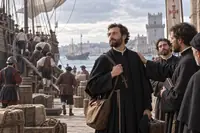
His roommate Ignatius kept repeating the question: "What does it profit a man to gain the whole world and lose his own soul?" until it burned in the proud professor’s mind.
He carried a little bell through the lanes of India, baptizing thousands of people until his arm was too tired to lift.

He died alone in a straw hut on the island of Shangchuan, his eyes fixed on the mainland of China, where he had never set foot.
Stay in silence
You understand the worth of an unfinished dream: sometimes the fire of mission does not need to reach its goal to have value; it only needs to burn until the last breath.
Here I am, I am ready to go!
Let us pray
Saint Francis Xavier,
you left behind the fame of a professor to go to the far ends of Asia, baptizing thousands, and died alone with your eyes still turned toward China.
Pray for missionaries, all who carry the Gospel to faraway places.
Teach me not to fear dreams left unfinished, for a fire that burns to the very end is already beautiful in God’s eyes.
Amen.
Sources
- Feast dayAuthor’s edited profile
- Patron ofPatronages and symbols, version 1.1
- Often depicted withPatronages and symbols, version 1.1
- Reflectionjesuits.global
- Reflectionnewadvent.org
Meet the next one
 Journey 7