

Journey 7 · Going Far, Standing Firm
Saint Ignatius of Loyola
The wounded soldier who became a knight of Christ
Feast day July 31
Tap to step inside
Saint Ignatius of Loyola
The wounded soldier who became a knight of Christ
Map of a life
This life told in 8 chapters
Begin the journey OpeningOpening1 min
 Chapter 1 of 8The wayward young nobleman of Loyola1 min
 Chapter 2 of 8A sickbed and a spiritual discernment2 min
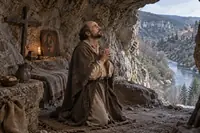 Chapter 3 of 8The vigil at Montserrat and the cave of Manresa1 min
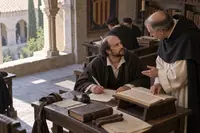 Chapter 4 of 8A journey to the Holy Land and eleven years back at school1 min
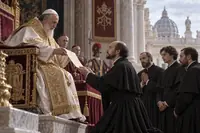 Chapter 5 of 8The vow of Montmartre and the birth of the Jesuits2 min
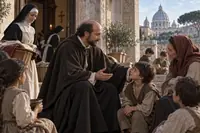 Chapter 6 of 8A commander in a small room in Rome1 min
 Chapter 7 of 8His last breath in complete silence1 min
- Chapter 8 of 8A knight for all time1 min
Feast day
Saint Ignatius of Loyola
Some places may celebrate on a slightly different day.
July 31
Patron of
- Retreats and spiritual exercises (proclaimed by Pius XI in 1922)
- The Jesuits
- Soldiers
Often depicted with
- The letters IHS
- A book with the words "Ad maiorem Dei gloriam"
Opening
Opening
In the stone castle of Loyola in the Basque country of northern Spain, one summer day in 1521, a thirty-year-old noble officer lay bedridden. One of his legs had been shattered by a cannonball on the battlefield of Pamplona, the broken bone sticking out. He had gritted his teeth through brutal operations without anesthesia, letting the surgeons saw the bone and stretch the leg so that he could still cut a fine figure in a nobleman’s elegant boots. Now he was skin and bone, hovering on the edge of death.
That knight was Íñigo López de Loyola. All his life until then he had longed for only one thing: to win glorious military victories and capture the heart of a noble lady at the royal court. But on that sickbed, when he asked for romances of chivalry to pass the time, all anyone could find were two old religious books, “The Life of Christ” and “The Lives of the Saints”. Through them, a conversion that would shake the world began in his soul.
The proud wounded soldier took off his shining armor and laid his nobleman’s sword at the foot of Our Lady’s altar, to become a true knight of the King of Kings. He is Saint Ignatius of Loyola, founder of the Jesuits, the Society of Jesus (Societas Jesu, SJ). He wrote the great spiritual handbook “The Spiritual Exercises” (Exercitia Spiritualia) and left the world a motto to live by: “AMDG”, Ad Majorem Dei Gloriam, for the greater glory of God in all things.
Chapter 1 of 8
The wayward young nobleman of Loyola
Íñigo was born in 1491 in the ancient castle of Loyola at Azpeitia, in the province of Guipúzcoa, in the northern Basque country of Spain. He was the youngest of thirteen children of a distinguished noble family, the son of Beltrán Yáñez de Oñaz y Loyola and María Sáenz de Licona y Balda.
His mother died when he was small, and as a youth Íñigo was sent to serve in the household of the royal treasurer Juan Velázquez de Cuéllar at Arévalo. Growing up in the glittering world of the court, the young man was the very image of a dashing, proud and wayward knight: dressing in splendid clothes, fond of wearing a long sword, skilled at fencing, passionate about gambling, and often mixed up in bloody street brawls. He had one burning worldly dream: to win glorious victories on the battlefield to bring honor to his family and capture the heart of a lady of high nobility.
In 1517 he joined the army under the Duke of Nájera and became a brave commander. On May 20, 1521, the French army poured across and laid siege to the fortress of Pamplona, the strongest stronghold of the kingdom of Navarre. Although the enemy greatly outnumbered them and the whole garrison wanted to surrender, Íñigo insisted on rallying the soldiers to fight to the end. In the fierce battle, after six hours of continuous bombardment, a cannonball struck the wall, and the fragments shattered his right leg and badly wounded his left. The fortress fell, but the French, out of admiration for the young commander’s courage (and because a certain military courtesy was still observed between enemies at the time), carried him on a stretcher on a two-week journey back to the castle of Loyola for treatment.
Chapter 2 of 8
A sickbed and a spiritual discernment
For many months he lay on his sickbed in the family castle, and the tearing pain tested his iron will. When he saw that the bone had knit crookedly, leaving the leg shorter, with an ugly lump of bone sticking out below the knee, so that he could no longer wear his close-fitting knight’s leather boots, Íñigo coldly ordered the physicians to saw off the lump and stretch the leg once more on a rack. He bit his lip and endured that brutal operation without a single cry, just to keep his worldly good looks, though in the end his right leg stayed permanently shorter than the left, leaving him with a limp for the rest of his life.
To pass the dull time in bed, he asked to borrow the adventure novels of chivalry that were his favorite reading. But the only books in the castle then were two religious ones: “The Life of Christ” by Ludolph of Saxony and “The Lives of the Saints” in a Spanish translation. Reluctantly, he picked them up and read. And page by page, the books began to work wonders in his soul.
It was here that he discovered the basic law of the discernment of spirits (Discretio Spirituum). When he daydreamed of military exploits, worldly fame and the beautiful lady, he felt a thrilling delight for the moment; but when those thoughts passed, his soul fell into a dryness, emptiness and sadness so heavy he could hardly breathe. On the other hand, when he reflected on the example of Saint Francis of Assisi and Saint Dominic, and asked himself,
“Saint Francis did this, Saint Dominic did that — why can’t I do it for Christ?”
, he felt a fire of zeal blaze up, and even after he closed the book his soul remained filled with a peace and deep sweetness that lasted much longer. He noticed the difference between these two movements of the soul: one brought passing satisfaction but left emptiness behind; the other brought a deep and lasting peace. That principle of discernment would later become the foundation of a whole spirituality.
In the spring of 1522, his wound barely healed, the wounded soldier limped out of bed. The knight of old was gone; in his place stood a pilgrim of God.
Chapter 3 of 8
The vigil at Montserrat and the cave of Manresa
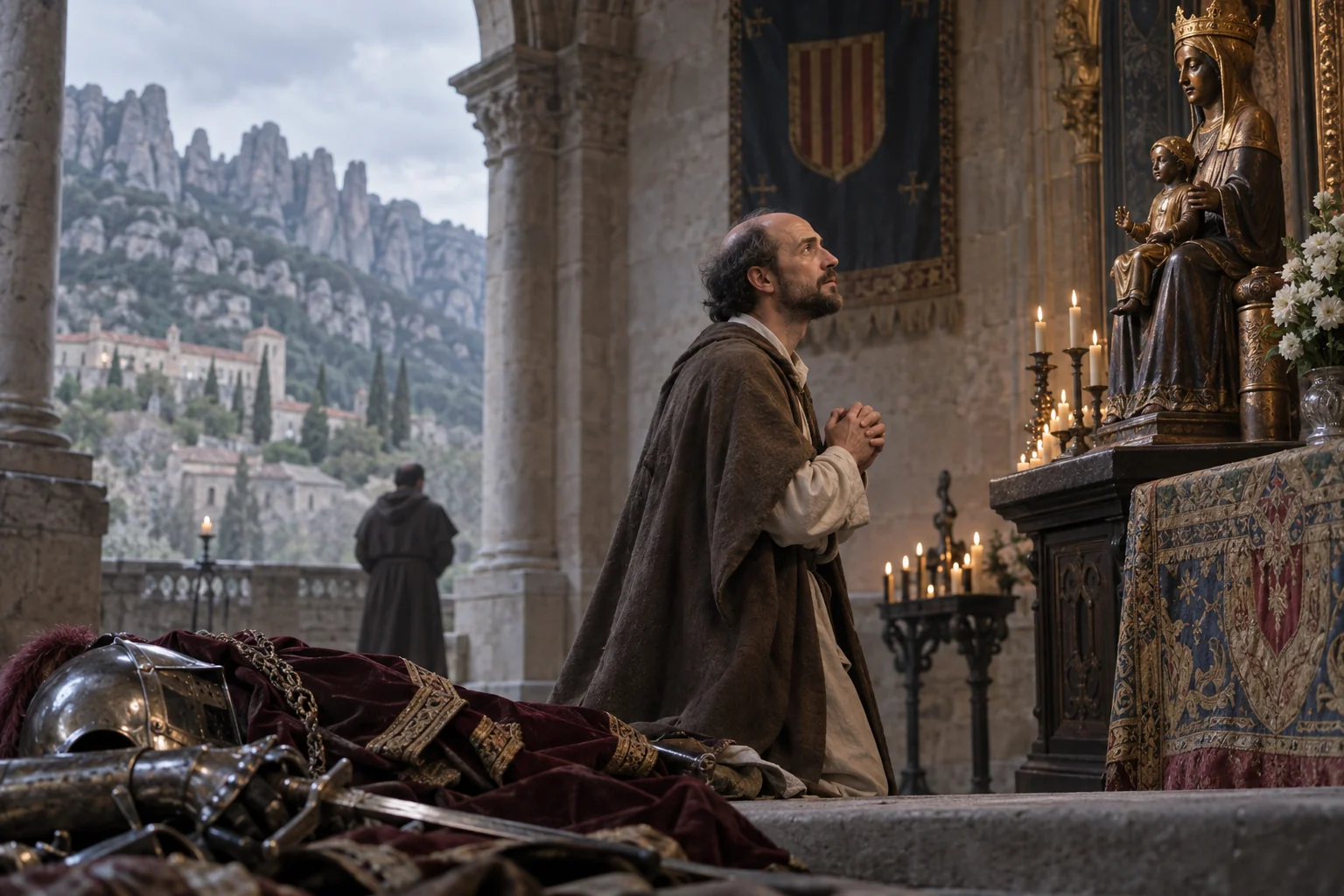
He left the family castle and rode a mule on pilgrimage to the shrine of Our Lady of Montserrat, perched on the famous jagged mountain range near Barcelona. On the night of March 24 to 25, 1522, as the feast of the Annunciation began, he did something decisive, fully in the spirit of a Christian knight: he gave all his fine clothes to a beggar; put on a coarse sackcloth robe that swept the ground, tied with a rope; and hung his sword and dagger before the altar of Our Lady of Montserrat. He kept vigil all night before Our Lady, standing and kneeling, offering his whole life as a knight fighting for the Kingdom of Heaven.
Leaving Montserrat, he went to the small town of Manresa not far away. He meant to stay only a few days, but ended up staying almost a whole year, from March 1522 to February 1523. He lived in a damp natural cave overlooking the river Cardoner. He let his hair and beard grow long, fasted and did strict penance, begged for food every day and spent seven hours a day on his knees praying in that cave. It later became an important pilgrimage site for the Jesuits, and he himself always looked on it as the place where God had schooled him in the spiritual life.
At Manresa he went through terrible spiritual crises: scruples about his past sins tormented him so badly that at times he wanted to throw himself into an abyss to end his anguish. But God rescued him. On the bank of the Cardoner, he received a great mystical enlightenment: everything in heaven and earth, from the mysteries of faith to all created things, suddenly opened up before his eyes with an extraordinary clarity and insight. Out of those hard-won experiences of spiritual combat he wrote his masterpiece, “The Spiritual Exercises” (Exercitia Spiritualia), a great handbook of spiritual training that guides people to recognize God’s will and freely choose to follow Christ. It is still widely used in the Church today.
Chapter 4 of 8
A journey to the Holy Land and eleven years back at school
In 1523 he made a poor man’s pilgrimage to the Holy Land, to Jerusalem, walking and begging along the way. He longed to stay in the Holy Land forever, to live and die where the Lord was born and crucified. But the Franciscan superior in charge of the Holy Land, worried about his safety under Muslim rule, made him return to Europe.
Back in Spain at thirty-three, Ignatius realized a practical truth: to help souls effectively, zeal alone was not enough; solid learning and knowledge were needed. Not at all put off by his age or his rank, the former commander sat at the same desks as primary-school children in Barcelona to relearn every basic rule of Latin grammar. Then he went on to study philosophy at the universities of Alcalá and Salamanca.
There, because of his zeal in teaching catechism to the people and guiding others through the Spiritual Exercises, he was twice suspected by the Inquisition, arrested and questioned, which was not unusual at the time for people of strong spiritual influence who had no official theological degree. When he was acquitted but forbidden to preach until he had finished theology, Ignatius calmly accepted it and decided to go farther still. In 1528 he walked to Paris and entered the Sorbonne, the most famous university in the world at the time. For seven hard years, from 1528 to 1535, begging during the summer holidays to pay his fees, he completed his studies with distinction and earned his Master of Arts at forty-three, very late compared with his fellow students.
Chapter 5 of 8
The vow of Montmartre and the birth of the Jesuits
It was at the University of Paris that he used the Spiritual Exercises to win over and gather a group of the school’s most outstanding students: his roommate Francis Xavier, a proud nobleman from Navarre; Peter Faber, a devout young shepherd from Savoy; and Diego Laínez, Alfonso Salmerón, Nicolás Bobadilla and Simão Rodrigues.
Early on the morning of August 15, 1534, the feast of the Assumption, in a small crypt chapel on the hill of Montmartre in Paris, Father Peter Faber, then the only priest in the group, celebrated Mass. Before receiving Holy Communion, Ignatius and his six companions solemnly vowed to live in poverty and chastity, and promised to go to the Holy Land as missionaries; if after a year they could not go to the Holy Land, they would go together to Rome and place themselves entirely at the Pope’s disposal, to be sent wherever in the world he wished. That was the first seed from which the Jesuits were born.
On June 24, 1537, in Venice, Ignatius and his companions were ordained priests. Because of the war between the Republic of Venice and the Ottoman Empire, the way to the Holy Land was blocked. Remembering their earlier vow, in the autumn of 1537 Ignatius set out for Rome with Faber and Laínez. A few kilometers from Rome, in the little wayside chapel of La Storta, in a moment of ecstatic prayer, Ignatius saw God the Father place him beside Jesus carrying the Cross. Jesus looked at him lovingly and said:
“I want you to serve Me... I will always support you in Rome!”
From that vision he was convinced that the new order must bear the holy Name of the One it served: the Society of Jesus (Compañía de Jesús; in Latin Societas Jesu, abbreviated SJ).
On September 27, 1540, through the bull Regimini Militantis Ecclesiae, Pope Paul III solemnly approved the Formula of the Society of Jesus. Besides the three usual vows of poverty, chastity and obedience taken in every religious order, the Jesuits take a special fourth vow: complete obedience to the Holy Father in every mission, ready to set out for any dangerous place without hesitation and without asking for travel money.
Chapter 6 of 8
A commander in a small room in Rome
In April 1541, Ignatius was unanimously elected by his brothers as the first Superior General of the Jesuits. He spent the remaining fifteen years of his life in a small, plain room at the house of Santa Maria della Strada in Rome.
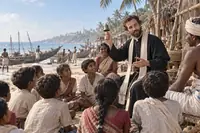
From that small room, the spiritual commander directed an extraordinary missionary army. He sent Francis Xavier to India and Japan, and Peter Canisius to revive the faith in Germany; later his order would send Matteo Ricci to China. He wrote the massive Constitutions of the Jesuits himself and nearly seven thousand pastoral letters to direct its work all over the world, an enormous volume of correspondence for a man managing everything from one small room. He founded the Roman College, today the famous Pontifical Gregorian University, and the German College (Collegium Germanicum) to form generations of outstanding clergy for the Church. In Rome he also founded the House of Santa Marta to protect women who had gone astray and wanted to start a new life, and an orphanage to care for homeless street children.
He taught the Jesuits a practical and flexible spirituality: “Be contemplatives in action” (Contemplativus in actione). A religious does not have to shut himself up behind monastery walls; he must find God in all things, in every event, every task and every person. The motto “AMDG” (Ad Majorem Dei Gloriam, for the greater glory of God) became the compass guiding every thought, word and deed of the members of the order he founded. He also left a rule of action still widely quoted today, even outside the Church:
“Act as if everything depended entirely on your own efforts; but pray as if everything depended on God alone!”
Chapter 7 of 8
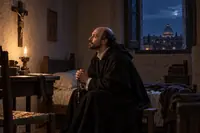
His last breath in complete silence
Years of extraordinary toil and a painful stomach illness drained the last of his strength. At the end of July 1556, sensing that the day to go home to the Father had come, he told his secretary, Father Polanco, to go and ask Pope Paul IV for the apostolic blessing for him. The secretary, busy with his letters and thinking his illness was not yet critical, hesitated and asked to put it off until the next morning. Ignatius smiled gently and answered:
“I would rather it were today than tomorrow... But do as you think best!”
That night he stayed alone in his room, deep in a last conversation with God. People heard him only whispering one thing over and over:
“O God... O my God...”
At dawn on July 31, 1556, when the secretary came into the room, Saint Ignatius of Loyola had already gone home to God, peacefully and in complete silence, with no ceremony and no eloquent last words. He was sixty-five.
When he died, the Jesuits had grown from the original group of seven friends into a body of more than a thousand members present on four continents, running more than a hundred colleges and educational institutions.
Chapter 8 of 8
A knight for all time
Pope Paul V beatified him on July 27, 1609. And on March 12, 1622, a great day for the Church, Pope Gregory XV canonized Ignatius of Loyola, on the same day as his spiritual son Saint Francis Xavier, Saint Teresa of Ávila, Saint Philip Neri and Saint Isidore the Farmer, a group canonization rare in the history of the Church.
In 1922, Pope Pius XI solemnly proclaimed Saint Ignatius of Loyola patron of all retreats and spiritual exercises throughout the world. The Church celebrates him on July 31 each year.
In Vietnam, the Jesuits are bound up with the birth of the Vietnamese Romanized script, Quốc ngữ, through the work of Father Alexandre de Rhodes (Đắc Lộ) and the Jesuit missionaries of the seventeenth century, as well as the dedicated service of Jesuits today in education, spiritual exercises and communications.
Saint Ignatius of Loyola reminds us today that every human life is a spiritual battle. The knight who longed only for glory and a noble lady’s love became the founder of an order that reached four continents from one small room in Rome. He teaches us not to waste our lives on selfish ambition and empty glory that soon passes. Have the courage for a radical conversion, let the love of Christ take hold of your whole heart, and make every breath and every small action each day a prayer offered up: “For the greater glory of God in all things!”
The end of the story
You have walked with Saint Ignatius of Loyola to the end of the story.
Three scenes from his life linger with you:
With his leg shattered by a cannonball, he still ordered the physicians to saw the bone again and stretch his leg once more, just to keep a knight’s good looks.
On the night of vigil at Montserrat, he hung his nobleman’s sword and dagger before Our Lady’s altar, offering his whole life as a knight of the Kingdom of Heaven.
On the road to Rome, in the chapel of La Storta, he heard Jesus say: "I want you to serve Me... I will always support you in Rome!"
Stay in silence
You see the road one knight walked: from longing to win the heart of a noble lady to directing a missionary army across four continents from one small room.
Act as if everything depended entirely on your own efforts; but pray as if everything depended on God alone!
Let us pray
Saint Ignatius,
you were once a knight who dreamed of glory, until you were wounded, bedridden, and met the Lord through the pages of the lives of the saints. Then you hung up your sword before Our Lady’s altar.
Teach me to look back over each day and recognize God in all things.
Help me do everything for the greater glory of God. And help me pray as you did: Take, Lord, my freedom, my memory, my understanding and my whole will; Your love and Your grace are enough for me.
Amen.
Sources
- Feast dayAuthor’s edited profile
- Patron ofPatronages and symbols, version 1.1
- Often depicted withPatronages and symbols, version 1.1
- Reflectionjesuits.global
- Reflectionignatius.org
Meet the next one
 Journey 7