

Journey 7 · Going Far, Standing Firm
Saint Maximilian Kolbe
The martyr of love in the death camp of Auschwitz
Feast day August 14
Tap to step inside
Saint Maximilian Kolbe
The martyr of love in the death camp of Auschwitz
Map of a life
This life told in 6 chapters
Begin the journey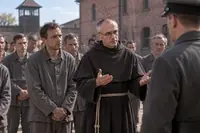 OpeningOpening1 min
 Chapter 1 of 6Two crowns in the village of Zduńska Wola1 min
 Chapter 2 of 6A knight of the Immaculate1 min
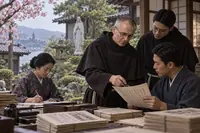 Chapter 3 of 6The City of the Immaculate, Niepokalanów, and Mugenzai no Sono1 min
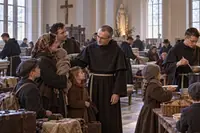 Chapter 4 of 6The death camp of Auschwitz and starvation bunker number 111 min
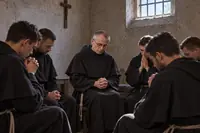 Chapter 5 of 6Psalms sung in the bunker of death1 min
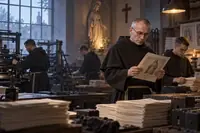 Chapter 6 of 6A saint of the twentieth century1 min
Feast day
Saint Maximilian Kolbe
Some places may celebrate on a slightly different day.
August 14
Patron of
- People with addictions
- Prisoners
- Journalists and broadcasters
- Families
Often depicted with
- A striped prison uniform numbered 16670
- Two crowns, white and red
Opening
Opening
At noon on a stifling day at the end of July 1941, the tension on the roll-call square of the Auschwitz death camp in Poland was unbearable. Thousands of prisoners had stood motionless under the scorching sun for hours. A prisoner from Block 14 had just escaped from the camp.
Under the camp’s brutal rule, whenever a prisoner escaped and was not recaptured, ten others from his block were picked at random and thrown into a starvation bunker to die, as a warning to everyone. The notoriously cruel SS officer Karl Fritzsch walked slowly between the rows, jabbing his finger at one man after another:
“You! You! You...!”
When the finger pointed at the tenth man, a Polish soldier named Franciszek Gajowniczek, he collapsed, covered his face and sobbed out:
“Poor me! What will become of my wife and children at home? I will never see my wife and children again!”
Then something happened that the Nazi camps had never seen. From a row farther back, a thin man in the blue-and-white striped uniform with the number 16670, his eyes bright behind round glasses, calmly stepped out of line and walked straight toward the SS officer. The guards cocked their submachine guns with a clatter. Fritzsch shouted:
“What do you want, you Polish swine?”
Prisoner 16670 stood at attention, took off his cloth cap, looked the murderer straight in the eye and said in precise German, with uncanny calm: “I am a Polish Catholic priest... I want to die in place of this man; he has a wife and young children!” Fritzsch stood stunned by such courage. He looked at the priest, then at the soldier weeping on the ground, and growled:
“Granted!”
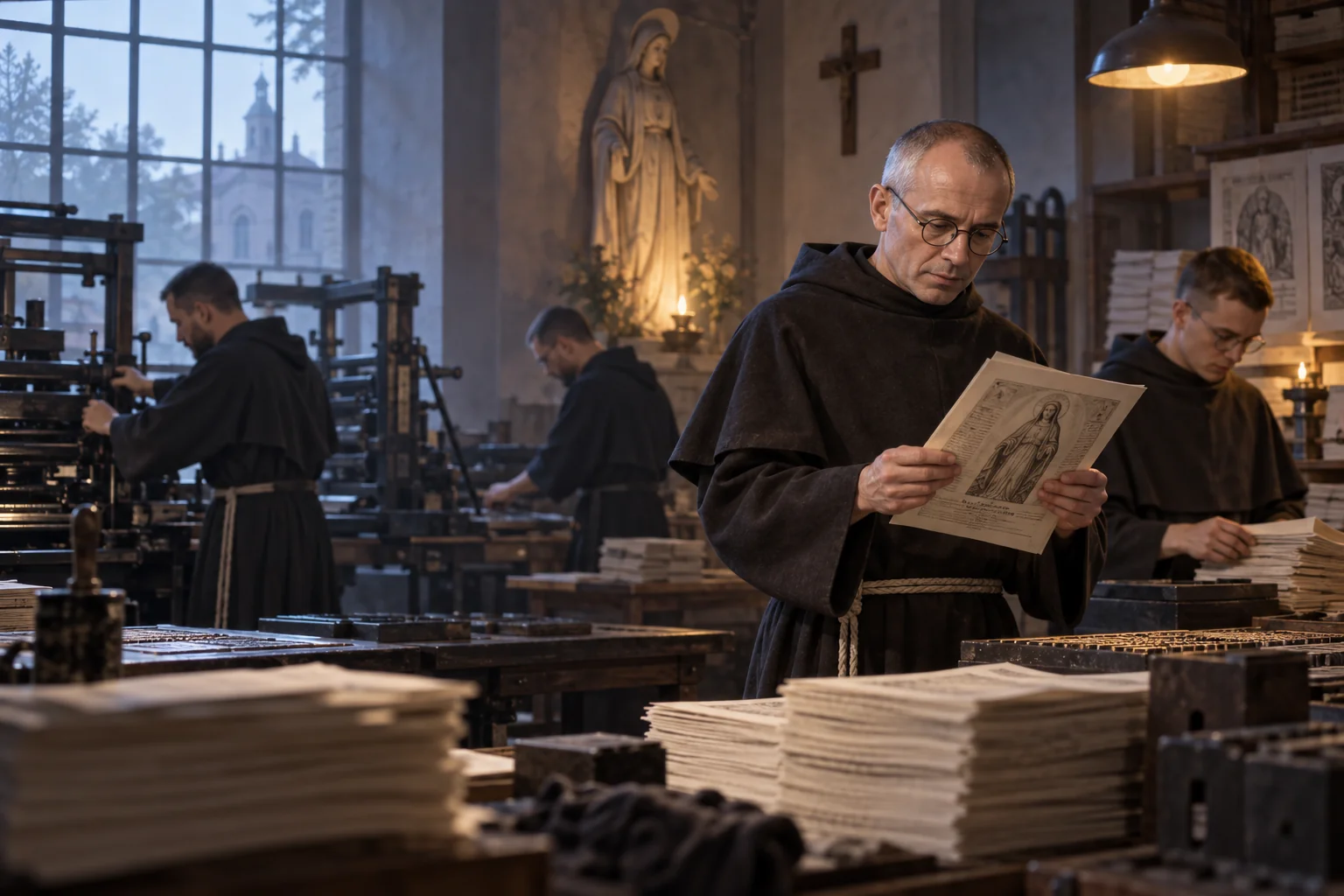
That priest was Father Maximilian Maria Kolbe, founder of the Militia of the Immaculata (Militia Immaculatae), who lit the fire of Gospel love in the darkest hell on earth of the twentieth century. Pope Saint John Paul II gave him a title that has stayed with him: “Martyr of Charity.”
Chapter 1 of 6
Two crowns in the village of Zduńska Wola
Rajmund Kolbe was born on January 8, 1894, in the textile town of Zduńska Wola, near the city of Łódź in Poland — then under the Russian Empire. For more than a century Poland had been wiped off the map of Europe, carved up among Russia, Austria and Prussia. His father, Juliusz Kolbe, was a poor weaver and a patriot; his mother, Maria Dąbrowska, was a deeply devout woman. He was the second of five children in a poor family.
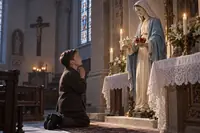
As a little boy, Rajmund was clever, mischievous and very stubborn. One day, after some prank, his mother scolded him: “I don’t know what will become of you!” The boy went unusually quiet. He ran to the parish church and knelt sobbing before Our Lady’s altar. There Our Lady appeared to the ten-year-old, holding two crowns: one pure white, for purity, and one deep red, for martyrdom. Our Lady asked him gently: “My child, which crown do you choose?” Little Rajmund looked up at her and answered:
“Mother, I choose both!”
Our Lady smiled at him tenderly and vanished.
From that moment the boy was changed. He grew calm, studied hard and nourished an ardent love for Mary that stayed with him all his life, right up to his last moment in the starvation bunker decades later.
Chapter 2 of 6
A knight of the Immaculate
In 1907, Rajmund and his older brother crossed the border to Lwów, then in Austria-Hungary, to enter the minor seminary of the Conventual Franciscans (the Order of Friars Minor Conventual, OFM Conv.). In 1910 he received the habit and took the new name Maximilian.
Seeing his outstanding gifts in mathematics and philosophy, his superiors sent him to Rome to study at the Pontifical Gregorian University and the Seraphic College of Saint Bonaventure. He earned two doctorates, in Philosophy in 1915 and in Theology in 1919. On April 28, 1918, he was ordained a priest in the church of Sant’Andrea della Valle in Rome.
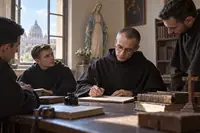
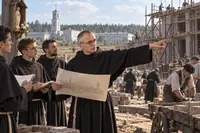
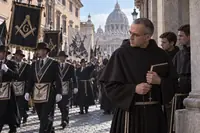
In Rome in 1917, after watching Freemasons parade openly through the streets insulting the Church and the Pope, Brother Maximilian had an idea that would shape his whole apostolate. On October 16, 1917, he and six fellow friars founded the “Militia of the Immaculata” (Militia Immaculatae, or MI). Its aim was to bring all people back to Christ through complete consecration to Mary Immaculate, using every modern means of communication, newspapers and radio, and wearing the Miraculous Medal as a spiritual weapon.
Chapter 3 of 6
The City of the Immaculate, Niepokalanów, and Mugenzai no Sono
In 1919 Father Kolbe returned to Poland with severe tuberculosis; one lung was destroyed and the other badly damaged, and he often coughed up blood. Even so, he began his great work in the press. In 1922, with no money at all, he started a small monthly called “Knight of the Immaculata” (Rycerz Niepokalanej). It grew at an astonishing rate: from an initial five thousand copies it shot up to nearly a million copies a month by the end of the 1930s.
In 1927, on a piece of wasteland forty kilometers from the capital, Warsaw, donated by Prince Jan Drucki-Lubecki, Father Kolbe built something the world had never seen: Niepokalanów, the “City of the Immaculate.” It became a huge friary and publishing center, home to nearly eight hundred friars living in complete poverty. They ran one of the most modern printing plants in Europe, put out daily papers, magazines and books, and set up their own radio station, a scale almost unheard of for a religious house at the time.
But his missionary zeal would not stop at the borders of Poland. In 1930, still racked by tuberculosis, Father Kolbe and four friars sailed all the way to Japan. In Nagasaki he founded a second City of the Immaculate, “Mugenzai no Sono” (Garden of the Immaculate), on the slope of Mount Hikosan. Many people laughed at him for building the friary on a steep mountainside facing away from the city, an awkward place for a mission. But the choice proved providential: on August 9, 1945, when the atomic bomb dropped on Nagasaki flattened the whole city, the friary of Mugenzai no Sono, shielded by the mountain, suffered only a few broken windows, and not a single friar was injured — though Father Kolbe had returned to Poland nearly a decade earlier and did not live to see it. He also published the Knight in Japanese (Seibo no Kishi), helping lay a firm foundation for the Church in modern Japan.
Chapter 4 of 6
The death camp of Auschwitz and starvation bunker number 11
In 1936 he returned to Poland to continue leading Niepokalanów. On September 1, 1939, Nazi Germany attacked Poland and the Second World War broke out. Niepokalanów was partly destroyed by bombing. Father Kolbe turned the friary into a Red Cross field hospital and opened its doors to more than three thousand war refugees, including more than two thousand Jews hunted by the Nazis. Under the occupation this was extremely dangerous; if discovered, it could have brought punishment on the whole friary.
He refused to sign the German ethnic register, the Deutsche Volksliste, which would have given him the privileges of an ethnic German, declaring that he was Polish through and through. On February 17, 1941, the Gestapo burst into Niepokalanów and arrested Father Kolbe and four companions. After months of imprisonment and beatings in Pawiak prison in Warsaw, on May 28, 1941, he was taken to the Auschwitz death camp, as prisoner number 16670.
At Auschwitz, because he was a Catholic priest, the SS guards singled him out for savage cruelty. He was put in the hardest labor squad, hauling heavy logs and blocks of stone. They whipped him, set dogs on him, and made him carry loads twice as heavy as the others. But prisoner 16670 never complained. Night after night he crept to corners of the barracks to comfort his fellow prisoners and hear confessions in secret, and he even gave away his one small piece of bread for the day to men faint with hunger.
Chapter 5 of 6
Psalms sung in the bunker of death
After he stepped forward to die in place of Franciszek Gajowniczek at the end of July 1941, Father Kolbe and the nine others were stripped naked and thrown into the dark underground starvation cells of Block 11. Usually, prisoners left there without food or water went mad with pain, turned on one another, screamed and cursed, and the bunker became a living hell.
But the presence of this holy priest changed everything. Father Kolbe stayed among his fellow prisoners, comforting them, leading them in prayer and helping them make their peace with God. Instead of screams and curses, hymns and the Hail Mary rang out from the dark bunker and echoed down the corridors. Prisoners in the neighboring cells joined in. The bunker of death became a chapel full of peace.
For two weeks, without a crumb of bread or a drop of water, his fellow prisoners died one by one, peacefully, in Father Kolbe’s arms. By August 14, 1941, only Father Kolbe and three others were still barely alive. Because the SS needed the bunker for new prisoners, they sent down a German named Hans Bock with a syringe of carbolic acid (phenol) to kill them.
Bruno Borgowiec, the prisoner who served as interpreter and orderly there, later recalled the end with deep emotion. When the executioner entered the cell, Father Kolbe was sitting propped in a corner, his face radiant with peace. He willingly held out his thin left arm for the injection, whispering his last prayer:
“Ave Maria!”
He died at noon on August 14, 1941, the eve of the Assumption, at the age of forty-seven. The next day his body was burned in the Auschwitz crematorium, and his ashes were scattered over the earth and sky of Poland.
Chapter 6 of 6
A saint of the twentieth century
Franciszek Gajowniczek, the man whose life he saved, survived the war, was reunited with his family, and spent the remaining fifty-three years of his life traveling the world to tell of the priest who had died in his place.
On October 17, 1971, Pope Paul VI beatified him. And on October 10, 1982, in Saint Peter’s Square, with the old soldier Franciszek Gajowniczek there in tears, Pope John Paul II, his fellow Pole, canonized Maximilian Maria Kolbe as a martyr of charity. The Church celebrates him on August 14 each year.
Saint Maximilian Kolbe left us words that still ring true today:
“Hatred cannot put out hatred; only Love is the one force that conquers evil!”
From a little boy who chose both crowns before Our Lady to a prisoner who stepped out of line to take death in the place of a stranger, he showed the world that even in the darkest, most brutal places on earth, Christian love that gives itself away can still burn brightly, and turn a starvation bunker into a sanctuary of the Kingdom of Heaven.
The end of the story
You have walked with Saint Maximilian Kolbe to the end of the story.
Three moments in his life keep hold of you:
At ten, when Our Lady asked the boy whether he chose the white crown of purity or the red crown of martyrdom, he answered: "Mother, I choose both!"
When the SS commander pointed at the soldier Gajowniczek to go to the starvation bunker, Father Kolbe stepped out of line and said: "I want to die in place of this man; he has a wife and young children!"
In the bunker of death, instead of screams of despair, hymns and the Hail Mary rang out, and he breathed his last with the words "Ave Maria!"
Stay in silence
You see light in the darkest place of all: even in one of the most inhuman death camps in history, love that gives itself away can turn a starvation bunker into a sanctuary.
Hatred cannot put out hatred; only Love is the one force that conquers evil!
Let us pray
Saint Maximilian Kolbe,
in the Auschwitz camp you stepped forward and asked to die in place of a father with a wife and children. In the starvation bunker you led your fellow prisoners in hymns until your last breath.
Teach me to sacrifice myself for others, even in small things.
Pray for people with addictions, for broken families, and for all who are in the darkest places, that they may see the light.
Amen.
Sources
- Feast dayAuthor’s edited profile
- Patron ofPatronages and symbols, version 1.1
- Often depicted withPatronages and symbols, version 1.1
- Reflectionvatican.va
- Reflectionvatican.va
Meet the next one
 Journey 7