

Journey 7 · Going Far, Standing Firm
Saint Lawrence
A smile on the gridiron and the treasure of the Church
Feast day August 10
Tap to step inside
Saint Lawrence
A smile on the gridiron and the treasure of the Church
Map of a life
This life told in 5 chapters
Begin the journey OpeningOpening1 min
 Chapter 1 of 5A young man from Huesca and a deacon of Rome1 min
 Chapter 2 of 5Tears on his teacher’s road to martyrdom1 min
 Chapter 3 of 5“These are the treasure of the Church!”1 min
 Chapter 4 of 5The gridiron and a radiant smile1 min
- Chapter 5 of 5A martyr praised by the whole Church1 min
Feast day
Saint Lawrence
Some places may celebrate on a slightly different day.
August 10
Patron of
- Deacons
- The poor
- Cooks
Often depicted with
- A gridiron
- The Church’s money bag
- A deacon’s dalmatic
Opening
Opening
On a sweltering summer day in 258, under the fierce persecution of Emperor Valerian, in a public place of execution in the city of Rome, a gruesome scene was unfolding: a young man, stripped naked, was tied fast to a huge iron gridiron set over a bed of red-hot, smoldering coals. The heavy smell of burning flesh rose into the air.
But from that scorching gridiron no one heard a single cry for mercy, or a single curse. The young man held his head high, looked at the Roman judge in the stand with shining eyes, and gave a strangely playful smile. He called out in a ringing voice, joking with the executioner himself:
“Gentlemen, this side is done to a turn — turn me over and eat!”
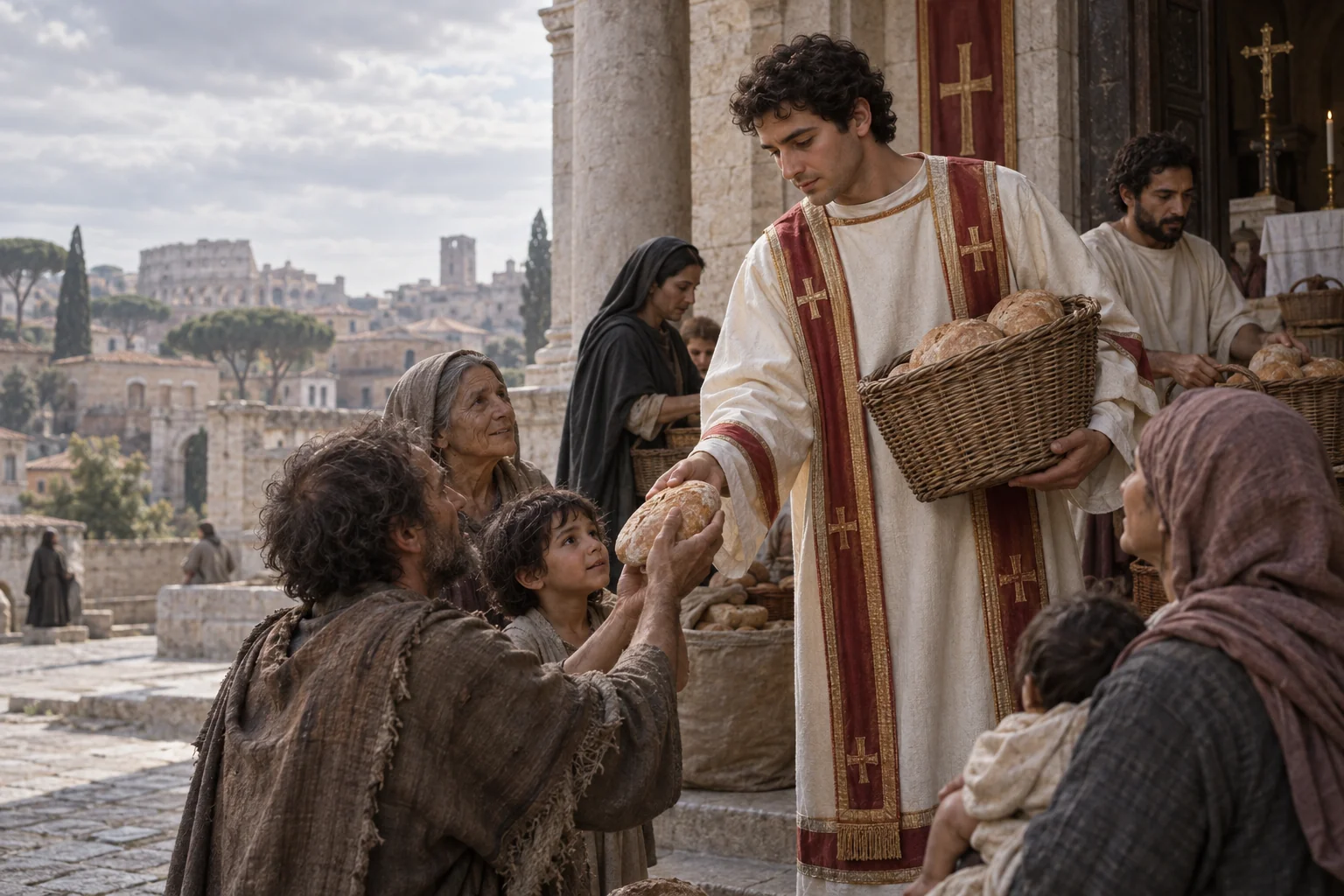
The young man smiling amid the flames was the deacon Lawrence (Laurentius), one of the most famous martyrs of the early Church of Rome. He was the keeper of the Church’s treasury, but he did something that has amazed every generation since: he brought all the disabled, the blind, the lame and the beggars before the prefect and declared aloud: “These are the true treasure of the Church!” He is honored as patron of the poor and of deacons, and remembered for a joyful faith that triumphed over death.
Chapter 1 of 5
A young man from Huesca and a deacon of Rome
Laurentius was born around 225 in Huesca, in the region of Aragon, Spain, a distant province of the Roman Empire, where the Christian community was still small and had to keep its faith quietly, among local pagan temples and Roman military posts scattered along the foot of the Pyrenees. He was an intelligent, devout young man from a devout Christian family. While studying theology in Zaragoza, he met a learned teacher, the priest Sixtus, a Greek by origin. The two formed a deep bond as master and disciple. When Father Sixtus moved to Rome to serve there, Lawrence followed him: a journey of thousands of kilometers across the Iberian Peninsula and over the Mediterranean Sea, no easy matter for a young provincial of that time, and a sign of how close the two were.
In 257, Father Sixtus was elected Pope, taking the name Sixtus II. Right after his election, knowing his young disciple’s complete honesty, great charity and good sense, Sixtus II ordained Lawrence a deacon and made him head of the seven deacons of the Church of Rome, the office of archdeacon. As archdeacon, Lawrence carried a heavy load: managing all the finances, lands, sacred vessels and goods of the Church of Rome; organizing the relief work himself, distributing food, clothing and daily allowances to more than one thousand five hundred widows, orphans and poor people in the city; and keeping the records of the catacomb cemeteries of the faithful. He worked with extraordinary dedication, regarding the service of the poor as the greatest honor of his life.
Chapter 2 of 5
Tears on his teacher’s road to martyrdom
In August 258, Emperor Valerian issued a second and bloodier edict: all Christian bishops, priests and deacons were to be executed at once, and all the Church’s property confiscated. This edict was far harsher than the first wave of persecution just a year earlier, which had only forced Church leaders to sacrifice to the pagan gods or go into exile. This time the Roman authorities aimed to wipe out the entire clergy and the funds that kept the Church’s charitable work going, a sign of the court’s growing fear of the Christian community spreading in the heart of the empire. On August 6, 258, while celebrating the liturgy in secret in the underground Catacomb of Callixtus on the Appian Way, Pope Sixtus II and four deacons were seized by Roman soldiers who burst in, and beheaded on the spot. That same catacomb later became the burial place of many other Popes from the second to the fourth centuries, known as the “Crypt of the Popes”.
Seeing his beloved teacher led away by soldiers to execution, Lawrence ran after him, sobbing, and said to the Holy Father: “Father, where are you going without your son? Holy priest, are you offering the sacrifice without your deacon to serve at your altar? What wrong have I done that you leave me behind alone like this?” Pope Sixtus II turned, looked at his beloved disciple with deep tenderness, and comforted him:
“My son, I am not abandoning you! A harder and more glorious struggle awaits you... In just three days you will follow in my footsteps into the glory of triumph!”
The Holy Father also told him to distribute all the Church’s goods to the poor at once, before the authorities could confiscate them.
Chapter 3 of 5
“These are the treasure of the Church!”
After killing the Pope, the prefect of Rome learned that Lawrence was the keeper of the Church’s treasury. He believed the Christians were hiding thousands of chalices of pure gold, oil vessels set with emeralds and huge chests of gold coins. He had Lawrence arrested and ordered:
“Hand over to the emperor all the treasure of your Church!”
The deacon Lawrence calmly replied:
“Yes, my lord, our Church is indeed very rich, with treasures greater than the emperor’s own! Give me three days, my lord, and I will gather all that treasure together and present it to you!”
The prefect gladly agreed.
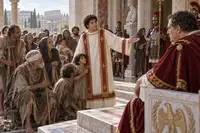
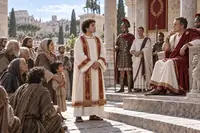
For the next three days and nights, Lawrence ran through every alley and back street of Rome: he gave away every remaining gold coin of the Church to poor families, and even sold the silver chalices to buy food to share. He gathered thousands of people together: the blind, the lame, the paralyzed, lepers covered in sores, starving widows and ragged orphans. On the third day, August 10, 258, Lawrence led that whole crowd of poor and suffering people into the forecourt of the prefect’s residence.
The prefect came out, eagerly expecting chests of glittering gold and silver. But all he saw was a ragged, smelly, crippled crowd. He roared in fury: “Where is the treasure? How dare you deceive me?” The deacon Lawrence spread out his arms toward the poor and said words that have stirred every generation since:
“My lord, these are the great treasure of our Church! These people are poor in earthly goods, but they carry within them faith and an immortal soul! Your gold and silver breed only greed and strife; but these people are the most precious jewels of Christ!”
Chapter 4 of 5
The gridiron and a radiant smile
Humiliated before all his officials, the prefect went mad with rage. He roared:
“How dare you mock me with beggars? Do you want a quick, glorious death by the sword? No! I will roast you slowly until you beg to hand over the gold!”
He ordered a special instrument of torture set up: a large iron gridiron over a bed of smoldering charcoal, to roast his body little by little, a cruelty rare even among the savage tortures of the Roman persecutions.
Saint Ambrose and Saint Augustine, writing a few centuries later in accounts that became the standard sources for this martyrdom, tell us that the fire of love for Jesus blazing in Lawrence’s soul was even fiercer than the fire burning his body. He lay calmly on the red-hot gridiron. His face shone with the beauty of an angel. Amid the extreme pain tearing at his flesh, he still kept his peace and his strangely playful smile. After a long while, he said to the executioner: “This side is done — turn me over!” And before breathing his last, he lifted his eyes to heaven and prayed that the city of Rome would receive the grace to turn to the Christian faith:
“Lord Jesus, I thank You for letting me pass through this gate of glory!”
and then he died in perfect peace.
The extraordinary courage and holiness of the deacon Lawrence shook the whole city of Rome. Many Roman officials and soldiers who witnessed his heroic death asked at once to become Christians. Later historians saw the martyrdom of Saint Lawrence as one of the decisive blows to paganism in Rome, only half a century before Emperor Constantine officially ended the persecutions.
Chapter 5 of 5
A martyr praised by the whole Church
Constantine the Great later had the magnificent Basilica of Saint Lawrence Outside the Walls (San Lorenzo fuori le Mura) built right over his tomb on the Via Tiburtina, one of the seven traditional great basilicas of Rome. That original fourth-century building was rebuilt and enlarged about two hundred years later, and to this day the remains of Saint Lawrence, together with Saint Stephen the Protomartyr, are kept in the crypt beneath the high altar of that basilica.
The name of Saint Lawrence is named in Eucharistic Prayer I, the Roman Canon, right after the names of the Apostles, an honor given to only a few of the first martyrs of the Church. The Church celebrates him on August 10 each year as a Feast. He is honored as patron of deacons, of the poor, and of cooks and chefs, a gently humorous link that comes from the way he died on the gridiron.
Saint Lawrence leaves the whole Church a lesson for every age:
“The true treasure of the Church is never splendid buildings or piles of money; the true treasure of the Church is the poor, the sick and those pushed to the margins of society!”
He teaches each of us: value and serve the poor with sincere charity and holy joy, because when we bend down to lift up someone in misery, we touch the priceless treasure of God on earth.
The end of the story
You have walked with Saint Lawrence to the end of the story.
Some scenes make you smile through your tears:
Running after his teacher, Pope Sixtus II, as he was led to execution, he asked through his tears: "Father, where are you going without your son?"
Ordered to hand over the Church’s treasure, he brought a whole crowd of the blind, the lame and beggars before the prefect and declared: "These are the great treasure of our Church!"
Roasted on a gridiron over red-hot coals, he still wittily told the executioner: "This side is done — turn me over!"
Stay in silence
You discover another definition of wealth: ragged people rejected by society are the most precious jewels the Church can offer to God.
These are the great treasure of our Church!
Let us pray
Saint Lawrence,
when you were ordered to hand over the Church’s treasure, you brought the blind, the lame and the beggars and said: "These are the treasure of the Church." On the gridiron you still kept your smile.
Teach me to see the poor as the most precious treasure.
Pray for those who serve in the parish, for deacons, and help me keep my joy even in suffering.
Amen.
Sources
- Feast dayAuthor’s edited profile
- Patron ofPatronages and symbols, version 1.1
- Often depicted withPatronages and symbols, version 1.1
- Reflectionnewadvent.org
- Reflectionvatican.va
Meet the next one
 Journey 7