

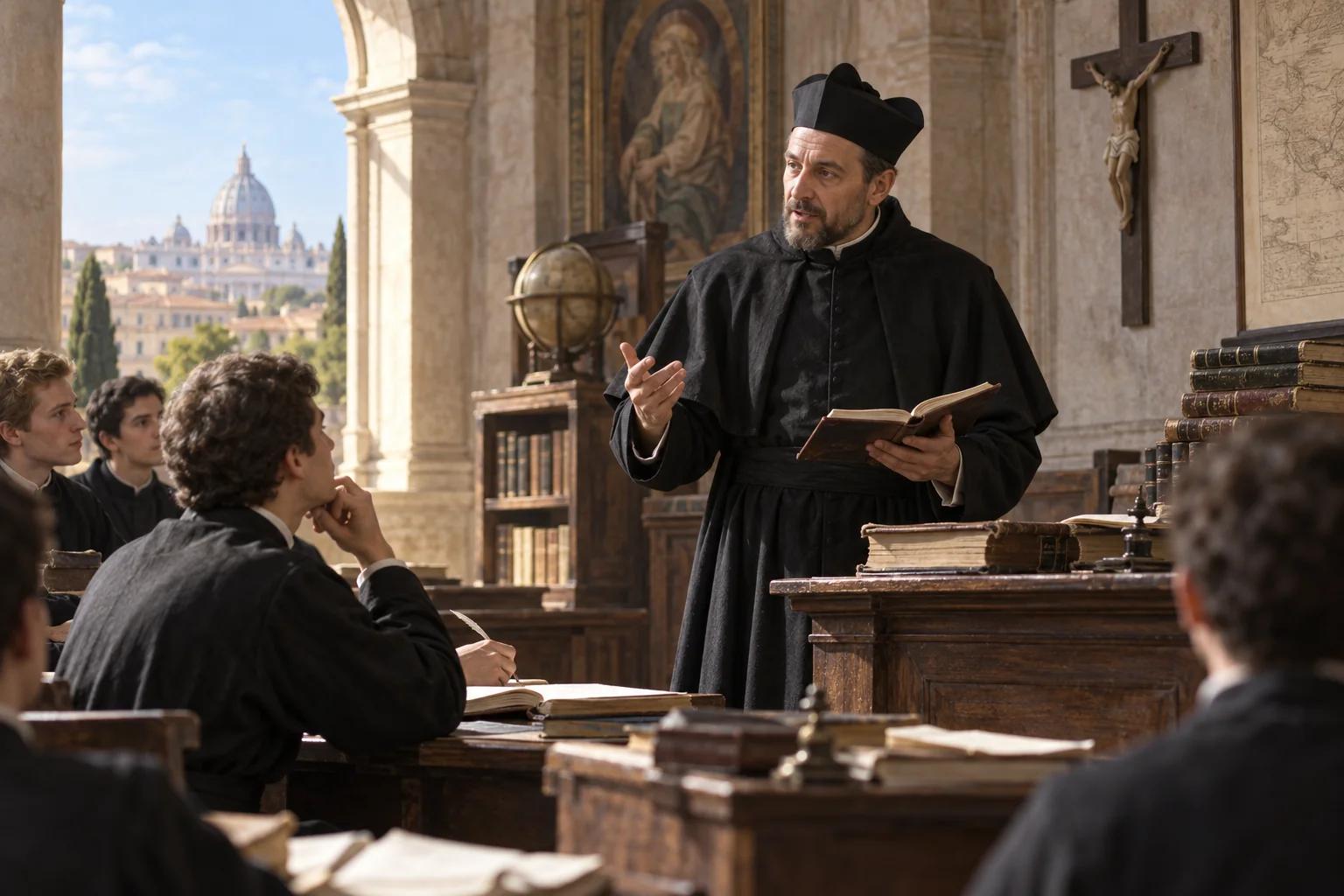
Journey 6 · Keepers of the Lamp of Faith
Saint Robert Bellarmine
Defending the faith with gentleness and a pen of steel
Feast day September 17
Tap to step inside
Saint Robert Bellarmine
Defending the faith with gentleness and a pen of steel
Map of a life
This life told in 6 chapters
Begin the journey OpeningOpening1 min
 Chapter 1 of 6A son of the wine country of Montepulciano1 min
 Chapter 2 of 6The great work “Controversies”1 min
 Chapter 3 of 6A cardinal’s robes and a poor man’s room1 min
 Chapter 4 of 6The Galileo affair and the conscience of a scholar2 min
 Chapter 5 of 6The spiritual books of his last years1 min
- Chapter 6 of 6A Doctor of the Church1 min
Feast day
Saint Robert Bellarmine
Some places may celebrate on a slightly different day.
September 17
Patron of
- Catechists (proclaimed in 1932)
- Canon lawyers
Often depicted with
- A cardinal’s red robes
- A catechism
Opening
Opening
At the end of the sixteenth century and the beginning of the seventeenth, the theological war between the Protestant movement and the Catholic Church raged fiercely all over Europe. Religious polemics at the time were usually full of bitter personal insults and blind prejudice on both sides. Protestant theologians published massive books attacking the papacy and the Catholic sacramental system. Meanwhile, many Catholic theologians were at a loss: they had not yet found a way to defend the faith that was systematic, scholarly and persuasive, instead of answering only with emotion.
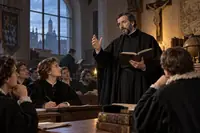
Into that seething situation came an Italian Jesuit priest, small in build and frail in health since childhood, but with eyes bright with rare learning. He revolutionized the method of apologetics: he read all the works of the Protestant reformers such as Martin Luther and John Calvin, quoted their words faithfully without cutting or twisting them — something rare amid the prejudiced debates of the time — then used Scripture itself, the Fathers of the Church and Church history to break down each false argument logically, courteously and so gently that even his Protestant opponents had to respect him.
That extraordinary man was Robert Bellarmine (Roberto Bellarmino), cardinal and Doctor of the Church, called “the strong watchtower of the Church”.
Chapter 1 of 6
A son of the wine country of Montepulciano
Roberto Francesco Romolo Bellarmino was born on October 4, 1542, in Montepulciano, an ancient hill town in Tuscany, famous for centuries for its spreading vineyards and the fine wine that bears the town’s name. His father, Vincenzo Bellarmino, was a lawyer of noble birth but modest means; his mother, Cinzia Cervini, was the sister of Cardinal Marcello Cervini, who later became Pope Marcellus II. He was the third child of a large family of twelve children.
As a boy, Roberto was brilliantly intelligent, with a gift for improvising Latin verse, a talent for the violin and a deep love of nature. But the boy soon recognized the emptiness behind all the worldly honors his family could give him. At eighteen, against his father’s wish that his son would enter political life to bring fame and wealth to the family, Roberto firmly asked to join the Jesuits in Rome in 1560.
After studying philosophy and theology in Rome, Florence, Mondovì and Padua, in 1569 he was sent by his superiors to the University of Louvain (in present-day Belgium), then regarded as the front line of the theological struggle with the Protestants spreading across the Low Countries. On March 25, 1570, he was ordained a priest in Ghent. At Louvain, Father Bellarmine quickly became an outstanding professor of theology. He taught himself Hebrew so that he could study Scripture in the original rather than relying only on translations, and tirelessly read all the works of the Fathers of both East and West. The young priest’s lectures were so compelling that not only Catholic students, but even Protestant scholars and ministers from Holland and England secretly crossed the border to hear him.
Chapter 2 of 6
The great work “Controversies”
In 1576, Pope Gregory XIII called Father Bellarmine back to Rome to take the chair of Controversial Theology at the Roman College, today the Gregorian University. It was there that he completed the greatest work of his life: the enormous four-volume “Disputations on the Controversies of the Christian Faith against the Heretics of This Time” (Disputationes de Controversiis Christianae Fidei), published between 1586 and 1593.
It was the most comprehensive and scholarly work of apologetics the Catholic Church had yet produced. He set out the arguments of the Protestants objectively and fairly, with complete respect, in clear contrast with the emotional polemics of the day, and then used Scripture and Church history to demonstrate the foundational truths: the primacy of the Bishop of Rome, the holy nature of the Church, the seven Sacraments, Purgatory, and the veneration of the saints. The book had such force that Protestant universities in Germany and England had to set up special chairs just to try to refute Bellarmine’s work. Queen Elizabeth I of England, perhaps worried about the book’s influence on her subjects, angrily issued a decree banning it, even laying down the death penalty for anyone who kept the work on English soil. And yet even Protestant scholars of the time had to admit that Bellarmine was a gracious, courteous opponent who never used the vulgar abuse so common in the polemics of the day.
Chapter 3 of 6
A cardinal’s robes and a poor man’s room
In 1599, Pope Clement VIII raised Father Bellarmine to the rank of cardinal. When announcing the appointment, the Pope declared firmly before the whole College of Cardinals:
“We choose him because in the whole Church of God today there is no one to equal him in learning and holiness!”
Though he now wore a cardinal’s red robes, Bellarmine kept the whole poor way of life of a Jesuit. He refused every rich benefice and ate only plain food, as the poor did. He gave all his income as cardinal to the hungry poor, to families of war victims, and to the sick. One freezing winter, he had all the expensive velvet and silk curtains hanging in his rooms taken down and sewn into warm clothes for the poor. When his steward complained about ruining such precious curtains, he only smiled and replied:
“The stone walls do not feel the cold; but the poor out there are freezing to death!”
He also went himself to the pawnshops of Rome to redeem things the poor had had to pawn in their need.
From 1602 to 1605, he was sent to be Archbishop of Capua. In those three short years, he lived out the model of the good shepherd set by the Council of Trent: preaching the Word of God to the faithful every day, visiting the sick in the hospitals himself, reforming the diocesan seminary, and standing up for the rights of the poor against oppression by local officials.
Chapter 4 of 6
The Galileo affair and the conscience of a scholar
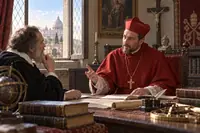
Cardinal Bellarmine’s name is closely tied to the case of the famous astronomer Galileo Galilei, which came to a head around 1615–1616. At that time, Galileo strongly supported Copernicus’s “heliocentric” theory — that the Earth revolves around the Sun — against the traditional “geocentric” view, which many regarded as more in keeping with the literal sense of certain passages of Scripture.
As the leading theological consultor of the Holy Office (forerunner of today’s Dicastery for the Doctrine of the Faith), Cardinal Bellarmine addressed this question in a famous letter of April 1615 to Father Paolo Antonio Foscarini, a Carmelite in Naples who had written a book defending heliocentrism. In that letter he set out a theological and scientific principle astonishingly wise for its time:
“If there were a true demonstration that the Sun stands still at the center and the Earth goes around it, then we would have to proceed with great care in explaining the passages of Scripture that seem to say the opposite; and we would have to say that we do not understand them, rather than hastily declare that the scientific claim is false!”
However, because Galileo could not yet produce conclusive proof of his theory (it would gain a firmer mechanical foundation only with Isaac Newton, nearly a century later), Cardinal Bellarmine advised Galileo in a friendly way to present heliocentrism as a useful mathematical hypothesis for calculation, rather than rushing to use it as a basis for reinterpreting Scripture. On February 25, 1616, he personally met Galileo and advised him along those lines. After the meeting, he even gave Galileo a handwritten certificate stating that the scientist had not been condemned or made to abjure, a document Galileo himself later kept as evidence in his own defense. Bellarmine’s attitude throughout the affair reflected the caution of both a genuine scientist and a serious theologian, quite unlike the rigid image later generations have often attached to the whole Galileo affair.
Cardinal Bellarmine was also the spiritual father of young Aloysius Gonzaga in Rome, and was at his side when he died a holy death. He loved Aloysius like his own son, and asked to be buried at the foot of the young saint’s tomb when his own time came.
Chapter 5 of 6
The spiritual books of his last years
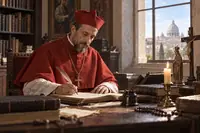
In his last years, weary of countless long political and theological debates, Cardinal Bellarmine gradually withdrew into silence. He wrote simple but warmhearted spiritual works, aimed at nourishing the faith of ordinary people rather than at scholarly debate. “The Art of Dying Well” (De Arte Bene Moriendi) teaches people how to prepare their souls for the hour of death through a holy life built up day by day. “The Ascent of the Mind to God by the Ladder of Created Things” (De Ascensione Mentis in Deum) praises the beauty of the created universe as a road leading to God. His “Short Catechism” was translated into more than sixty languages and became the handbook for teaching the faith in mission lands throughout the world for centuries afterward.
In the autumn of 1621, at seventy-eight, he asked Pope Gregory XV for permission to leave all his offices in the Holy See and withdraw to the Jesuit novitiate of Sant’Andrea al Quirinale to prepare for his last hour. Lying on a simple wooden bed, he calmly prayed the Creed and the Rosary. The Pope himself came and knelt beside his sickbed to ask for his blessing, a rare gesture that reversed the usual order between Pope and cardinal. On the morning of September 17, 1621, the feast of the Stigmata of Saint Francis of Assisi, Robert Bellarmine died peacefully. When people examined his room after his death, they were astonished to find that he had left no money or possessions at all; he had given everything to the poor long before.
Chapter 6 of 6
A Doctor of the Church
Pope Pius XI beatified him in 1923, and on June 29, 1930, the same Pope canonized Robert Bellarmine. On September 17, 1931, he was proclaimed a Doctor of the Church. In 1932, he was proclaimed patron of catechists. The Church celebrates him on September 17 each year.
Saint Robert Bellarmine leaves a lesson for religious dialogue in every age:
“To defend the Truth, one does not use hatred or insults; one must use thorough understanding, complete honesty and a gentle attitude full of love!”
From a scholar whose pen could break every argument of his opponents to a cardinal ready to take down the curtains of his own room to sew clothes for the poor, he shows that the most learned mind can live side by side with a poor, humble heart wholly devoted to serving the least of all.
The end of the story
You have walked with Saint Robert Bellarmine to the end of the story.
These three scenes stay with you:
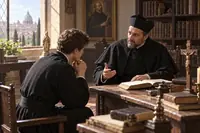
His "Controversies" was so forceful that Queen Elizabeth I of England decreed the death penalty for anyone who kept it.
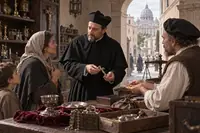
One freezing winter, he had all the velvet and silk curtains in his rooms sewn into warm clothes for the poor, saying: "The stone walls do not feel the cold."
In the affair involving Galileo, he wrote a letter urging caution: if science could prove something, the way Scripture is understood must be reconsidered, rather than hastily rejecting science.
Stay in silence
You recognize the true way to defend a truth: not with hatred or insults, but with thorough understanding, honesty and a gentle attitude full of love.
The stone walls do not feel the cold; but the poor out there are freezing to death!
Let us pray
Saint Robert,
you defended the faith with a sharp pen, yet treated everyone with gentleness. You took down even the curtains of your room to sew warm clothes for the poor.
Teach me to defend the truth without hating anyone.
Pray for catechists, who teach the faith to children, that they may hand it on simply and clearly.
Amen.
Sources
- Feast dayAuthor’s edited profile
- Patron ofPatronages and symbols, version 1.1
- Often depicted withPatronages and symbols, version 1.1
- Reflectionvatican.va
- Reflectionvaticanobservatory.org
Meet the next one
 Journey 6