

Journey 6 · Keepers of the Lamp of Faith
Saint Peter Canisius
The quiet teacher who revived the German lands
Feast day December 21
Tap to step inside
Saint Peter Canisius
The quiet teacher who revived the German lands
Map of a life
This life told in 7 chapters
Begin the journey OpeningOpening1 min
 Chapter 1 of 7A son of the town of Nijmegen1 min
 Chapter 2 of 7The meeting at Mainz and a Jesuit vocation1 min
 Chapter 3 of 7A call from Saint Peter’s Basilica1 min
 Chapter 4 of 7Three catechisms that changed a continent1 min
 Chapter 5 of 7A way of teaching built on gentleness1 min
 Chapter 6 of 7His last seventeen years in Fribourg1 min
 Chapter 7 of 7A Doctor of perseverance1 min
Feast day
Saint Peter Canisius
Some places may celebrate on a slightly different day.
December 21
Patron of
- Germany ("Apostle of Germany")
- Catechists
Often depicted with
- A catechism
Opening
Opening
In the middle of the sixteenth century, on the rough roads of the principalities of the German Empire, people grew used to the sight of a small Jesuit priest walking briskly in a black cassock frayed at the hem. On his back was a leather bag heavy with little books; in his hand, a bamboo staff. He walked tens of thousands of kilometers through the freezing sleet of northern Europe, winter after winter, town after town.
Wherever he went, ruined schools reopened, catechism classes rang with children’s voices, and cold, abandoned churches suddenly glowed again with the sanctuary lamp before the Blessed Sacrament. That tireless traveler was Peter Canisius (born Pieter Kanijs), the man called “the second Apostle of Germany” after Saint Boniface long before him, and one of the outstanding Doctors of the Catholic renewal that followed the Council of Trent.
In a time when religious division was tearing Germany apart, when hostility and bitter polemics drove people into an endless spiral of hatred, he chose the opposite path: no swords, no words of abuse against his opponents. He used gentleness, patient love and plain little catechisms to rekindle the faith in the hearts of millions of people.
Chapter 1 of 7
A son of the town of Nijmegen
Pieter Kanijs was born on May 8, 1521, in Nijmegen, an ancient town in the region of Guelders, then part of the German Empire and now in the Netherlands. His father, Jacob Kanijs, was a respected and wealthy burgomaster; his mother, Ägidia van Houweningen, was a devout woman who died when he was still very small.
Having lost his mother early, Pieter was raised with care by his father and with love by his stepmother. The boy was intelligent and eager to learn, with an unusually sharp memory. At fifteen, in 1536, his father sent him to the city of Cologne, one of the greatest university and cultural centers in Germany at the time, to study the liberal arts, philosophy and canon law. In Cologne he also often went to a Carthusian monastery in the city, where he was deeply influenced by the simple, fervent piety of the Devotio Moderna (the “New Devotion”), a spiritual movement emphasizing a plain inner life, which had spread throughout the Low Countries since the previous century.
The young student lived in a time of great upheaval: Martin Luther’s Protestant Reformation was spreading like a storm across northern Germany. Many university professors and priests wavered, and not a few left the Catholic faith to follow the new movement. But Pieter was fortunate to meet Father Nicolaus van Esche, a devout and holy priest, who became his first spiritual father, teaching him how to build a deep inner life, to pray faithfully and to fast and practice self-denial amid the temptations of a turbulent city.
In 1540, at nineteen, he graduated with distinction as Master of Arts. Back home, his wealthy father had already arranged a good marriage into a noble family, so that his son would inherit the whole family fortune. But Pieter firmly refused, determined to give his whole life to an ideal higher than anything his father had imagined.
Chapter 2 of 7
The meeting at Mainz and a Jesuit vocation
In the spring of 1543, Pieter heard that Father Peter Faber (Pierre Favre), one of the first companions who founded the Jesuits with Saint Ignatius of Loyola, was in the city of Mainz. The young man hurried there to meet him.
Father Peter Faber personally guided Pieter through the thirty days of the Spiritual Exercises according to the method of Saint Ignatius, a demanding retreat combining meditation on Scripture with a deep examination of conscience every day. That spiritual experience brought about a complete conversion in the heart of the twenty-two-year-old. He realized that the one purpose of his life was to serve God and save souls under the banner of Christ.
On May 8, 1543, on his twenty-second birthday, Pieter Kanijs entered the Society of Jesus at Mainz, becoming the first Dutchman to join that young order, which had been formally approved less than three years earlier. He took the Latin form of his name, Petrus Canisius. He sold the large inheritance from his father, gave it all to the poor, and poured all his energy into his new mission. In 1546 he was ordained a priest in Cologne, at only twenty-five.
In his very first years as a priest, his zeal and eloquence were put to the test at once. He led the loyal professors and laity of Cologne and successfully blocked the plan of Archbishop Hermann von Wied, who had tried to turn the whole archdiocese Protestant. Thanks to Father Canisius’s steadfastness, Cologne remained a Catholic stronghold in the heart of northern Germany, while many neighboring regions had gone over entirely to the Protestant side.
Chapter 3 of 7
A call from Saint Peter’s Basilica
In 1547, Cardinal Otto Truchsess von Waldburg chose Father Canisius as his theological adviser to accompany him to the Council of Trent, which was then meeting at Bologna. There the Council Fathers were amazed at the young priest’s knowledge of Scripture and the Fathers. After the Council, Saint Ignatius of Loyola himself called him to Rome for further training.
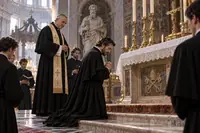
On September 4, 1549, before making his solemn vows in Saint Peter’s Basilica in Rome, Father Canisius knelt at the foot of the altar of the profession of faith and received a mystical vision that changed his whole life: he saw the Most Sacred Heart of Jesus thrown open and shining, inviting him to drink the living water from that very Heart. And a command resounded in his soul: Jesus, together with Saint Peter and Saint Paul, entrusted him with the mission of going back to the German lands, where the faith lay in ruins, to bring healing and renewal to his own people. He wrote in his diary:
“Lord, You opened Your Heart to me, so that I could see to its very depths... From there You promised to give me the armor of trust and send me to save Germany!”
Carrying that fire, Father Canisius set out again for the North, not knowing that the journey would last almost the whole remaining half-century of his life.
Chapter 4 of 7
Three catechisms that changed a continent
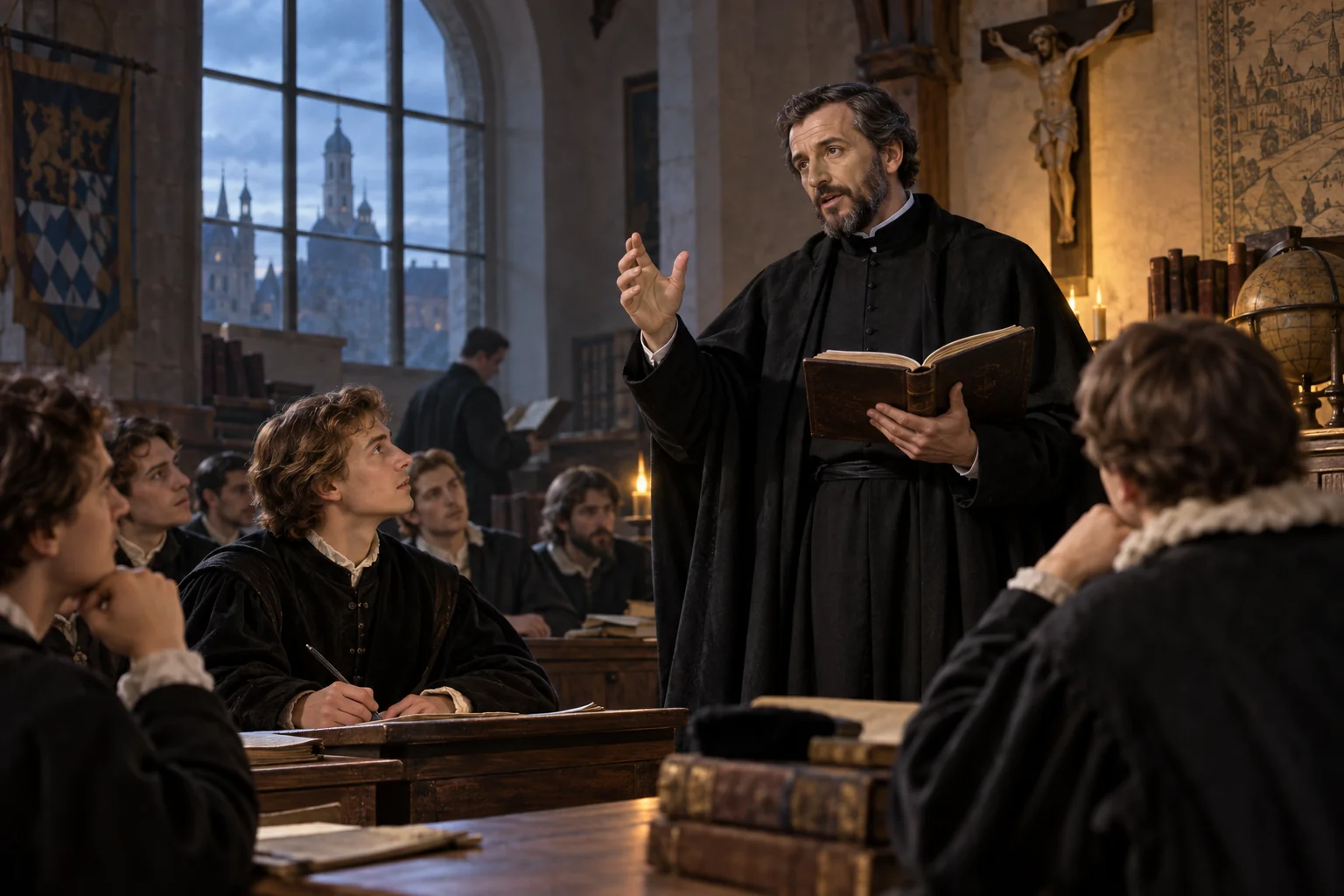
In Germany, Father Canisius was appointed professor and then rector of the University of Ingolstadt in Bavaria, and later transferred to the University of Vienna at the urgent request of Emperor Ferdinand I himself. In Vienna he also taught theology at the university, preached in Saint Stephen’s Cathedral, the heart of the capital’s religious life, and served as confessor in the city’s hospital and prison.
But the state of the faith in Vienna at the time was bleaker than one can imagine: for twenty years not a single young man had entered the seminary; hundreds of parishes had no priest to care for them; the people had never been taught even the most basic truths of the faith; the sacraments were almost completely forgotten in daily life. Realizing that the root cause of that decline was not that people had deliberately abandoned the faith, but simply that they had never been properly taught, Father Canisius undertook a work that changed the history of the Church: he compiled a set of three catechisms, in both Latin and German. The Large Catechism, published in 1555, was for professors, priests and university students, presenting the truths of the faith comprehensively and clearly with full quotations from Scripture and the Fathers. The Small Catechism, in 1556, was for secondary-school youth and ordinary lay people. And the Basic Catechism, in 1558, was for primary-school children, written as short questions and answers, with simple prayers and vivid, easy-to-remember illustrations.
The impact of those catechisms on the whole German-speaking world was so great it is hard to measure: within a single lifetime, they were reprinted more than two hundred times and translated into almost every European language. From classes of children in remote villages to the lecture halls of prestigious universities, people learned their catechism from Canisius’s books. Many people at the time simply called the catechism “the Canisius”. People used to say to one another:
“Canisius has brought more people back to the Church with his catechism than all the other theologians put together!”
Chapter 5 of 7
A way of teaching built on gentleness
Unlike the harsh, hate-filled polemics common in his day, Saint Peter Canisius always kept a gentle, courteous and compassionate attitude toward the followers of the Protestant movement, even while he never wavered in defending the Catholic faith.
He urged the Jesuit priests and brothers under him to follow a golden rule:
“We must love with all our hearts our brothers who have gone astray; we are not allowed to insult or hurt them... Win them over with humility, truth and the example of a holy life! Never argue with bitterness or anger; for a wound can only be healed with soothing ointment, and no one ever healed a wound by rubbing stinging salt into it!”
In 1556, Saint Ignatius of Loyola appointed Father Canisius the first Provincial of the Jesuits in Upper Germany, covering Germany, Austria and Switzerland. During fourteen years as Provincial, he traveled everywhere, founding a network of excellent Jesuit colleges and universities in Prague, Ingolstadt, Munich, Innsbruck, Dillingen and many other cities. Those schools formed a whole generation of lay people and young intellectuals who were both firm in faith and deeply learned, becoming the backbone of the renewal of the Catholic Church throughout Central Europe for many generations afterward.
Three times he refused the see of Vienna, which both the emperor and the Holy See wanted to give him (a post many of his contemporaries would have accepted without a second thought), because he wanted only to be a poor religious all his life, teaching catechism to children and ordinary people. He worked without rest: writing books, preaching, hearing confessions, visiting prisoners and victims of war. When his brothers in the order, worried, urged him to rest a little before he wore himself out, Canisius only smiled and replied:
“We shall have a whole endless eternity to rest!”
Chapter 6 of 7
His last seventeen years in Fribourg
In 1580, at fifty-nine, in obedience to the Holy See, he moved to the city of Fribourg, Switzerland. There he founded the College of Saint Michael, a school that later became one of the greatest Catholic cultural centers in Switzerland and is still open today.
He spent the whole of his last seventeen years in Fribourg. Though old and frail, he kept preaching the Word of God tirelessly in the Cathedral of Saint Nicholas. The voice of that white-haired old man still moved thousands of hearts every time he stood in the pulpit.
In 1591, at seventy, he suffered a stroke that left half his body paralyzed. No longer able to go about preaching as before, Canisius sat in a simple wooden chair, patiently writing books with his one good hand. When his hand was no longer strong enough to hold the pen, he dictated to a young secretary who sat writing down every line. He still taught his students to pray the Rosary, and offered all his physical pain to pray for the unity of the Church, which he had seen divided all his life.
In early December 1597, sensing that his hour of departure was near, he received the Anointing of the Sick and Viaticum with deep devotion. On the afternoon of December 21, 1597, his eyes lifted to the picture of Our Lady hanging on the wall, his lips softly spoke a last word of thanks:
“Lord Jesus, I thank You... Mother Mary, receive my soul!”
Then he died peacefully, at the age of seventy-six. The whole city of Fribourg mourned him; the people reverently buried him right before the high altar of the church of Saint Michael, which he himself had helped to build.
Chapter 7 of 7
A Doctor of perseverance
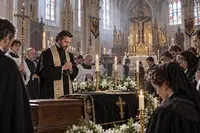
Pope Pius IX beatified him in 1864. And on May 21, 1925, during the Holy Year, Pope Pius XI canonized Peter Canisius and at the same time proclaimed him a Doctor of the Church. The Church celebrates him on December 21 each year.
Saint Peter Canisius leaves a lesson for those who proclaim the Gospel in every age: to keep and spread the faith, Christians need neither violence nor bitterness. From a young man who refused a vast fortune to throw himself into a young religious order, to an old man paralyzed down one side still tirelessly dictating books to his secretary, he teaches each of us: equip yourself with a thorough and solid understanding of the Word of God and the teaching of the Church, and bring that teaching into life with gentleness, with a patient heart that knows how to love and to speak sincerely with everyone around you. Only love joined to truth is strong enough to drive away the darkness and bring peace and unity to the world.
The end of the story
You have walked with Saint Peter Canisius to the end of the story.
Some moments on his long road stay with you:
Before making his solemn vows, he received a vision of the Heart of Jesus thrown open and shining, calling him to go back and save Germany, torn apart by religious division.
The three catechisms he compiled were reprinted more than two hundred times, so that people simply called them "the Canisius".
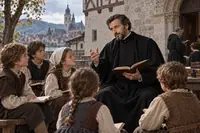
Though both the emperor and the Holy See asked him to become a bishop, he refused three times, wanting only to be a poor religious all his life, teaching the faith.
Stay in silence
You understand why he is called "the second Apostle of Germany": he never spoke a single word of abuse to his brothers who had gone astray, but used only gentleness and little books to warm a whole people again.
A wound can only be healed with soothing ointment, and no one ever healed a wound by rubbing stinging salt into it!
Let us pray
Saint Peter Canisius,
you wrote little catechisms that a whole people learned by heart, and three times you refused to become a bishop so that you could go on teaching the faith.
Pray for the catechists of my parish, that they may be patient and loving with the children.
Teach me to treat people of other beliefs gently, without a single word of abuse.
Amen.
Sources
- Feast dayAuthor’s edited profile
- Patron ofPatronages and symbols, version 1.1
- Often depicted withPatronages and symbols, version 1.1
- Reflectionvatican.va
- Reflectionjesuiten.org
Meet the next one
 Journey 6