

Journey 6 · Keepers of the Lamp of Faith
Saint Gregory the Great, Pope
Servant of the servants of God
Feast day September 3
Tap to step inside
Saint Gregory the Great, Pope
Servant of the servants of God
Map of a life
This life told in 10 chapters
Begin the journey OpeningOpening1 min
 Chapter 1 of 10The prefect who became a monk1 min
 Chapter 2 of 10The fair-haired boys at the slave market1 min
 Chapter 3 of 10Envoy to Constantinople1 min
 Chapter 4 of 10The Pope who did not want to be Pope1 min
 Chapter 5 of 10Servant of the servants1 min
 Chapter 6 of 10A book on the shepherd and a book on Saint Benedict1 min
- Chapter 7 of 10A line of prayer in today’s Mass1 min
 Chapter 8 of 10A dove at his ear, and things that were not his1 min
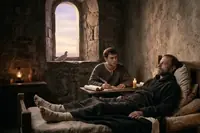 Chapter 9 of 10“I am a sick man”1 min
 Chapter 10 of 10A sick man who did great things1 min
Feast day
Saint Gregory the Great, Pope
Some places may celebrate on a slightly different day.
September 3
Patron of
- Musicians and choirs (Gregorian chant)
- Teachers
- Popes
- England (he sent the missionaries there)
Often depicted with
- A dove at his ear
- The papal tiara
- A book
Opening
Opening
In the year 590, Rome was a dying city. The winter before, the Tiber had burst its banks, flooding the low-lying districts and sweeping away the Church’s granaries. Then came the plague. Pope Pelagius II was one of the first to die of it. The population of Rome, once nearly a million in the time of the emperors, was now only a few tens of thousands, scraping by among ruined temples and palaces. From the north, the Lombards were plundering their way across Italy and would soon be at the city walls.
At that moment, the clergy and people of Rome agreed on one man to be Pope: a fifty-year-old monk, thin and frail, often suffering from stomach pains, who had once held the highest office in Rome and then given it all up to enter a monastery. His name was Gregory.
He did not want to accept. He wrote to the emperor in Constantinople, asking him not to confirm the election. And according to a writer of the time, he even tried to slip out of the city.
Fourteen years later, when he died, the Church called him by a title given to very few in history: “the Great”, Gregory the Great.
Chapter 1 of 10
The prefect who became a monk
Gregory was born around 540 in Rome, into a rich and devout noble family. His home was on the Caelian Hill, one of the seven hills of Rome. His mother, Silvia, was later venerated as a saint. Two of his aunts were consecrated virgins, also venerated as saints. In that family, faith was part of everyday life, as natural as breathing.
He was thoroughly educated in law and literature, and entered public service like every young nobleman of the time. Around 573, when he was just over thirty, he was appointed Prefect of the City of Rome, the highest civil office in the city, responsible for everything from food supplies and public order to the repair of bridges and drains. He wore silk and jewels and went about surrounded by attendants.
But only a year or two later, when his father died, he did something that astonished all Rome: he sold most of his property, used the money to found six monasteries on the family’s estates in Sicily, and turned his own house on the Caelian Hill into a monastery dedicated to Saint Andrew. He took off his silk, put on a rough monk’s habit, and entered that monastery as an ordinary monk.
Later, as Pope, he often looked back on his years in the monastery as the happiest time of his life. He wrote that back then his soul seemed lifted above all turmoil, whereas now, under the burden of governing, it was tossed about by everyday cares like a boat on the waves.
He fasted so severely that he ruined his health. For the rest of his life he was tormented by stomach pains and gout, and some years he was bedridden.
Chapter 2 of 10
The fair-haired boys at the slave market
The English have been telling one story about Gregory for more than thirteen hundred years. The historian Bede, an English monk of the eighth century, recorded it as a tradition handed down from his people’s forefathers.
One day, while he was still a monk, Gregory passed through the marketplace in Rome and saw some boys being sold as slaves. They had fair skin, bright faces and golden hair, very different from the Romans. He asked where they came from. He was told: from the island of Britain, and they were still pagans. He asked what people they belonged to. The answer was: “Angli”, the Angles. Gregory replied with a pun that English schoolchildren still learn today: “Non Angli, sed angeli” — not Angles, but angels — for their faces were like those of angels.
The story goes that he asked the Pope’s leave to go as a missionary to that land and set out, but the people of Rome protested so loudly that the Pope had to send someone after him to bring him back.
No one knows whether the story is true word for word. But what followed is history. In 596, as Pope, Gregory sent the monk Augustine, prior of his own monastery of Saint Andrew, together with about forty monks, to England. Augustine became the first Archbishop of Canterbury, and from then on Christianity took root in England. The English call Gregory “the Apostle of England”, though he never set foot on that island.
Gregory’s letters to Augustine survive, and one has been especially treasured by later missionaries. In it he advised them not to destroy the pagan temples of the English, but only to remove the idols, bless the buildings with holy water and set up altars, so that the people could keep coming to the places they were used to and gradually come to know the true God. He wrote: whoever wants to climb a high mountain must go step by step, not in a single leap.
Chapter 3 of 10
Envoy to Constantinople
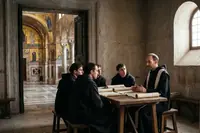
In 579, Pope Pelagius II took Gregory out of the monastery, ordained him a deacon, and sent him as the representative of the Holy See to the Byzantine emperor in Constantinople. He stayed six or seven years, at what was then the most lavish court in the world.
Oddly enough, he hardly learned Greek, though he lived in a Greek-speaking city. Perhaps he wanted to remain a monk even in the middle of the palace. He brought some of his brother monks with him, lived with them as in a monastery, and began explaining to them the Book of Job, the book about a just man who suffers. Those talks later became the “Morals on Job”, one of the most widely read works of the whole Middle Ages.
Around 586 he returned to Rome and went back into the monastery of Saint Andrew. Four years later, the plague came.
Chapter 4 of 10
The Pope who did not want to be Pope
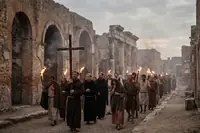
When Pope Pelagius II died of the plague at the beginning of 590, the whole city of Rome chose Gregory. While he waited for confirmation from Constantinople, he still had to care for the dying city. He led the people in penitential processions throughout the city, seven processions from seven different churches converging on the Basilica of Saint Mary Major. It is said that along the way some of the marchers collapsed and died of the plague. Later tradition adds that as the procession passed the mausoleum of Emperor Hadrian, people saw the Archangel Michael on top of it sheathing his sword, a sign that the plague was over; from then on the mausoleum was called Castel Sant’Angelo, the Castle of the Holy Angel.
Saint Gregory of Tours, a Frankish bishop of the same time, tells in his history that Gregory tried to escape from Rome: he had some merchants hide him in a large basket and carry him out of the city gate. But the people went looking for him, and, the account says, a pillar of light showed them where he was hiding. They brought him back.
On September 3, 590, Gregory was consecrated Bishop of Rome. He was the first monk in history to become Pope.
Chapter 5 of 10
Servant of the servants
In his letters Gregory so often called himself by one title that it became bound up with his name: “Servus servorum Dei”, servant of the servants of God. He used it partly to protest against the Patriarch of Constantinople at the time, who called himself “Ecumenical Patriarch”, a title Gregory considered proud. He wrote that the head of the Church must be the servant of all.
To this day, nearly fourteen hundred years later, “Servant of the servants of God” is still one of the official titles of every Pope, used at the head of solemn documents.
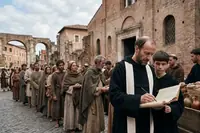
And Gregory lived that title literally. The Church of Rome at that time owned many estates in Italy, Sicily and North Africa. He managed them like a careful steward, writing hundreds of letters about every small matter: farmers must not be made to pay excessive rents, true weights must be used, money wrongly collected must be returned. The income went to feed the poor. He drew up a register of the names of the poor in Rome, and at the beginning of each month, grain, wine, oil, cheese and fish were distributed to them according to the list. The sick and disabled had food brought right to their homes.
His biographer tells that once, hearing that a beggar had died of hunger in an alley in Rome, Gregory was so grieved that he blamed himself and did penance as if he had killed the man with his own hands.
When the Lombards besieged Rome, the distant Byzantine court sent no troops to help. It was Gregory, a Pope with no army, who negotiated with the Lombard king, paid ransom for prisoners, provided food for the city and saved Rome from being sacked. Many historians see this as the moment when the Popes began, not by choice but by necessity, to take charge of the civil as well as the religious affairs of Rome.
Chapter 6 of 10
A book on the shepherd and a book on Saint Benedict
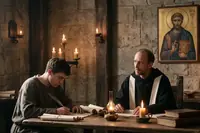
Busy and sick as he was, Gregory wrote a great deal. More than eight hundred of his letters survive today.
In his very first year as Pope, he wrote the “Pastoral Rule”, as a reply to those who had reproached him for trying to avoid office. The book is about what it means to be a shepherd of souls: one must speak differently to the rich and to the poor, to the joyful and to the sad, to the hot-tempered and to the timid; one must be the first to do what one teaches. Throughout the Middle Ages, a newly consecrated bishop was usually given a copy. King Alfred the Great of England, three hundred years later, translated it himself into Old English and sent a copy to every diocese in the land.
Then he wrote the “Dialogues,” stories of saints in Italy. The whole second book is devoted to a single man: Saint Benedict, the father of Western monasticism, whose story you can read elsewhere in this app. Almost everything we know of Saint Benedict’s life, from the cave of Subiaco to the monastery of Monte Cassino, from the cup of poisoned wine that shattered to the scene where he saw his sister Scholastica’s soul rise to heaven like a dove, comes from Gregory’s pen. Without Gregory, we might know very little about Saint Benedict.
In the fourth book of the “Dialogues”, Gregory tells of a monk named Justus in his monastery, who died after secretly keeping three gold coins for himself. Gregory ordered thirty Masses to be offered on thirty consecutive days for his soul. From that story comes a custom still alive today: requesting “Gregorian Masses”, thirty Masses on thirty consecutive days for someone who has died. In Vietnam, many families still request Gregorian Masses for a loved one who has just died, sometimes without knowing where the name comes from.
Chapter 7 of 10
A line of prayer in today’s Mass
Vietnamese Catholics hear one line whenever the priest uses Eucharistic Prayer I, the Roman Canon, and few probably know that Saint Gregory himself added it.
In the prayer of offering, after asking God to accept the gifts, come the words: “Order our days in your peace, and command that we be delivered from eternal damnation and counted among the flock of those you have chosen.” According to historians of the liturgy, it was Saint Gregory who added that petition for peaceful days to the Canon, in the years when the Lombards were besieging Rome and plague and famine were raging. A Pope in the midst of war placed a prayer for peace at the heart of the Mass, and nearly fourteen hundred years later the Church still prays it.
He also rearranged the place of the Our Father in the Mass, putting it right after the Canon, before Communion, as we still say it today. He explained that it was fitting to pray the prayer the Lord Himself taught over the Lord’s own Body and Blood.
Chapter 8 of 10
A dove at his ear, and things that were not his
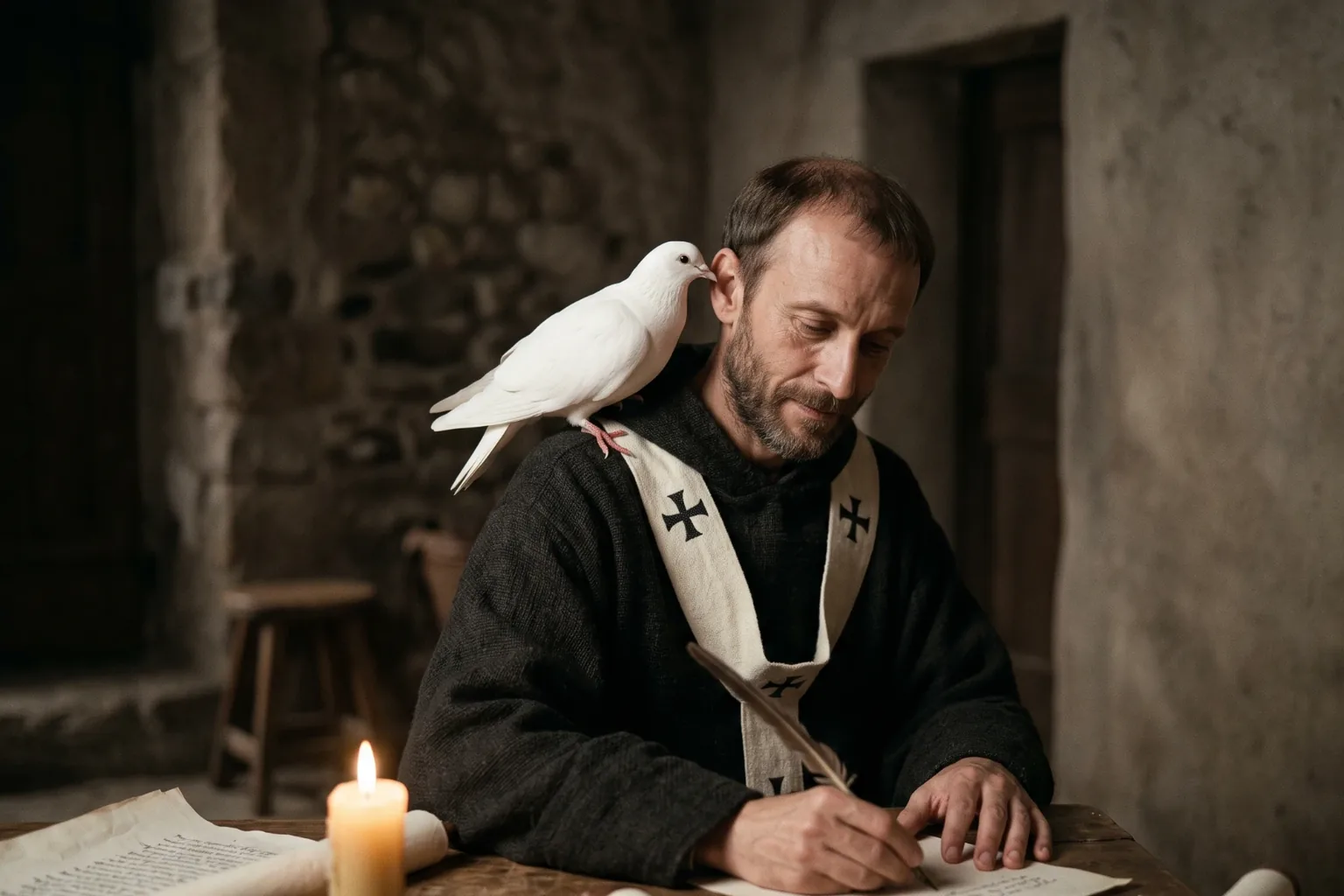
In many old paintings, Saint Gregory is shown sitting and writing, with a dove perched on his shoulder, its beak close to his ear. That image comes from a story told by his secretary: once, while Gregory was dictating to him, a curtain separated the two men. The curious secretary drew back the curtain to look, and saw a white dove holding its beak to the Pope’s ear. The dove is the image of the Holy Spirit. The story is a way of saying that what he wrote came from God.
There are two things bearing Gregory’s name that many people mistakenly think are his.
The first is “Gregorian chant”, the single-line Latin hymns still sung today in monasteries and cathedrals. Since the Middle Ages, people believed that Saint Gregory himself had composed or arranged those chants, and there are paintings of him listening to the dove dictate each note. But musicologists today think that style of singing took shape mainly two or three hundred years after him, in the Frankish kingdom in the time of Charlemagne. His name was attached to it out of honor. Even so, Saint Gregory is still regarded as the patron of choirs and church musicians.
The second is the “Gregorian calendar”, the solar calendar the whole world, Vietnam included, uses every day. That calendar is named not for Saint Gregory the Great but for Pope Gregory XIII, who introduced it in 1582, nearly a thousand years later.
Chapter 9 of 10
“I am a sick man”
In his last years, Gregory could hardly leave his bed because of gout. He wrote in a letter that he had been bedridden for nearly two years, in such pain that he could get up for only a few hours on great feasts to celebrate Mass. He still dictated letters to his secretary, still cared for the poor, still followed every piece of news from distant England.
He died on March 12, 604, and was buried in Saint Peter’s Basilica. His epitaph gives him an unusual but beautiful title: “consul Dei”, God’s consul, as if to say that the former prefect, having given up his worldly office, had become an official of God. Right after his death, the people venerated him as a saint.
He is one of the four great early Doctors of the Western Church, with Saint Ambrose, Saint Augustine and Saint Jerome. In 1969 his feast was moved from March 12 to September 3, the day of his consecration, because the Church did not want the feasts of great saints to fall in the middle of Lent.
Chapter 10 of 10
A sick man who did great things
In Vietnam, Gregory is the baptismal name of quite a few people, especially older men in long-established parishes. If your name is Gregory and you celebrate your patron on September 3, your patron is a man who did very great things in a very weak body.
Gregory did not want to be Pope. He wanted to stay in the monastery, to pray and read. But when God called, he said yes and did his very best, in spite of his aching stomach, his swollen feet, the ruined city and the enemies all around. He did not do it because he liked power; he did it because he thought of himself as a servant.
Perhaps that is what is closest to each of us. All of us are sometimes handed a task we do not want and do not feel strong enough for: caring for aging parents, leading a group, taking on a responsibility in the parish. Gregory reminds us that God does not wait until we are healthy, capable and ready before calling us. He only needs us to know that we are servants, and to climb the mountain step by step, not in a single leap to the summit.
The end of the story
You have walked with Saint Gregory the Great, Pope to the end of the story.
Images that will stay with you:
The Prefect of Rome taking off his silk and turning his own house into a monastery.
Fair-haired boys at the slave market, and the words: “Not Angles, but angels.”
A Pope bedridden with gout, still dictating letters to his secretary to care for the poor.
Stay in silence
At the end of the story, you realize that God does not wait until we are strong enough before He calls us; He only needs us to know that we are servants.
Today, take on one small responsibility you have been avoiding, and do it step by step.
Let us pray
Saint Gregory,
you wanted to stay in the monastery, but when God called, you took on the burden of caring for the whole Church amid plague and war. Help me to accept the responsibilities God gives me, even when I feel weak.
You kept the name of every poor person in the city on a list so that no one would go hungry. May my family and my parish forget no one.
And pray for my loved ones who have died, as you offered thirty Masses for the brother in your monastery, that they may soon see the face of God.
Amen.
Sources
- Feast dayArticle, version 1.1
- Patron ofPatronages and symbols, version 1.1
- Often depicted withPatronages and symbols, version 1.1