

Journey 6 · Keepers of the Lamp of Faith
Saint Bonaventure
The Seraphic Doctor and the torch of the Cross
Feast day July 15
Tap to step inside
Saint Bonaventure
The Seraphic Doctor and the torch of the Cross
Map of a life
This life told in 6 chapters
Begin the journey OpeningOpening1 min
 Chapter 1 of 6“O good fortune!” – Saint Francis’s cry1 min
 Chapter 2 of 6The man who saved the Franciscan family1 min
 Chapter 3 of 6“Where is your library?”1 min
 Chapter 4 of 6The masterpiece “The Journey of the Mind into God”1 min
 Chapter 5 of 6A cardinal’s hat hung on a tree branch1 min
 Chapter 6 of 6His last rest in Lyon1 min
Feast day
Saint Bonaventure
Some places may celebrate on a slightly different day.
July 15
Patron of
- The Franciscan Order
- Theologians
Often depicted with
- A cardinal’s hat hanging on a tree branch
- A book
Opening
Opening
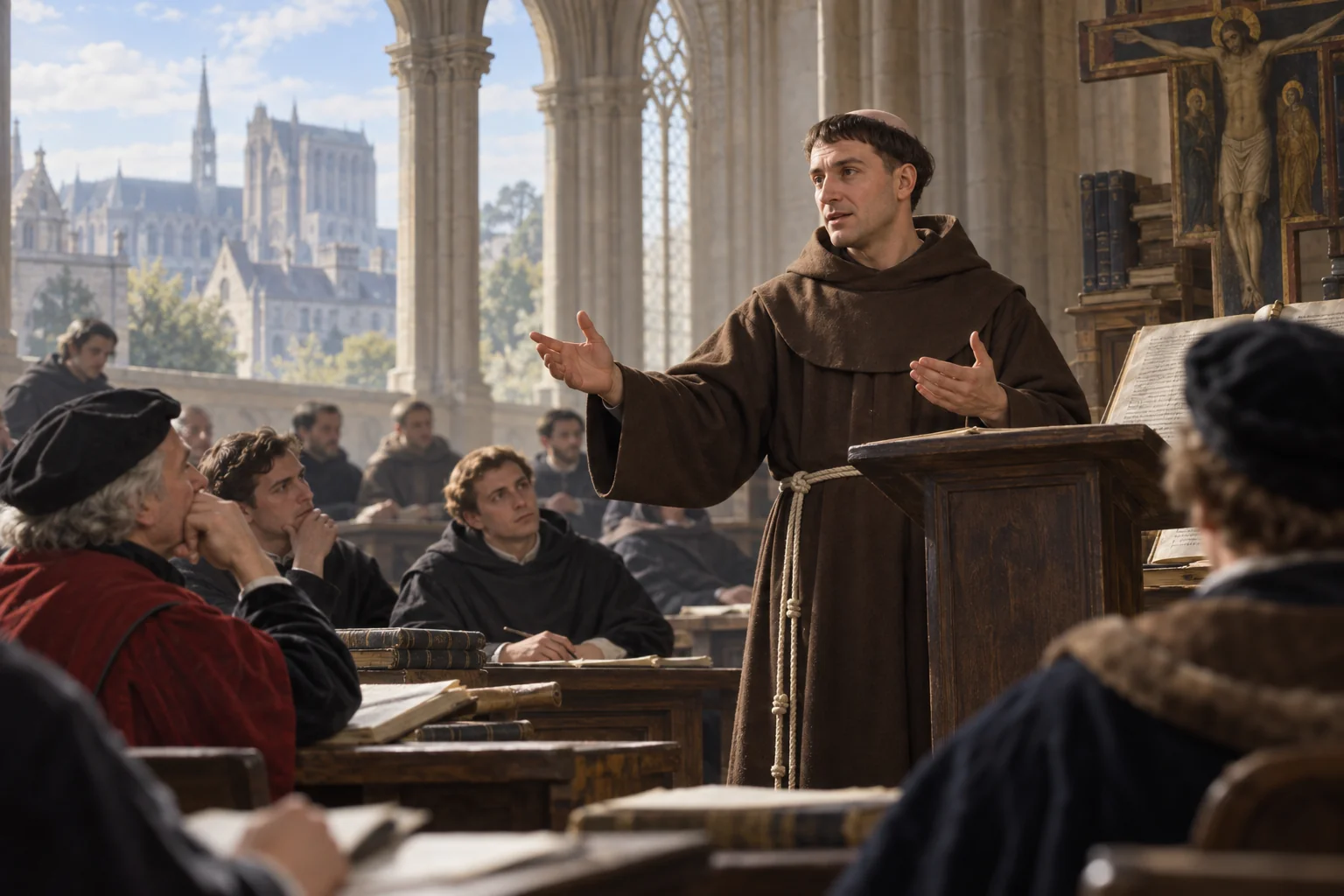
In thirteenth-century Paris, people often saw two young mendicant friars strolling arm in arm along the banks of the Seine, absorbed in discussing the deepest theological mysteries the human mind can reach. One was a Dominican, tall and imposing, named Thomas Aquinas. The other was a Franciscan with a graceful bearing, gentle eyes and a smile always at the ready, named Bonaventure.
Theirs was one of the great friendships in the history of the Church: two towering figures of medieval thought who taught at the same university and defended their orders together against attacks from the secular clergy, yet followed clearly different theological paths. If Saint Thomas Aquinas used the perfect clarity of reason and philosophy to build a massive cathedral of faith, Saint Bonaventure made theology soar on the wings of a heart burning with love. He is called the “Seraphic Doctor” (Doctor Seraphicus) because every page he wrote and every sermon he preached seemed to blaze with the fire of love of the Seraphim, the angels who stand closest to the throne of God in the tradition of Scripture. He was also the man who saved the Franciscan Order from the brink of collapse after its founder’s death, and he is honored to this day as the “second founder” of the Order of Friars Minor.
Chapter 1 of 6
“O good fortune!” – Saint Francis’s cry
Giovanni di Fidanza was born around 1221 in Bagnoregio, an ancient town perched on the top of a rocky hill in central Italy, not far from Lake Bolsena. His father, also named Giovanni di Fidanza, was a well-known physician in the region; his mother, Maria di Ritello, was a deeply devout woman.
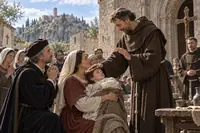
As a small child, Giovanni fell gravely ill, so close to death that the physicians, even his own father with all his skill, gave up hope. In desperation, his mother carried her dying child to Saint Francis of Assisi, who was then preaching near Bagnoregio, begging him to pray for healing and promising to give the child to God if he recovered. Saint Francis laid his hands on the child in blessing. To everyone’s wonder, the boy recovered completely on the spot.
Foreseeing a bright and holy future for the boy, Saint Francis cried out in Italian:
“O buona ventura!”
(“O good fortune!”). From then on, the boy was known by the name that stayed with him all his life: Bonaventure.
In 1235, Bonaventure was sent to Paris to study the liberal arts (the basic curriculum of medieval universities: grammar, rhetoric, logic, arithmetic, geometry, music and astronomy) at the University of Paris, by then the leading center of learning in Europe. In 1243, at twenty-two, strongly drawn by the ideal of poverty and the holiness of the famous theology professor Alexander of Hales, he formally joined the Order of Friars Minor, the Franciscans. After brilliantly completing his studies in theology, he began teaching at the University of Paris itself, quickly becoming one of the most learned masters of theology of his day, and stood side by side with his close friend Thomas Aquinas defending the Mendicant Orders (Franciscans and Dominicans) against fierce attacks from professors of the secular clergy, who saw the mendicant friars as a threat to their traditional academic standing.
Chapter 2 of 6
The man who saved the Franciscan family
In 1257, at thirty-six, a heavy responsibility suddenly fell on his shoulders: Bonaventure was elected the seventh Minister General (superior general) of the Order of Friars Minor.
At the time, the Franciscan Order was facing a very serious internal crisis. Within a few decades of the death of Saint Francis of Assisi, the order had grown at a dizzying pace, to tens of thousands of friars all over Europe; but that very growth split it into two bitterly opposed factions. One, called the “Spirituals” (Spirituali), demanded that the original poverty be kept to the letter, even to extremes: forbidding friars to study, forbidding solid friaries to be built, not even allowing books to be kept in one’s own cell. The other side favored “relaxation”, wanting to turn the order into an ordinary clerical institution, gradually settling into a more comfortable way of life so as to adapt easily to the order’s ever larger role in the Church.
With wisdom, gentleness and great firmness, Saint Bonaventure saved the order from the danger of collapse. He held a General Chapter at Narbonne in 1260 and issued the Constitutions of Narbonne, giving the whole order a solid structure, a document that would guide Franciscan life for many centuries. He skillfully found the middle way: keeping true poverty in the genuine spirit of Saint Francis, while encouraging the friars to pursue theological study so that they could serve the Church more effectively, instead of stopping at a purely contemplative life. In 1263, he wrote the “Major Legend” (Legenda Maior) on the life of Saint Francis of Assisi, the only official work approved by the whole order as the standard for generations of friars to follow, replacing the many different biographies that had circulated before and were sometimes controversial. For that great service, he is regarded as the “second founder” of the Franciscan Order, a title very few successors of any founder in the history of the Church have ever earned.
Chapter 3 of 6
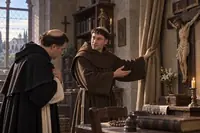
“Where is your library?”
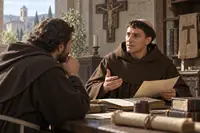
A beautiful story has been handed down about the friendship between Saint Thomas Aquinas and Saint Bonaventure in Paris. One day, Saint Thomas came to visit Bonaventure’s cell. Amazed at the learned and deep works his friend had written, Saint Thomas asked:
“Father Bonaventure, could you show me where your library is? From which books have you drawn these beautiful theological thoughts?”
Bonaventure only smiled and did not answer at once. He walked quietly to a corner of the room and drew back a curtain covering part of the wall. Behind it were no piles of parchment books, as Saint Thomas had imagined, but only a large wooden crucifix: Jesus nailed to the cross, covered with wounds. Bonaventure pointed to the crucifix and answered humbly:
“Father Thomas, this is my only library! Everything I know, everything I have written, I have learned from this Crucified One!”
Saint Thomas bowed his head, moved. He recognized the mystical depth hidden behind his friend’s simple manner, a depth that his own sharp reason, however great, could not reach on its own.
Chapter 4 of 6
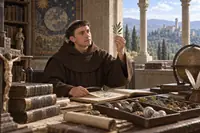
The masterpiece “The Journey of the Mind into God”
In the autumn of 1259, on the thirty-fifth anniversary of Saint Francis receiving the stigmata, Bonaventure went on retreat to Mount La Verna, an isolated peak in the Tuscan Apennines more than eleven hundred meters high, in the dense Casentino forest. In 1213 a local count named Orlando di Chiusi had given it to Saint Francis as a hermitage far from the world. It was on that steep rocky summit, where thirty-five years earlier Saint Francis had received the stigmata in a vision of a six-winged Seraph bearing the image of the Crucified, that Bonaventure wrote one of the great masterpieces of mystical philosophy and theology of the Middle Ages: “The Journey of the Mind into God” (Itinerarium Mentis in Deum).
In that work, he compared the believer’s life to a spiritual climb of six steps, corresponding to the six wings of the Seraph Saint Francis had seen, leading the soul gradually into complete union with God. The three main stages of that journey are, in turn:
- seeing the traces of God in the visible world of created things around us — Vestigium;
- contemplating the very image of God in the human soul, through memory, understanding and will — Imago;
- and finally, beholding God Himself in His absolute goodness and the fathomless mystery of the Trinity — Similitudo.
But the summit of the whole journey, according to Bonaventure, is not a purely rational understanding, but an ecstasy of love, where the soul enters into complete silence before the Beloved hanging on the Cross, beyond all words and concepts the human mind can grasp.
He summed up that spirit in a few words about his own work as a theologian:
“Theology is not only for satisfying the curiosity of the mind; the ultimate purpose of theology is to make us better and to make us love God more!”
Chapter 5 of 6
A cardinal’s hat hung on a tree branch
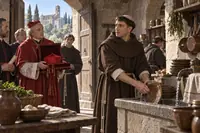
In 1273, Pope Gregory X appointed Bonaventure Cardinal Bishop of Albano, and sent papal envoys to bring the cardinal’s insignia to him in person at the friary of Mugello, near Florence.
When the envoys arrived solemnly carrying the cardinal’s hat and robes, they were astonished to find the famous Minister General of the whole Franciscan Order with his sleeves rolled up, busily washing dishes in a corner of the friary kitchen, work no one expected a man of his standing to do himself. Seeing that his hands were covered in grease and not fit to receive the solemn insignia just then, he simply smiled and said to the envoys:
“Please be so kind as to take that cardinal’s hat out into the garden and hang it on that tree branch over there for me, until I finish washing these dishes!”
The envoys were moved to tears by such serene, almost childlike humility in a man whose scholarly fame had spread across Europe, yet who kept the simplicity of a true mendicant friar.
In 1274, together with Pope Gregory X, he presided over the Second Council of Lyon, one of the important councils of the Middle Ages, which brought together large numbers of bishops and delegations from all over Europe. With diplomatic skill and deep charity, he helped bring about a historic result: a partial healing of the split between the Catholic Church and the Orthodox East. Sadly, the unity reached at that Council lasted only a short time before the old tensions surfaced again.
Chapter 6 of 6
His last rest in Lyon
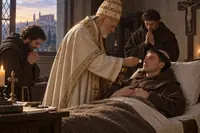
In the middle of the Council, while it was going well, Saint Bonaventure fell gravely ill, worn out by many years of leading a great religious order while teaching, writing and taking part in the Church’s diplomatic work without rest.
During the night of July 14 to 15, 1274, Pope Gregory X himself gave him the Anointing of the Sick and Viaticum. Saint Bonaventure died peacefully, at the age of fifty-three.
Lyon had never seen a funeral like it: the Pope himself, all the Council Fathers, the cardinals and bishops, even the king of Aragon, who was at the Council, followed his body together with thousands of friars. The official record of the Council still preserves these moving lines:
“A man of outstanding gifts, of indescribable holiness and wonderful gentleness has died... He was loved by everyone, because he loved everyone with all his heart!”
Pope Sixtus IV solemnly canonized Bonaventure on April 14, 1482, more than two hundred years after his death. In 1588, Pope Sixtus V proclaimed him a Doctor of the Church with the title “Seraphic Doctor” (Doctor Seraphicus). The Church celebrates him on July 15 each year.
Saint Bonaventure leaves Christians today a lesson: philosophical or theological knowledge, however learned, is meaningless if it does not lead the human heart to love God and neighbor more. The child healed through the prayer of Saint Francis became a scholar famous throughout Paris, yet he still called the Cross his only library. He teaches each of us to let the Cross of Christ be the book that lights up our lives, and to make our whole life a journey that keeps moving toward loving union with God.
The end of the story
You have walked with Saint Bonaventure to the end of the story.
Some scenes you want to linger over:
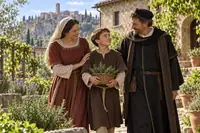
As a dying child, the boy was healed when Saint Francis of Assisi himself laid hands on him, and Francis cried out with emotion: "O buona ventura!" — O good fortune!
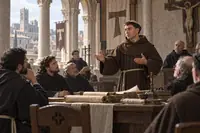
When Thomas Aquinas asked where his library was, Bonaventure pointed to the large crucifix in his room and answered: "This is my only library!"
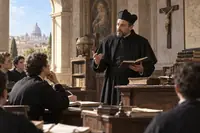
The envoys came to hand him the cardinal’s hat in person, but found him washing dishes in a corner of the kitchen, so he simply asked them to hang the hat on a tree branch until he finished.
Stay in silence
You feel the depth behind a simple saying: however learned our knowledge, it is meaningless if it does not lead the human heart to love God more.
This is my only library! Everything I know, I have learned from this Crucified One!
Let us pray
Saint Bonaventure,
when asked where your library was, you pointed to the crucifix. And when the envoys brought you the cardinal’s hat, you were washing dishes in a corner of the kitchen.
Teach me to learn from the Cross of the Lord, more than from any book.
May learned people be humble, and may all that I know lead me to love God more.
Amen.
Sources
- Feast dayAuthor’s edited profile
- Patron ofPatronages and symbols, version 1.1
- Often depicted withPatronages and symbols, version 1.1
- Reflectionvatican.va
- Reflectionofm.org
Meet the next one
 Journey 6