

Journey 1 · Those Who Met the Lord
Saint Peter
The rock that learned to weep
Feast day June 29
Tap to step inside
Saint Peter
The rock that learned to weep
Map of a life
This life told in 6 chapters
Begin the journey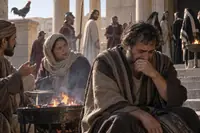 OpeningOpening1 min
 Chapter 1 of 6A fisherman with a home2 min
- Chapter 2 of 6A profession of faith, and a lesson in stumbling1 min
 Chapter 3 of 6The dark night of denial2 min
 Chapter 4 of 6The lakeshore of a new beginning2 min
 Chapter 5 of 6From a locked room to faraway lands1 min
 Chapter 6 of 6Chains, and a final witness in Rome2 min
Feast day
Saint Peter
Some places may celebrate on a slightly different day.
June 29
Other feast days
- The Chair of Saint Peter · February 22
Patron of
- The Popes
- The city of Rome
- Fishermen and all who work with nets
Often depicted with
- The two keys of the Kingdom
- A rooster
- An upside-down cross
- A boat and fishing nets
Opening
Opening
There were two fires in Peter’s life that he could never have forgotten, however long he lived.
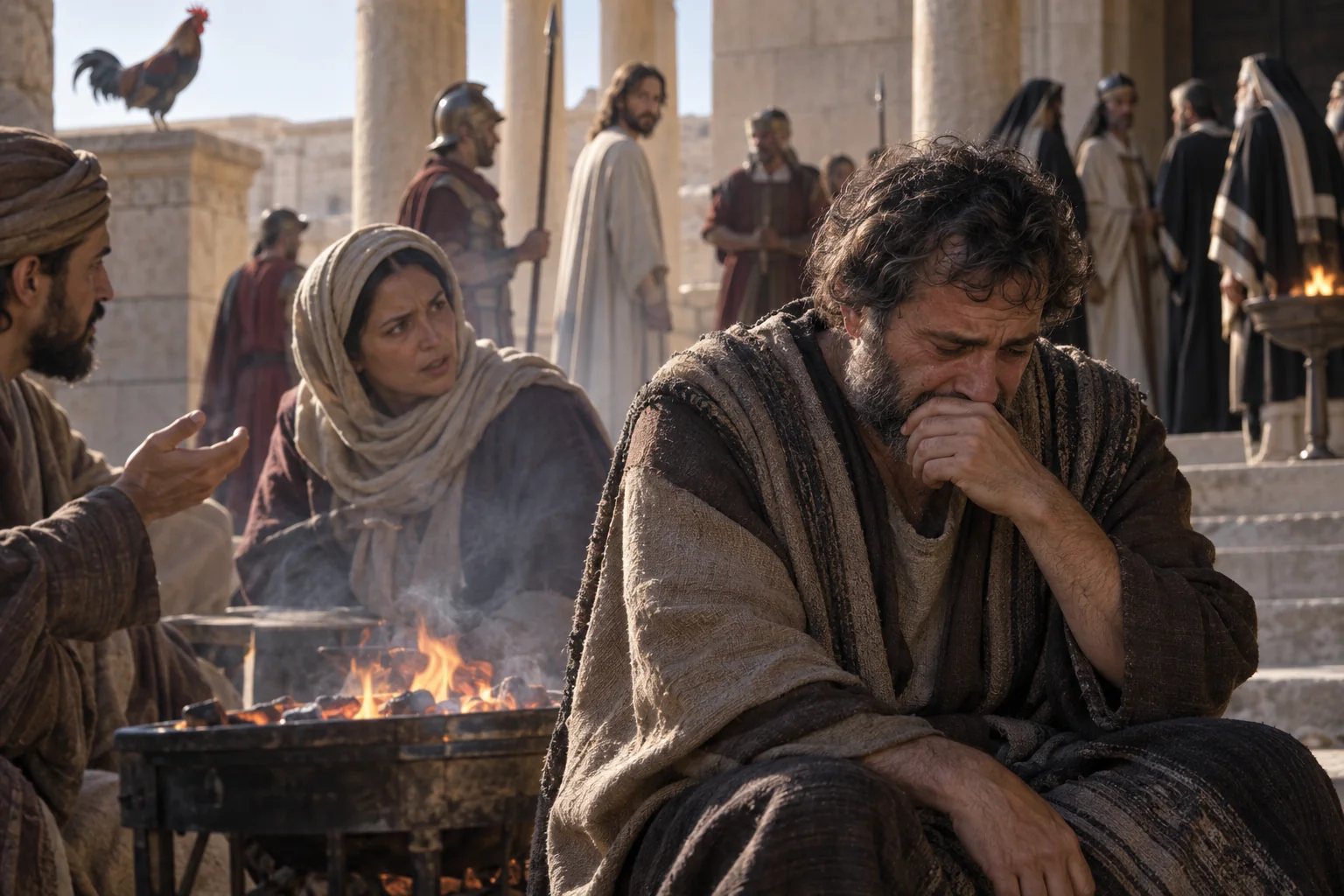
The first fire burned in the courtyard of the high priest’s house, on a bitterly cold night at Passover. He stood there, warming his calloused hands over the glowing coals, and three times swore up and down that he had never known a man called Jesus.
The second fire burned on the shore of the Lake of Tiberias, early one misty morning. This time the very One he had denied sat there, grilling fish for him with his own hands, and asked him whether he loved him.
Between those two fires lies a whole lifetime: tears, betrayal, and a love that never gave up even when it was denied. Anyone who wants to understand why a man who fell so badly was given the keys of the Kingdom has to walk that same rough road with him; there is no shortcut.
Chapter 1 of 6
A fisherman with a home
His birth name was Simon, a fisherman from Bethsaida on the Sea of Galilee who later moved to Capernaum, a fairly busy fishing port on the trade route linking Damascus to the Mediterranean coast. The town probably had only about fifteen hundred people, but its harbor was no small thing: a breakwater more than two meters high stretching hundreds of meters along the shore, room enough for dozens of fishing boats to come and go each day. In the mid-1980s, a severe drought dropped the level of the Sea of Galilee lower than ever before, revealing beneath the mud an intact wooden boat from the first century — about eight meters long, exactly the kind of boat fishermen like Simon used. Excavations have also turned up countless fishhooks, net weights and the rough stone tools of ordinary working families.
He had a home and a wife: the Gospel tells of Jesus stopping in to heal his mother-in-law of a high fever right in his own house in Capernaum. Archaeologists later uncovered an ancient house right next to the town’s synagogue, venerated by generations of early Christians as Peter’s own house. Very early on they scratched prayers all over its walls, a sign that the place was treated as holy almost within living memory of him. His wife’s name, his age when he began to follow the Lord — the Gospel records none of these details.
The one who first brought him to Jesus was his younger brother Andrew. At their very first meeting, Jesus looked straight at him and gave him an entirely different name: Kepha — Aramaic for Rock, which Greek speakers later rendered as Peter. A fisherman whose hands still smelled of nets and fish was suddenly called by the name of a solid foundation, though he could not yet imagine what lay ahead, nor understand why he had been chosen.
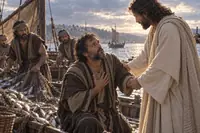
Then one morning, after a whole long night of casting nets without catching a single fish, Jesus told him to row out into the deep water and let down the nets once more. Simon grumbled under his breath — a seasoned fisherman like him knew perfectly well that fish rarely bite by day — but he did as he was told. The nets came up so heavy and full they were on the point of tearing, and the two boats were so loaded they nearly sank in the middle of the lake. He fell to his knees in the boat, still wet from the catch:
“Lord, go away from me, for I am a sinful man.”
Jesus answered simply: “Do not be afraid; from now on you will be catching people.”
He left behind his boat, his nets, the very trade that had fed his family for so many years, to follow an unknown carpenter from Nazareth.
Chapter 2 of 6
A profession of faith, and a lesson in stumbling
Peter was always present at the most important moments of his Master’s life: when Jairus’s daughter was raised from death, when the Master was transfigured in dazzling light on the high mountain, when he sweated blood in his agony in the Garden of Olives. Peter was also the only one who ever dared to step out of the boat and walk on the water toward his Master in the middle of a storm, until he saw the wind and the churning waves, panicked, began to sink, and had to cry out for help.
At Caesarea Philippi, when Jesus asked his disciples who people said he was, Peter blurted out before all the others:
“You are the Christ, the Son of the living God.”
Jesus called him blessed, named him Rock, the foundation on which he would build his Church — and promised to give him the keys of the Kingdom of Heaven, with the power to bind and to loose.
But right after those beautiful words, when the Master began to speak of having to suffer and die in Jerusalem, Peter took him aside and began to rebuke him: “God forbid it, Lord! This must never happen to you!” Jesus turned and said sharply, sparing him nothing:
“Get behind me, Satan! You are a stumbling block to me, for you are thinking not as God thinks, but as human beings do.”
Within a few short minutes, he was praised as the foundation rock and then called Satan to his face. Faith does not ripen in a single flash of insight. It has to be worked over again and again, sometimes by praise, sometimes by a blow to one’s pride.
Chapter 3 of 6
The dark night of denial
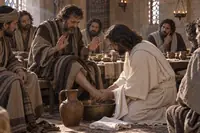
At the last meal before the Passion, when he saw his Master stoop down to wash his feet, Peter pulled his feet back, refusing outright to let the Master do a job reserved for the lowest servant of the house. But when Jesus told him that unless he was washed he would have no share with him, Peter changed his tune at once: “Then, Lord, not just my feet, but my hands and my head as well!” His zeal always ran well ahead of his understanding.
He declared before all his companions that even if everyone else ran away and abandoned the Master, he alone would follow him to prison and to death. Jesus only looked at him with sad eyes:
“Truly I tell you, this very night, before the rooster crows twice, you will deny me three times.”
That night, when soldiers burst into the Garden of Olives to arrest the Master, Peter rashly drew his sword and cut off the ear of one of the high priest’s servants. Jesus made him put the sword back in its sheath at once, allowing no violence of any kind.
He trailed behind the crowd leading his Master away, keeping just enough distance not to be recognized, then slipped in to warm himself by the fire in the high priest’s courtyard with the servants. A servant girl stared at him in the flickering firelight: “This man was with Jesus too.” He denied it flatly: “I don’t know what you’re talking about.” A little later someone else pointed at him, certain. Then a third, hearing his unmistakable Galilean accent, insisted he was surely one of them. All three times he swore an oath and denied it, each time more fiercely.
Just as the rooster crowed the second time, the Lord, who was being led across that same courtyard, turned and looked straight at Peter. Only Saint Luke records this detail, and it leaves the reader very still.
There was not a flicker of reproach or condemnation in that look. Only a sorrow so gentle that he could not bear it. He ran out of the courtyard into the darkness, collapsed and wept as he had never wept in his life. When a man sees that he is utterly weak and faithless, and still feels himself loved in the very moment of betrayal, his tears of repentance can become the beginning of a completely new life.
Chapter 4 of 6
The lakeshore of a new beginning
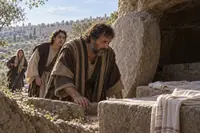
On Easter morning, as soon as Mary Magdalene ran back breathless with news of the empty tomb, Peter and John raced to the grave. John, younger and faster, got there first, but stopped short at the entrance, letting Peter go in first as a gesture of respect for the eldest of the group. Peter saw the burial cloths lying there neatly folded, and something began to break open in his heart, though he did not yet understand it all.
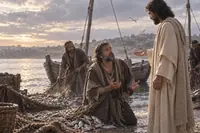
Then there was another morning, on the shore of the Lake of Tiberias, after a night of casting nets and catching nothing, just like the night long ago when he first met the Master. A stranger standing on the shore called out to ask whether they had caught anything, then told them to cast the net on the right side of the boat. The net came up so heavy, so full of fish, that they could not haul it out of the water. John was the first to recognize him and cried out:
“It is the Lord!”
Peter did not wait for the boat to reach land; he leapt straight into the water and swam for the shore, leaving the others to struggle with the heavy net.
On the shore a charcoal fire was already burning, fish grilling on it with a wonderful smell, and bread laid out. After that warm breakfast, Jesus turned to him and asked, without beating around the bush:
“Simon, son of John, do you love me more than these?”
Three times he asked — exactly as many times as Peter had denied him that night by the fire. By the third time, Peter no longer dared to claim anything certain about himself. The man who had once boasted he would die for his Master could now only surrender completely:
“Lord, you know everything; you know that I love you.”
Each time he answered, Jesus gave him a charge: “Feed my sheep.”
The shepherd chosen to tend the whole flock was not someone who had never fallen. He was someone who had fallen very hard, had wept a great deal, and had been forgiven completely, and so he could understand and have compassion on the other sheep who would one day stumble just as he had.
Chapter 5 of 6
From a locked room to faraway lands
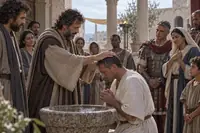
On the day of Pentecost, when the Holy Spirit came down, the man who had once trembled and denied his Master in the dark now stood in a crowded square in Jerusalem, preaching boldly without a trace of fear. Three thousand people asked to be baptized that very day.
He healed a man lame from birth right at the Beautiful Gate of the Temple, was arrested and threatened in every way, yet answered bluntly before a whole council of religious authorities:
“We must obey God rather than human beings.”
He went on traveling everywhere — Samaria, Lydda, Joppa — healing, comforting, building up small communities just taking their first steps.
A great turning point came when he was invited into the very home of a Roman officer named Cornelius, a Gentile who was uncircumcised and did not keep the Law of Moses. Under the strict Jewish custom of the time, a devout Jew was not supposed to set foot in a Gentile’s house, for fear of becoming unclean. But Peter, after a vision that made him rethink everything he had believed to be right, went in. And when he saw the Holy Spirit pour down on the very people listening intently to him, he baptized them on the spot, without waiting for any other formality. From that moment, the door of the Gospel was opened even to those not born of Jewish blood. The decision caused fierce controversy in the community, and he afterwards had to explain it in every detail.
Chapter 6 of 6
Chains, and a final witness in Rome
Around the year 44, King Herod Agrippa I moved against the Church. After having James killed, and seeing that this pleased the Jewish leaders, the king had Peter arrested, intending to execute him right after the feast. On the night before the execution, while the whole community prayed for him without ceasing, an angel appeared, the chains fell from his hands on their own, and the prison doors swung open by themselves. He wandered through the dark night, thinking he was dreaming, until he found his way to a believer’s house and knocked. A servant girl named Rhoda recognized his voice and was so overjoyed that she ran inside to tell everyone, forgetting to open the door and leaving him standing outside, still knocking. A small, rather funny, deeply human detail, right in the middle of a story of life and death.
At the Council of Jerusalem around the year 49, he defended the view that salvation comes from free grace, not from keeping the whole of the old Jewish law. And yet Paul himself, in his letter to the Galatians, frankly tells how he once had to oppose Peter publicly in Antioch, because Peter had hesitated and withdrawn from eating with the Gentile believers, simply for fear of displeasing some conservative Jews newly arrived from Jerusalem. The Church does not hide that even its own leader sometimes wavered and was inconsistent.
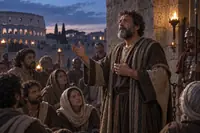
The oldest tradition takes his last steps all the way to Rome, and places his death in the final years of the tyrant Nero’s reign, around 64 to 67 — the same time as the great fire that burned most of Rome, for which Nero blamed the Christians. It is told that when he was led out to be executed, he himself asked to be crucified head down, because he felt unworthy to die in the same position as his holy Master.
The man who had denied his Master three times by a fire on a night of utter fear in the end chose to die hanging upside down on a cross for that same Master. Perhaps no lesson about the mercy of God has ever been written more clearly — not in words, but in a whole human life.
The Church celebrates the two Apostles Peter and Paul together on the same day, June 29 each year; February 22 is reserved for the Chair of Saint Peter. For Vietnamese Catholics who bear this saint’s name, his life is a very real reminder: never let one fall, however heavy, become a reason to give up for good. What the Lord asks of each of us is not a heart that has never sinned, but a heart that knows how to bow and admit its fault, how to weep, and how to get up and go on.
The end of the story
You have walked with Saint Peter to the end of the story.
Surely you can still see:
By the fire in the high priest’s courtyard, three times denying the one he had sworn he would die for.
His Master’s eyes turning to look at him that night — not a flicker of reproach, only a gentle sorrow that made him burst into tears.
Another fire, a morning by the lake, and the same question asked three times: "Do you love me?"
Stay in silence
The more you think about it, the deeper it sinks in: Peter was not chosen as the foundation because he had never fallen. He was chosen because he fell very hard, wept honestly, and let forgiving love lift him to his feet.
One fall is not the end of the story — it can be the beginning of a deeper love.
Let us pray
Saint Peter,
by that fire one night, you denied your Master three times, then broke down in tears when he turned and looked at you. And by the lake one morning, you answered three times: "You know that I love you."
Do not let me give up after I fall. When I have done wrong, let me weep honestly and rise again in the Lord’s forgiving love.
Pray for the Pope and for the Church, that the Church may always be a firm rock for those who are floundering.
Amen.
Sources
- Feast dayAuthor’s edited profile
- Patron ofPatronages and symbols, version 1.1
- Often depicted withPatronages and symbols, version 1.1
- Reflectionvatican.va
- Reflectionvatican.va
Meet the next one
 Journey 1