

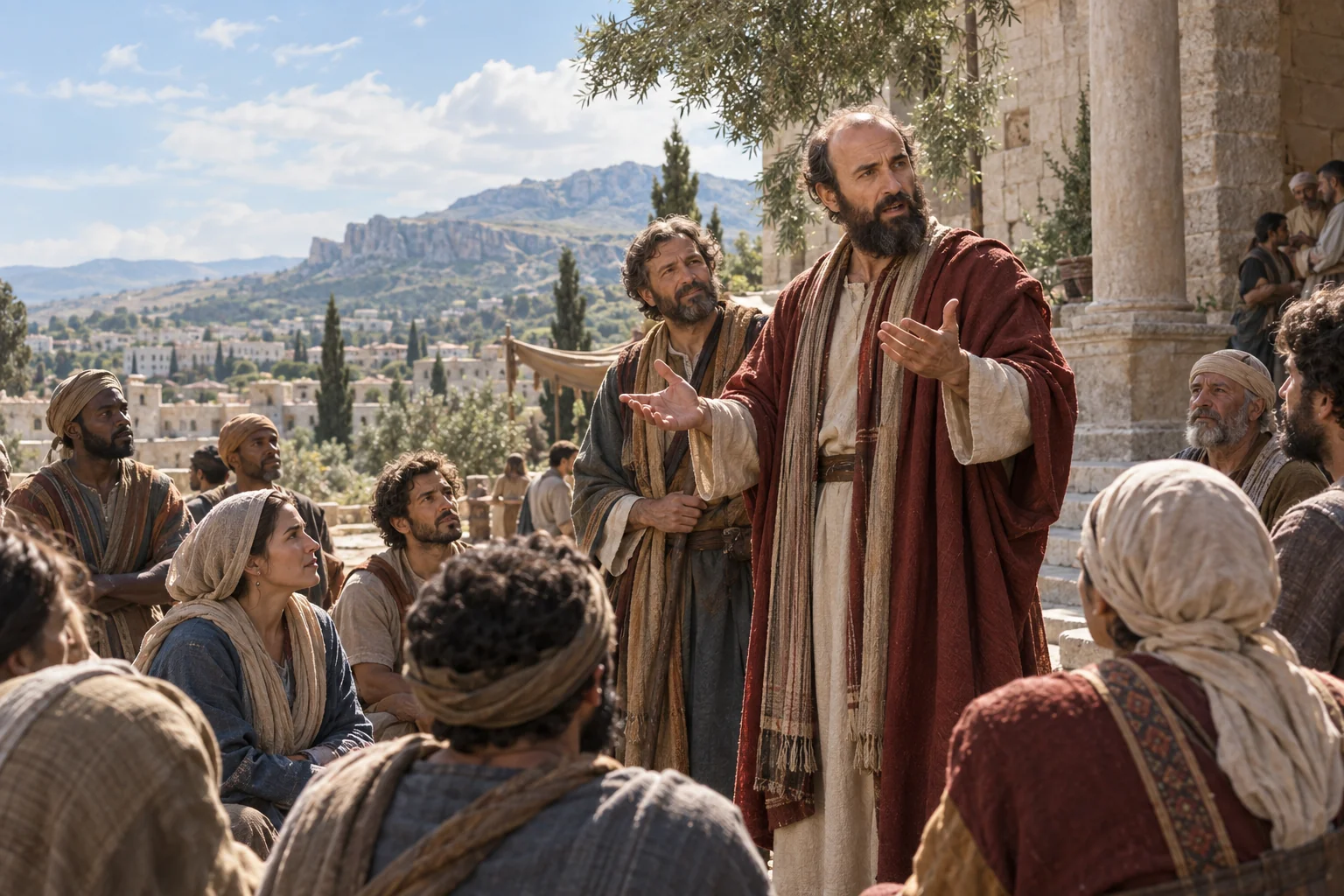
Journey 1 · Those Who Met the Lord
Saint Paul
A road that opened from a fall
Feast day June 29
Tap to step inside
Saint Paul
A road that opened from a fall
Map of a life
This life told in 6 chapters
Begin the journey OpeningOpening1 min
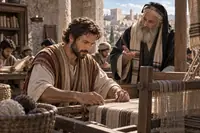 Chapter 1 of 6The gifted son of Tarsus2 min
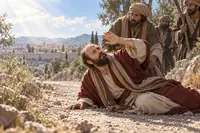 Chapter 2 of 6Damascus, around 33 to 362 min
 Chapter 3 of 6The man Barnabas went looking for1 min
 Chapter 4 of 6Voyages across endless storms2 min
 Chapter 5 of 6Persecution, and letters written in chains1 min
- Chapter 6 of 6The race has reached its finish1 min
Feast day
Saint Paul
Some places may celebrate on a slightly different day.
June 29
Other feast days
- The Conversion of Saint Paul the Apostle · January 25
Patron of
- Missionaries
- Writers, journalists and media workers (the Society of Saint Paul)
- The city of Rome, the island of Malta
Often depicted with
- A sword
- A book or scroll
Opening
Opening
The road from Jerusalem down to Damascus runs about two hundred and forty kilometers, across the dry desert east of Mount Hermon, nearly a week’s journey by caravan. The man riding in that caravan was named Saul, and he carried letters from the high priest authorizing him to hunt down anyone following the new “Way” in Damascus and drag them back in chains to Jerusalem for trial. He traveled with all the zeal of a man convinced he was doing the right thing.
Then, at the blazing height of noon, a light from heaven threw him to the ground. Scripture never says he fell from a horse, as paintings like to show; the text says only that he fell, and heard a voice:
“Saul, Saul, why are you persecuting me?”
He scrambled up out of the dust of the road. His eyes could no longer see anything.
From that fall, his life took a completely new direction: a road that would carry him across seas and over mountains, through stonings, floggings, shipwrecks, prisons, and finally a sword stroke on the outskirts of Rome. But through all those miles, every step bore the same indelible mark: the mark of the day he realized that the one he was so fiercely persecuting was the very one who had bent down to embrace him.
Chapter 1 of 6
The gifted son of Tarsus
He was born in Tarsus, a thriving port city in Cilicia, which the Greek geographer Strabo, writing at the time, praised as surpassing even Athens and Alexandria in learning. He was a Jew through and through, of the tribe of Benjamin, yet he was also a Roman citizen from birth, a rare privilege that not every Jew enjoyed, and one that would later save his life more than once.
His Jewish name was Saul; Paul was the name he used in the Greek- and Latin-speaking world. He did not change his name right after his conversion, as many people think; the Acts of the Apostles simply introduces him later by both names: “Saul, also known as Paul.”
As a young man, his family sent him to Jerusalem to study at the feet of the great teacher Gamaliel, one of the most brilliant and respected masters of the law of his time. He lived strictly as a Pharisee, keeping the law so meticulously that no one could fault him. At the same time, he learned a trade with his hands: weaving a coarse cloth from goat hair called cilicium, a specialty of his home region of Cilicia, widely used to make tents for the Roman army. Cutting, treating and stitching that thick, stiff cloth to the right standard, then adding cords and rings so the tents could be pitched quickly in the field, was a highly skilled trade that paid fairly well. That very craft, years later, would support him through all his long missionary journeys, so that he would never become a burden to any of the poor communities he passed through.
When the movement of those who believed in Jesus began to spread among the people, Saul saw it as a monstrous threat that had to be torn out by the roots to protect the purity of his ancestors’ law. He was there, approving, at the very moment the crowd stoned the deacon Stephen to death — standing guard over the cloaks of the men throwing the stones. After that he did not stop, but went searching house by house, dragging off men and women alike, without mercy. Later, as an Apostle, Paul never once tried to hide that dark chapter of his life. He brought it up not to torment himself or to boast of a spectacular change, but to show one thing clearly: no one, however bad, is too far gone for the mercy of God.
Chapter 2 of 6
Damascus, around 33 to 36
After his fall on the road, Saul had to be led by the hand into Damascus. The man who had come to bind others now had to be led, step by step, completely blind. He was taken to stay in a house on the street called “Straight” (the Via Recta), the main thoroughfare running more than a kilometer and a half through the heart of Damascus, one of the few ancient streets in the world still called by exactly the same name today. For three whole days he sat in darkness, neither eating nor drinking anything.
The Lord sent an ordinary believer in Damascus named Ananias to see him. Ananias knew this man’s reputation and was so frightened that he protested: “Lord, I have heard from many people about this man, about all the harm he has done to your saints in Jerusalem.” But in the end he went. He entered the house, laid his hands on Saul’s blind eyes, and said very gently:
“Brother Saul...”
The man who had hunted disciples everywhere now needed a disciple to bend down and heal him. True conversion does not happen only in one dazzling moment between heaven and earth. It always needs a hand of flesh and blood, held out to welcome and to reconcile.
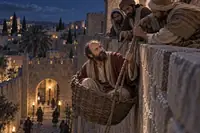
Saul’s sight returned. He was baptized, ate, and slowly regained his strength. Right after that, when he began preaching in the synagogues of Damascus that Jesus was the Son of God, the very Jews who had been his allies turned and looked for a way to kill him. They watched the city gates day and night, waiting to murder him. The disciples had to put him in a large basket and lower him on ropes through an opening in the city wall near the Bab Kisan gate in the southeast corner (a small chapel still stands there today in memory of that escape), and he slipped away in the dark.
After that, he withdrew into the Arabian desert for a long time, alone with everything that had just happened, before returning to Damascus. Only three years later did he go up to Jerusalem, staying with Peter for just fifteen days and also meeting the Apostle James. So great a calling needed that long, quiet time to put down firm roots.
Chapter 3 of 6
The man Barnabas went looking for
In Jerusalem, almost no one dared to believe him. The man who had terrorized the community without mercy now wanted to join that very community. It sounded more like a clever trap than the truth. Just then, a man named Barnabas stepped forward to vouch for him, telling the Apostles in detail how bravely Saul had borne witness in Damascus.
Some time later, seeing that his life was still in danger, the brothers sent him back to live quietly in his hometown of Tarsus, where he was almost forgotten for years. Only when the community in Antioch grew strong and needed more people to build it up did Barnabas make the long journey to Tarsus himself to bring him back to work with him. For a whole year the two of them taught and built up that community, and it was in Antioch that people first began calling the disciples by a new name: Christians.
Paul was not a lone hero who accomplished all the great things that followed by himself. Without the generous heart of Ananias, without the trust of Barnabas who vouched for him, history might never have had so renowned an Apostle to the Gentiles.
There is something worth pondering: during that long time hidden away in Tarsus, Paul must have tasted both the suspicion and the loneliness of someone standing between two worlds: no longer trusted by his old Pharisee companions, yet not fully accepted by the Christian community either. Years in the life of a man who would later preach to the ends of the earth passed in a silence no one recorded. Perhaps that forgotten stretch of time, and not the dazzling moment on the road to Damascus, was where God quietly prepared him for the roads ahead.
Chapter 4 of 6
Voyages across endless storms
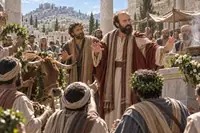
From then on, Paul set out without rest. His first journey took him across the sea to Cyprus and deep into the interior of Asia Minor. In the city of Lystra, after he healed a man lame from birth, the pagan crowd was so amazed that they took him and Barnabas for gods come down to earth, and hurried to bring oxen to offer sacrifice on the spot; the two of them had to tear their clothes to stop it. And yet only a few days later, in that same place, opponents stirred up the crowd to turn against them; they stoned Paul until he lost consciousness and dragged him outside the city, thinking he was dead. The disciples gathered around his motionless body. He struggled to his feet, and went straight back into the very city that had stoned him, to keep strengthening the faith of those who remained.
His second journey took him all the way to Macedonia, bringing the Gospel to Europe for the first time. In the city of Philippi, he and his companion Silas were savagely beaten, thrown into prison, and had both feet locked in wooden stocks. In the middle of the night in that dark prison, instead of moaning and complaining, the two of them sang hymns aloud. A sudden earthquake burst open every prison door; the jailer woke with a start, thought all the prisoners had escaped, and was about to draw his sword and kill himself for fear of punishment, but Paul called out from the darkness in time to reassure him. That very night, the jailer’s whole household asked to be baptized.
He came to Athens and stood on the famous Areopagus, where philosophers gathered to debate all day long, and cleverly used an altar inscribed “To an Unknown God,” which he had happened to see in the city, to begin his sermon about a God who truly exists. Some mocked him; others asked to hear more.
In Corinth he stayed a year and a half, weaving tents by day to earn his living and teaching tirelessly by night. In Ephesus he wrote letters full of love and also of frank rebuke to the churches of Corinth, Galatia and Rome. At the same time he organized a collection among all the Gentile communities to send famine relief to the poor of the church in Jerusalem.
Not every community he founded was at peace. The community at Corinth made him write letter after long letter, sometimes sternly correcting its factions, sometimes hurting because some even doubted his standing as an Apostle. In one passage he writes almost with a sigh: he had been hungry and thirsty, naked, beaten, adrift at sea, in danger on every side. He says it not to complain, but to show that the power of the Gospel lies not in eloquence or fame, but in weakness held up by God’s grace.
Chapter 5 of 6
Persecution, and letters written in chains
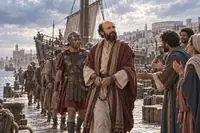
Back in Jerusalem, he was seized by an angry mob right in the Temple courts and would have been beaten to death on the spot if Roman soldiers had not stepped in just in time. Discovering that an assassination plot was being prepared, the Roman commander had to send a whole detachment of several hundred soldiers to escort him by night to Caesarea to keep him alive. He was held there for two full years. Standing before the governors and even King Agrippa II, he used his Roman citizenship to appeal directly to the emperor, a legal move that forced the authorities to send him all the way to Rome for trial.
The voyage to Rome ran into a violent storm that raged for fourteen days and nights without stopping. The ship finally broke apart near the shore of Malta, but thanks to his calm words and leadership, all two hundred and seventy-six people on board swam safely to shore, and not one was lost.
In Rome he was kept under house arrest for two years, in a house he rented himself. Though his hands and feet were still in chains, he was allowed to receive anyone who came to see him and never stopped teaching about the Kingdom of God. From that rented room, under the constant watch of Roman guards, he wrote the great letters to the churches of Philippi, Colossae and Ephesus, and a personal letter to Philemon.
Chapter 6 of 6
The race has reached its finish
According to early Christian tradition, after a short time of freedom he was arrested a second time, and this time there was no way out. Because he was a Roman citizen, he was not crucified like Peter, but beheaded somewhere outside the gates of Rome, under the emperor Nero, around 64 to 67, the same period as the great fire that burned most of the capital, which Nero did all he could to blame on the Christian community.
In his last letter to his beloved disciple Timothy, there is a passage that stops the reader short. It is not the voice of a distant saint, but the words of a lonely old man in a cold prison, asking his disciple to bring him his cloak to get through the coming winter, and a few books to read to ease his loneliness. Right after that comes the unforgettable sentence, one of the most quoted in the whole New Testament:
“I have fought the good fight, I have finished the race, I have kept the faith. Now the crown of righteousness is waiting for me.”
The Church celebrates his conversion on January 25 each year, and celebrates his martyrdom together with Saint Peter on June 29.
A man who once held in his hand a warrant to arrest others ended by shedding his blood for the very faith he had tried to tear out by the roots. For Vietnamese Catholics living far from home, struggling in a foreign land, or caught in a hardship that seems to have no way out, Paul is a very real reminder: no past, however dark, can stop the grace of God from finding a person and transforming them completely.
The end of the story
You have walked with Saint Paul to the end of the story.
Scenes that stay with you:
At noon on the road to Damascus, a light threw him to the ground, and a voice called by name the very man out hunting its followers.
Three days of blindness in the dark, waiting for a stranger’s hand to rest on his eyes and call softly: "Brother Saul..."
From a cold prison in Rome, the last words he left behind: "I have kept the faith. The crown is waiting for me."
Stay in silence
Slowly it sinks in: the man who once stood guarding the cloaks of killers became the most tireless preacher of all. Grace never asks how dark someone’s past has been — only whether the heart is ready to turn back.
No fall, however dark, lies beyond the reach of transforming grace.
Let us pray
Saint Paul,
on the road to Damascus, the Lord called you by name while you were on your way to persecute Him. From then on, the man who had guarded the cloaks of those who threw the stones became a tireless preacher.
Help me believe that no past is so dark that the Lord cannot make it new. Open my eyes as yours were opened, so that I may recognize the Lord in the people I once looked down on.
And when my life is nearly done, let me also be able to say as you did: "I have kept the faith."
Amen.
Sources
- Feast dayAuthor’s edited profile
- Patron ofPatronages and symbols, version 1.1
- Often depicted withPatronages and symbols, version 1.1
- Reflectionvatican.va
- Reflectiongutenberg.org
Meet the next one
 Journey 1