

Journey 1 · Those Who Met the Lord
Saint John the Baptist
A voice by the river
Feast day June 24
Tap to step inside
Saint John the Baptist
A voice by the river
Map of a life
This life told in 6 chapters
Begin the journey OpeningOpening1 min
 Chapter 1 of 6A son who came in old age3 min
 Chapter 2 of 6The fifteenth year of the emperor Tiberius2 min
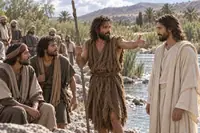 Chapter 3 of 6When the One who was to come stepped into the river1 min
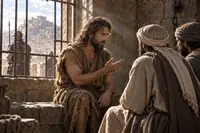 Chapter 4 of 6A question from the darkness of a prison2 min
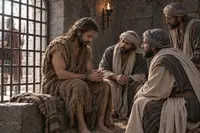 Chapter 5 of 6A royal feast and the death of a prisoner1 min
- Chapter 6 of 6A call that still lingers in human hearts1 min
Feast day
Saint John the Baptist
Some places may celebrate on a slightly different day.
June 24
Other feast days
- The Passion of Saint John the Baptist · August 29
Patron of
- The Order of Malta
- The city of Florence (Italy), Quebec (Canada), Puerto Rico
- Those preparing for Baptism
Often depicted with
- A camel-hair garment
- A lamb
- A reed cross with the banner "Ecce Agnus Dei"
- A shell for pouring baptismal water
Opening
Opening
People smelled him before they saw him. The smell of roughly tanned hide, of desert dust, of wild honey still clinging to fingers that had never known a scented bar of soap. Then they saw him: a shaggy-haired man in a coarse cloak of woven camel hair, standing in the middle of the silt-brown Jordan, shouting things few people wanted to hear.
And yet crowd after crowd left their markets and their fields and walked a whole day from Jerusalem down into that sunken land, hot as a furnace, just to stand and listen to him. He did not promise them an easier life. He made them look straight at what was crooked in their own hearts, made them share their clothes and food with those who had nothing, and then plunged them into the cold water as a sign of being washed clean to the root.
His name was John. His whole life he waited for exactly one meeting. And when that meeting came, he knew how to step back into the shadows and give all the light to someone else, something few people ever manage to do.
Chapter 1 of 6
A son who came in old age
In a small village hidden in the hill country of Judea lived an old priest named Zechariah, with his wife Elizabeth. Both came from an old priestly line and lived so uprightly that no one in the village could find fault with them. But they carried one sorrow nothing could mend: more than half their lives had passed, and they had never held a child of their own.
In the Jewish society of that time, a childless woman carried a kind of invisible stain; people whispered behind her back, thinking it a sign of some sin not yet forgiven. Over the years the couple must have learned to live with those looks, and to swallow their hurt each time the house next door rang with children’s voices.
Then one day the lot fell to Zechariah, one of the many priests of the division of Abijah, to enter the sanctuary and offer incense. It was an honor that might come only once in a lifetime: he alone went in, while the whole crowd waited outside. In the thick, drifting smoke, an angel appeared, standing to the right of the altar of incense. Zechariah was so frightened that his whole body went rigid.
The angel reassured him: do not be afraid, your prayer has been heard; Elizabeth will bear you a son, and you shall name him John. The child would be great in the sight of the Lord and would go ahead to prepare the way for the Savior, in the spirit and power of the prophet Elijah.
The old man blurted out a very human question, and who could blame him?
“How can I be sure of this? For I am an old man, and my wife is getting on in years.”
Not an argument, just the question of a man who had waited so long he no longer dared believe in miracles. But that very question struck him dumb: he could not say a word until the day the child was born.
Those nine silent months must have been the strangest of his life: a priest used to explaining the law to the people, now able only to gesture, to write, and to listen. Perhaps that enforced silence gave him time to let what had happened sink in, instead of rushing to tell the whole village.
On the day the baby was born, relatives and neighbors came to celebrate, and everyone assumed the child would be named after his father, as custom required. But Elizabeth was firm: “No, he is to be called John.” People were puzzled, said no one in the family had that name, and turned to ask the father by signs. Zechariah asked for a small tablet and, with trembling hand, wrote:
“His name is John.”
At that very moment his tongue was set free. After nine months without a word, the first sound that burst from his throat was a blessing of God.
Of the years that followed, Scripture says only one thing: the boy grew and became strong in spirit, and lived in the wilderness until the day he appeared before Israel. No one knows how old he was when he left home, or where he lived, ate and slept through all those years. One theory holds that he spent time with the Essenes, an ascetic community living apart near the Dead Sea, but that is only a scholar’s guess with no firm evidence. The desert kept John’s secret, as it keeps all its secrets, until the day it was ready to roar.
Chapter 2 of 6
The fifteenth year of the emperor Tiberius
Saint Luke, the most careful historian among the Gospel writers, dates John’s appearance with surprising precision: in the fifteenth year of the reign of the emperor Tiberius, when Pontius Pilate was governor of Judea and Herod Antipas ruled Galilee — around the year 28 or 29 AD. With the machinery of Roman power running smoothly from the capital to the farthest provinces, the word of God came, not to any palace, but to a nobody in the wilderness.
Nothing about his appearance commanded respect in the usual way: a camel-hair cloak scratching his skin, a belt of animal hide, meals of locusts and wild honey, the diet of a man living without any comforts at all. Yet when hundreds of people gathered round him on the muddy riverbank asking what they must do to change their lives, he gave them no lofty spiritual formula. His answers were practical and ordinary: whoever has two coats, give one to the person who has none; whoever has food, do the same. To the tax collectors, despised by everyone for cheating the people, he said only: do not collect more than you are owed. To the soldiers who liked to harass and threaten honest people to squeeze money out of them, he said only: do not extort, do not make false accusations, be content with your pay.
There is nothing lofty in those words, only everyday matters of food and clothing that any decent person ought to know. But perhaps that is exactly why they touched people’s hearts. For John, repentance was not a warm feeling as you stepped out of the water. It meant sharing your food and keeping your hands clean in a job that easily breeds greed.
People began whispering to one another, unable to hide their hope: could this be the Messiah the nation had awaited for centuries? John put a stop to that at once, without letting it go to his head in the least. He pointed to someone still to come:
“One more powerful than I is coming; I am not worthy to stoop down and untie the strap of his sandals. I baptize you with water, but he will baptize you with the Holy Spirit and with fire.”
Chapter 3 of 6
When the One who was to come stepped into the river
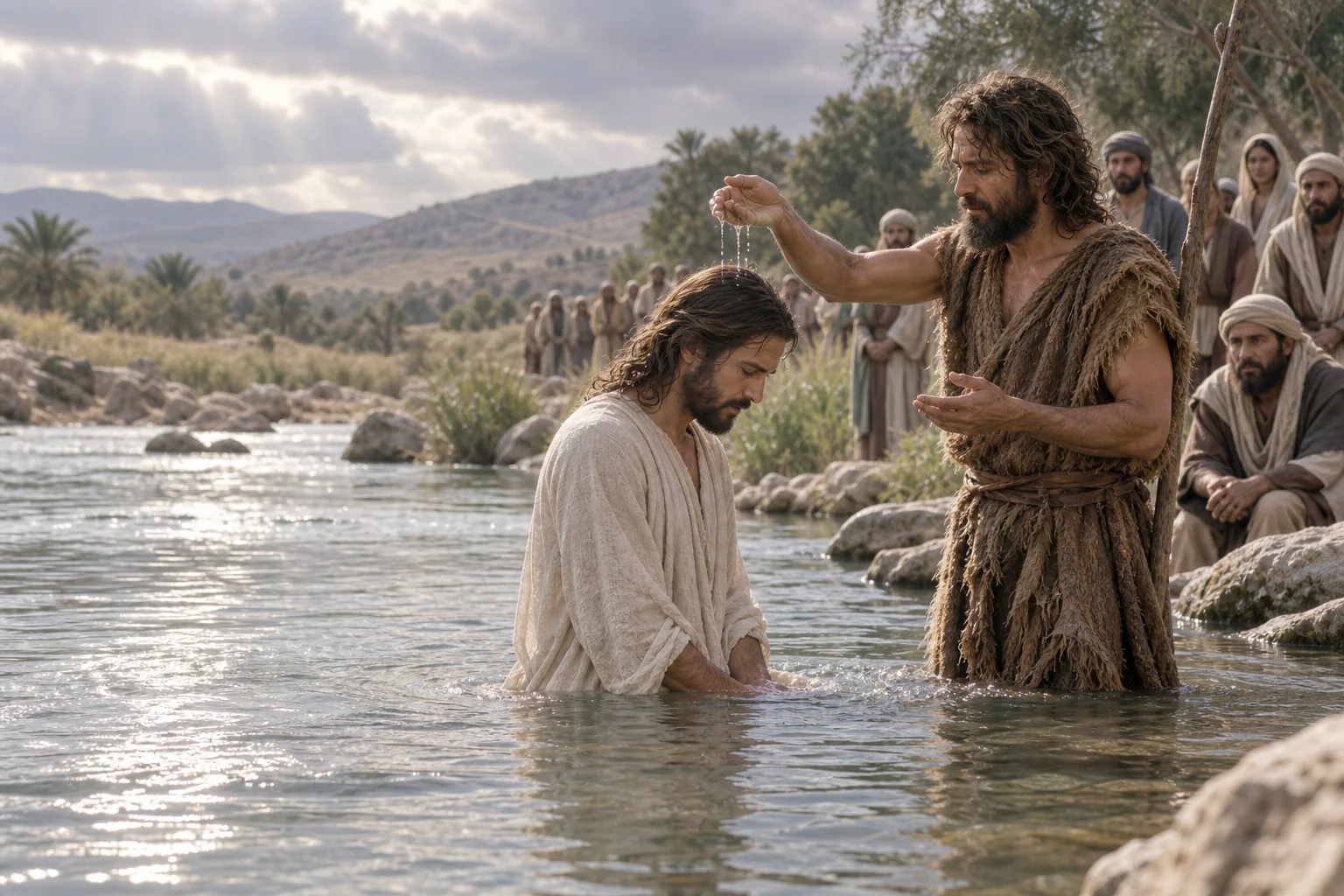
Then one day, among the long line of people waiting their turn to go down into the water, a man from Nazareth quietly came forward. John saw him, and something in him stopped short.
“It is I who need to be baptized by you, and yet you come to me?”
he exclaimed, trying to hold him back. But the man answered calmly: “Let it be so for now, for it is fitting for us in this way to fulfill all righteousness.”
John bowed his head, asked nothing more, and lowered him into the silt-brown water of the Jordan.
Then the heavens opened. Something like a dove came down, and a voice from above was heard: “This is my beloved Son, with whom I am well pleased.” The writer of the fourth Gospel also keeps another sentence John spoke the very next day, when he saw that man passing in the distance:
“This is the Lamb of God, who takes away the sin of the world.”
Two disciples standing beside John heard those words and quietly left their teacher to follow the stranger. One of them was Andrew. That same day Andrew ran to find his brother Simon and brought him to meet the new teacher. It was the start of a chain of encounters that would change history.
Some time later, the disciples who stayed with John noticed the crowds leaving their teacher’s stretch of river and flocking to the other man. Some were openly annoyed and ran to tell John, as if it were a threat. But he only smiled and compared himself to the friend of the bridegroom, who waits outside and is happy just to hear the bridegroom’s voice, with no need to be noticed himself. Then he said something few people ever dare to say plainly about themselves:
“He must increase, but I must decrease.”
There was no bitterness in those words. They sound like the sigh of relief of a man who has finished the task he was given and has nothing left to hold on to for himself.
Chapter 4 of 6
A question from the darkness of a prison
A dry, burning wind began to blow harder through the rocky mountains east of the Dead Sea. There, on a sheer peak with deep ravines on three sides, rose a fortress with a fierce-sounding name: Machaerus, “the black fortress.” From its summit you could see as far as Jerusalem, Jericho and, far in the distance, the fortress of Masada. Herod the Great, father of Antipas, had built a splendid Roman-style palace there, with gardens, Roman baths and a banquet hall where guests reclined to eat and drink in luxury. Directly beneath that palace, cut deep into the rock, lay dark, damp dungeons.
John was locked up there. The immediate reason was that he had dared to denounce Herod Antipas publicly for marrying Herodias, the wife of his own brother, Herod Philip. The Law of Moses, in the book of Leviticus, clearly forbade taking your brother’s wife. To marry Herodias, Antipas also had to put away his first wife, the princess Phasaelis, daughter of King Aretas IV of Nabatea. That decision cost him dearly: Aretas, enraged, went to war, and Antipas’s army was badly defeated. The Jewish historian Josephus, writing at the time, adds that Herod imprisoned John because he feared John’s influence over the people might turn into a revolt. So two motives, the private grudge of a woman exposed and the political fear of a suspicious king, closed in on one man.
Lying in the moldy darkness beneath his jailer’s marble floors, John still heard news now and then of what the man he had baptized was doing: healing the sick, driving out demons, teaching the crowds. He sent his disciples to put a blunt question to him:
“Are you the one who is to come, or should we wait for someone else?”
It was a strange question from the man who had been so certain on the riverbank. Perhaps in prison, when time crawls and hope wears thin with each damp, lightless day, even a prophet may waver. Scripture tells us nothing more of that inner struggle; it simply leaves the question there, bare and unexplained.
Jesus did not reproach him for asking. He told the messengers to go back and report exactly what they had seen and heard: the blind see, the lame walk, lepers are cleansed, the deaf hear, the dead are raised, the poor hear the good news. Then, as the messengers turned to go, he faced the crowd and said something that left everyone stunned:
“Truly I tell you, among those born of women there has never been anyone greater than John the Baptist.”
The prisoner in the darkness beneath the black fortress had not been forgotten. He simply was not allowed to see the work he had begun come to flower.
Chapter 5 of 6
A royal feast and the death of a prisoner
That year, on the king’s birthday, a lavish banquet was held on the summit of Machaerus. Wine flowed freely and guests laughed and talked in the lamplight. Herodias’s daughter, whom tradition later named Salome, stepped into the middle of the hall and danced so enchantingly that Herod blurted out an oath in front of everyone: whatever she asked, he would give her, even half his kingdom.
The girl ran to ask her mother what to request. And the mother, still nursing her hatred for the man who had dared to condemn her marriage in public, whispered the answer in her daughter’s ear: ask for the head of John the Baptist, on a platter.
The king was stunned, and perhaps felt a flicker of regret. But he had just sworn the oath in front of so many powerful guests; taking it back would mean losing face then and there. He chose to save face rather than save an innocent man. A soldier was sent down to the dungeon, and minutes later the head of the man who had brought a whole stretch of the Jordan to its knees in repentance was carried into the feast on a platter.
His disciples later came to ask for his body and buried it, then quietly went to tell Jesus.
Here was a man with the power of life and death in his hands, who knew perfectly well whom he was about to kill (Scripture records that Herod feared and respected John and even liked listening to him), and still he went ahead, all because of a rash oath sworn in a drunken moment. Perhaps that is the most frightening thing in the whole story: knowing what is right is never enough if, at the moment of decision, we choose to save face.
Chapter 6 of 6
A call that still lingers in human hearts
The Church celebrates the birth of Saint John the Baptist on June 24 and commemorates his martyrdom on August 29. He is one of the very few saints whose birthday is kept as a feast, perhaps because his birth itself was already a wonderful sign.
In Vietnamese parishes, those named after Saint John the Baptist are often reminded to dare to speak the truth, even when those in power do not want to hear it. But perhaps the greater lesson lies in what he said on the riverbank: be glad when others are recognized more than you, and know when to step back and make room for something greater, without ever counting it a loss.
The voice that once cried out was silenced by a sword in the middle of a drunken feast on a mountaintop. But the call to live uprightly, to share our bread and our clothing, and to step aside for something greater than ourselves has not grown old, though more than two thousand years have passed since that night in the black fortress.
The end of the story
You have walked with Saint John the Baptist to the end of the story.
Three things you will find hard to forget:
Nine months of a father’s silence, waiting for the day he would write down a name no one in the family had ever borne.
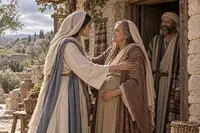
In the middle of the muddy Jordan, a voice rang out that made people look straight at what was crooked in their hearts.
In the dark prison of Machaerus, a question burst from the very man who had been most certain: "Are you the one who is to come?"
Stay in silence
And then it dawns on you: John lived his whole life only to point in another direction. When that light came near, he gladly stepped back, without a trace of bitterness.
He must increase, but I must decrease. Making way for something greater than yourself is also a way of loving completely.
Let us pray
Saint John the Baptist,
in the middle of the Jordan you invited people to look straight at what was crooked in their hearts. And when Jesus came, you gladly stepped back, without a trace of bitterness.
Help me find the courage to see my own faults, and turn back to the Lord with all my heart.
Teach me to grow smaller so that others may grow, to be glad when the person beside me is praised, and not to keep the light for myself.
When I doubt, as you did in that dark prison, let me still dare to ask the Lord, and wait patiently for His answer.
Amen.
Sources
- Feast dayAuthor’s edited profile
- Patron ofPatronages and symbols, version 1.1
- Often depicted withPatronages and symbols, version 1.1
- Reflectionvatican.va
- Reflectiongutenberg.org
Meet the next one
 Journey 1