

Journey 1 · Those Who Met the Lord
Saint Joseph
The star of silence
Feast day March 19
Tap to step inside
Saint Joseph
The star of silence
Map of a life
This life told in 8 chapters
Begin the journey OpeningOpening1 min
 Chapter 1 of 8The righteous man of Nazareth2 min
 Chapter 2 of 8Accepting a life beyond all plans1 min
 Chapter 3 of 8Bethlehem and the Child’s first days2 min
 Chapter 4 of 8The father who rose in the night2 min
 Chapter 5 of 8Home again, to live ordinary days1 min
 Chapter 6 of 8Three days of searching1 min
- Chapter 7 of 8A death no one dated1 min
- Chapter 8 of 8The father whose name lives on1 min
Feast day
Saint Joseph
Some places may celebrate on a slightly different day.
March 19
Other feast days
- Saint Joseph the Worker · May 1
Patron of
- The Universal Church (declared by Pius IX in 1870)
- The Church in Vietnam
- Workers and craftsmen (Saint Joseph the Worker, May 1)
- Fathers and families
- The dying, and the grace of a happy death
Often depicted with
- A white lily
- Holding the Child Jesus
- Carpenter’s tools
- A flowering staff
Opening
Opening
In all four Gospels, not a single word from his mouth is recorded. He lived right beside the Son of God from His first day until He was grown, and left behind not one quotation. Yet when someone had to leap up in the night to save a child’s life, it was him. When someone had to bear the town’s gossip to shelter a pregnant woman whose story no one knew, that was him too. The hands that held the saw and the axe, that planed each beam straight, turned out to be the first hands to hold the Savior of the world.
Nazareth called him Joseph the builder. The Church, two thousand years later, still calls him by a simple name: Saint Joseph, foster father of the Word made flesh.
He left no last words, no letter, no sermon. What he left was a home. And perhaps that is the hardest thing of all to build.
Chapter 1 of 8
The righteous man of Nazareth
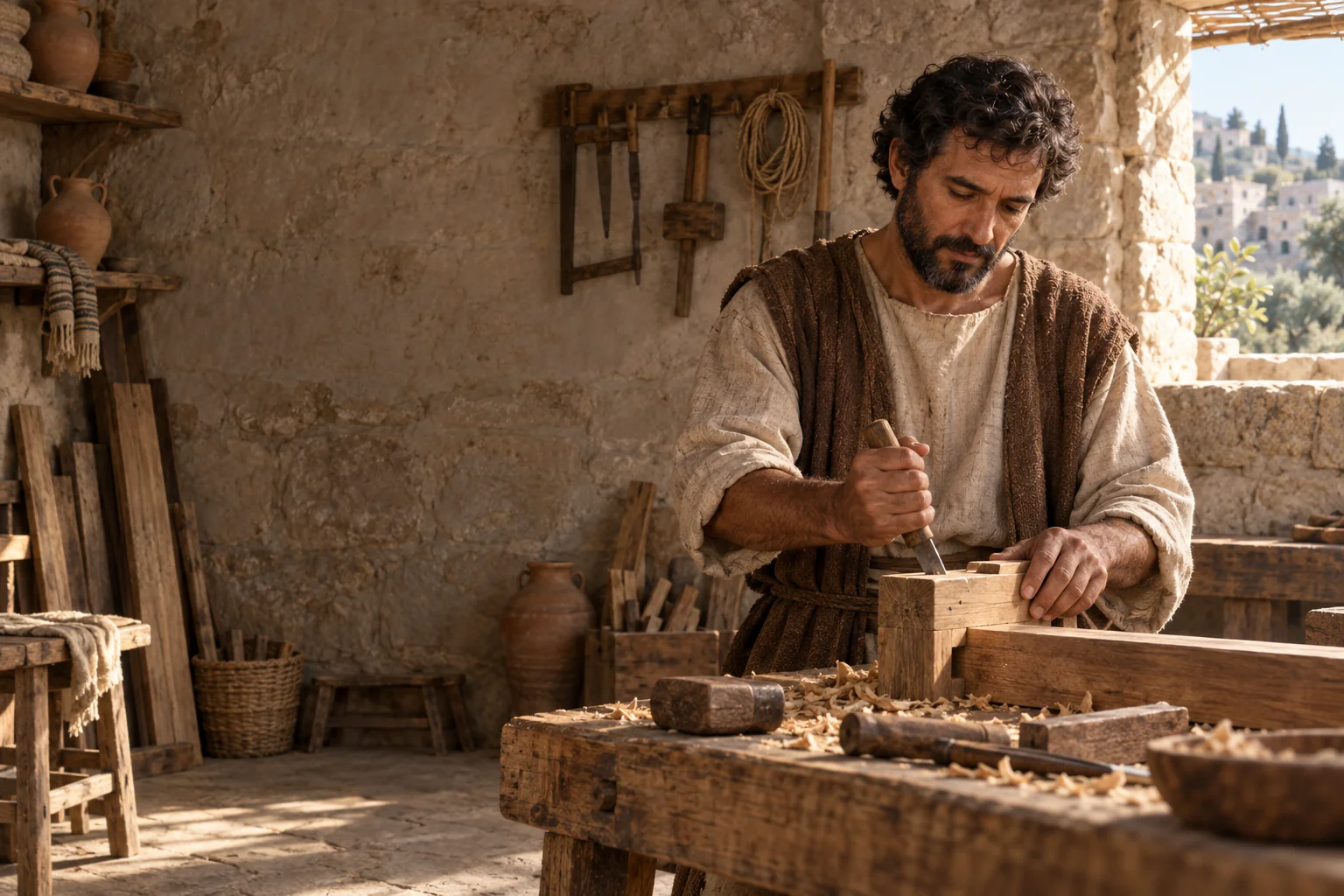
Nazareth in those days was a speck on the map: a few hundred stone houses on a hillside, probably fewer than a thousand people, so small that someone once scoffed, “Can anything good come out of Nazareth?” Yet only about six kilometers away, the city of Sepphoris was being lavishly rebuilt in the Roman style on the orders of Herod Antipas. The ring of chisels, the pounding of hammers, the shouts of workers hauling stone columns carried to all the villages around. It may well have been on that noisy building site that people saw a young man named Joseph, of the line of King David but with no ties left to any throne, carrying timber and cutting stone day after day, earning his bread with the strength of his hands.
His trade was what the Greek calls a tekton, not quite the “carpenter” we are used to reading about. In a dry land with few trees, like Judea and Galilee, a tekton had to know stonework too: how to raise a wall, hang a door, mend a roof, any job that needed skilled hands and staying power. It was a respected trade, but never a rich one. Men were paid by the day; some days there was enough to eat, some days only enough to get by.
In the middle of that working life, Joseph became betrothed to a young woman named Mary. Under Jewish law, the betrothal (kiddushin) already bound the two as husband and wife in the eyes of the law, though they did not yet live under one roof and would wait as much as a year for the wedding itself. During that time of waiting, couples usually lived apart, hearing of each other mostly through their families.
Then one day, word came: Mary was with child.
No one recorded where or when Joseph heard the news — perhaps one evening after a long day on the building site, sawdust still on his sleeves. But any man in his place would have grasped the consequences at once: by law, a betrothed woman who was pregnant by another man could be judged an adulteress, and the penalty, on paper, was stoning. In practice the sentence was rarely carried out by then, but public shame was almost certain, before the whole village and both families.
Joseph had every reason to be angry, to demand answers, to push the whole painful matter onto Mary. But he did not. He simply planned to write a bill of divorce quietly (the accepted procedure of the time, which required no reason to be given before a court) and then step away in silence, exposing no one, dragging no one’s name into the marketplace.
Scripture calls him “a righteous man.” Not righteous in the rigid sense of following the law and punishing every breach. Righteous in such a way that, at the very moment his heart was most broken, he still had room to think of someone else before counting his own loss.
Chapter 2 of 8
Accepting a life beyond all plans
The story might have ended there, with a quiet parting and a name dropped from the story, had it not been for one night.
He lay asleep, and in a dream a voice spoke, calling him by the name of his own house:
“Joseph, son of David, do not be afraid to take Mary into your home, for the Child she carries is from the Holy Spirit. She will bear a son, and you will name him Jesus, for he will save his people from their sins.”
When he woke, who knows how long he lay staring up at the roof before he got up. But the Gospel tells it in a single sentence: he did as the angel had commanded, and took his wife into his home.
No bargaining. No asking for one more sign to be sure.
People often speak of Mary saying “yes” to the angel Gabriel, and forget that Joseph had a “yes” of his own. He did not say it in words; he said it in deeds, by making room in his house, making room in his life, for a child who was not his by blood, and for a wife the whole village might still be whispering about behind her back.
There is a detail that is easy to miss: the naming of the child. In those days, when a father named a child, he formally received that child into his family and his line, before the law and before the community. Nine months later, when Joseph spoke the name “Jesus” for the first time, he was not only obeying a command from a dream. He was publicly taking a child as his own, shouldering whatever talk might come, and asking nothing for himself.
Chapter 3 of 8
Bethlehem and the Child’s first days
Then the Roman emperor decreed a census. Everyone had to register in his ancestral town. For Joseph, that was Bethlehem, the old home of David’s line, about a hundred and forty kilometers from Nazareth as the crow flies. On foot or by donkey, the journey took five to seven days, sometimes more, depending on the travelers’ strength. The safest road did not run straight through Samaria, a region Jews of the time usually avoided, but went around through the Jordan valley, down to Jericho, and then climbed back up into the hills around Jerusalem.
Mary was close to giving birth by then. Picture a woman in her last month riding a donkey for hours each day, over rough stony roads, under the Middle Eastern sun, and you see that the journey was nothing like as gentle as the paintings suggest.
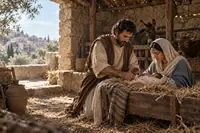
They reached Bethlehem at the worst possible moment. The records do not say why, but there was no room at the inn — perhaps because that small town was filling with people of David’s line, all coming to register at the same time. The Child was born where animals were kept, wrapped in a cloth, and laid in a feeding trough.
No one knocked from door to door begging, no cold innkeeper turned them away as the Christmas plays like to show. The truth was simpler and starker: a young, poor couple, far from home on the night of the birth, took the only place left.
Eight days later the Child was circumcised and formally given the name Jesus. Then, on the day of purification under the law of Moses, Joseph and Mary carried their son up to the Temple in Jerusalem with the offering of the poor: a pair of turtledoves, instead of the lamb that better-off families gave. There an old man named Simeon had waited his whole life to see this moment. He took the child in his arms, gave thanks, and then turned to Mary and said words that stopped the newborn joy short: this child would be a sign that people would oppose, and a sword would pierce her own soul.
Joseph stood there, surely unable to say a word. From the very first days, being a father meant learning to live beside something far greater than he could understand: glad, and yet carrying a worry he had no name for.
Chapter 4 of 8
The father who rose in the night
Some time later, wise men from the East, perhaps from Persia or Babylon, made the long journey and went all over Jerusalem asking about a newborn king. Word reached Herod, a suspicious old king so notoriously cruel that he had killed his own wife and sons for fear of losing his throne. He pretended he wanted to come and worship, but in truth he was planning how to remove a future rival.
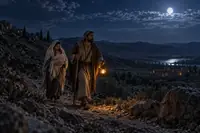
That night Joseph dreamed again. This time the dream brought no good news, but an urgent command: get up now, take the Child and his mother, and flee to Egypt, for Herod is about to search for the child to kill him.
He got up in the middle of the night. He did not wait for daylight, and had time to gather only the barest necessities.
From Bethlehem to the land of Egypt was many times longer than the journey from Nazareth — perhaps six or seven hundred kilometers, through Gaza and into the Sinai desert along the coast road known as “the way of the sea,” the trade route that had linked the Near East with Egypt for thousands of years. It was a road with water and resting places, somewhat safer than crossing the open desert. But for a family fleeing in the night with a newborn, no possessions and no escort, “somewhat safer” was still a wager with their lives.
Behind them, Herod struck. He sent soldiers to Bethlehem to kill every boy two years old and under. It was a small massacre, barely noticed by Roman historians, yet it left a wound that never healed in the families who remained. Jesus survived. But his life was bought with the blood of other children, a painful truth the Gospel does not shy away from.
For anyone who has had to leave home in the night, holding a small child and fleeing war or disaster, there is perhaps no need to explain what Joseph felt: there is only time to think about keeping the people you love alive, and no time yet to wonder how you will live tomorrow.
The Gospel says nothing at all about the years in Egypt. We do not know where they stayed, how they made a living, whether anyone helped them. We only know that they were there, waiting, until the day they could return.
Chapter 5 of 8
Home again, to live ordinary days
Herod died around the fourth year before Christ, of an illness the historians of the time describe as horrible. The dream came to Joseph once more, this time telling him he could go home.
But he was still not entirely at ease. Hearing that Herod’s son Archelaus, no gentler than his father, was ruling Judea, he chose not to return to Bethlehem, but took his family north, back to Nazareth, where another, milder ruler held power.
That was not a reckless decision based on blind faith. It was the decision of a man who knew what was worth fearing, who looked carefully at the real situation, and only then placed his family where they would be as safe as possible.
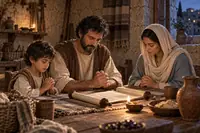
From then on, the story falls almost silent for many years. Saint Luke records only one sentence: the child grew and became strong, filled with wisdom. Behind that short sentence lie thousands of mornings getting up for work, thousands of plain meals, Sabbaths kept, pilgrimages up to the Temple each year: a rhythm of life so ordinary that no one bothered to write it down.
Perhaps it was in those quiet years that Joseph taught his son how to hold an axe, how to measure a beam straight, how to bargain for a day’s wage that would see them through. No one wrote those lessons down. But one thing is certain: the Son of God had a thoroughly human childhood, raised by the labor of an earthly father. There was nothing special to tell, and yet it was the foundation for everything that came after.
Chapter 6 of 8
Three days of searching
Jesus was twelve. The whole family, as usual, went up to Jerusalem for the Passover. It was the greatest feast of the year, and whole villages traveled together, both for company and for safety from robbers on the road.
When the feast was over, the crowds streamed home. In the crush, they assumed the boy was walking with some group of relatives. Joseph and Mary had traveled a whole day before they realized their son was nowhere in the caravan.
They turned back to Jerusalem, asking everywhere, searching for three whole days. Three days in a crowded city, not knowing where to begin: it must have felt like a nightmare that would not end.
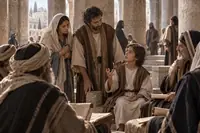
At last they found him sitting among the teachers in the Temple, listening and asking questions that left everyone amazed at how much a twelve-year-old understood. Mary could not hold back her reproach:
“Son, why have you done this to us? Your father and I have been searching for you in sorrow.”
Jesus answered, so calmly that it seemed almost strange: “Why were you looking for me? Did you not know that I must be in my Father’s house?” Neither of them fully understood what their son meant.
That is the last time Scripture mentions Joseph alive. He steps out of the story as a father who has just lived through three days of terror, who has broken down at finding his son again, and who dimly realizes that the child he is raising belongs to something far greater than the little house in Nazareth.
After that, Jesus went back to Nazareth with his parents, and was obedient to them as before. Joseph went on being a father, only now he knew that a distance between himself and his son had begun to open, and he had to learn to love his son even without understanding the whole road his son would walk.
Chapter 7 of 8
A death no one dated
Then Joseph disappears from the pages of the Gospels, without a word of warning.
In all the years of Jesus’ public ministry, not a single line mentions his foster father. Even at the foot of the cross, we see Mary, but not Joseph. From that silence, later generations of believers concluded that he had died before Jesus began his mission. That is a reasonable assumption handed down through popular devotion, not something clearly recorded.
People like to imagine him dying in the arms of Jesus and Mary, a peaceful death with the two people he loved most at his side. The image is so beautiful that it is why Joseph is honored as patron of the dying and of a happy death. But we must be honest: no one wrote that moment down. It is what devotion longs for, not what history confirms.
Even so, there is something strangely fitting about it: a man who lived his whole life without a single recorded word should also leave without any last words. He had finished his work long before, through his steady, quiet presence, year after year.
Chapter 8 of 8
The father whose name lives on
Every year on March 19, the Church throughout the world celebrates the Solemnity of Saint Joseph, Husband of the Blessed Virgin Mary. In 1870, Pope Pius IX declared him Patron of the Universal Church. In 1955, Pius XII added the feast of Saint Joseph the Worker on May 1 — for those who work with their hands, the people most like him. And in 2020, while the whole world reeled from the pandemic, Pope Francis wrote a whole apostolic letter, Patris corde (
“With a Father’s Heart”
), about this silent man.
In Vietnam, few saints’ names are more common than Joseph. Countless people bear it, and more parishes, religious congregations and associations are named for him than anyone could count. People bring him very real, very ordinary prayers: for steady work to feed the family, for peace between husband, wife and children, for the grace to live honestly in a world full of temptation, and for a peaceful death when the time comes.
Perhaps that is why Joseph has never felt like a stranger to the Vietnamese.
- A father up before the rooster crows to make it to the market.
- A husband who swallows his worries so his wife and children can sleep in peace.
- A workman who takes the heaviest share of the work on himself, just so his children have decent clothes to wear to school.
Anyone living such a life finds in Joseph someone who went before them and knew the very same worries.
The star that bears his name does not blaze; it asks no one to look up. It quietly gives just enough light to those carrying a family, a job, a small responsibility no one notices, so that they know: get up when you need to get up, love with your whole heart, and hold on to whatever has been placed in your hands, even if no one ever applauds.
The end of the story
You have walked with Saint Joseph to the end of the story.
A few moments that are hard to forget:
One night he chose to step away quietly and with honor, rather than push the woman he loved into disgrace.
A dream, and a man rising to make room in his house for a child not his own by blood.
At midnight, in the face of danger, those same hands carried the little one away, with time to save nothing but their lives.
Stay in silence
Looking back, you realize: not one of his words is recorded in the Gospel. Yet a whole household stood firm because of what he quietly did, at the right moment, with no one needing to see.
Some of the greatest loves need no words; they only need to be lived, at the right time, to the very end.
Let us pray
Saint Joseph,
the Gospel records not one word of yours, yet the whole house of Nazareth stood firm because of your hands. You rose in the night to carry the Mother and the Child to safety, needing no one to know, waiting for no one’s thanks.
Teach me to love my family more by what I do than by what I say: to rise early for others, to keep silent when I should, to keep my word even when no one is watching.
On the days I worry about making ends meet, about my children’s future, help me be like you: to do my part fully, and entrust the rest to God.
Amen.
Sources
- Feast dayAuthor’s edited profile
- Patron ofPatronages and symbols, version 1.1
- Often depicted withPatronages and symbols, version 1.1
- Reflectiongutenberg.org
- Reflectionvatican.va
Meet the next one
 Journey 1