

Journey 1 · Those Who Met the Lord
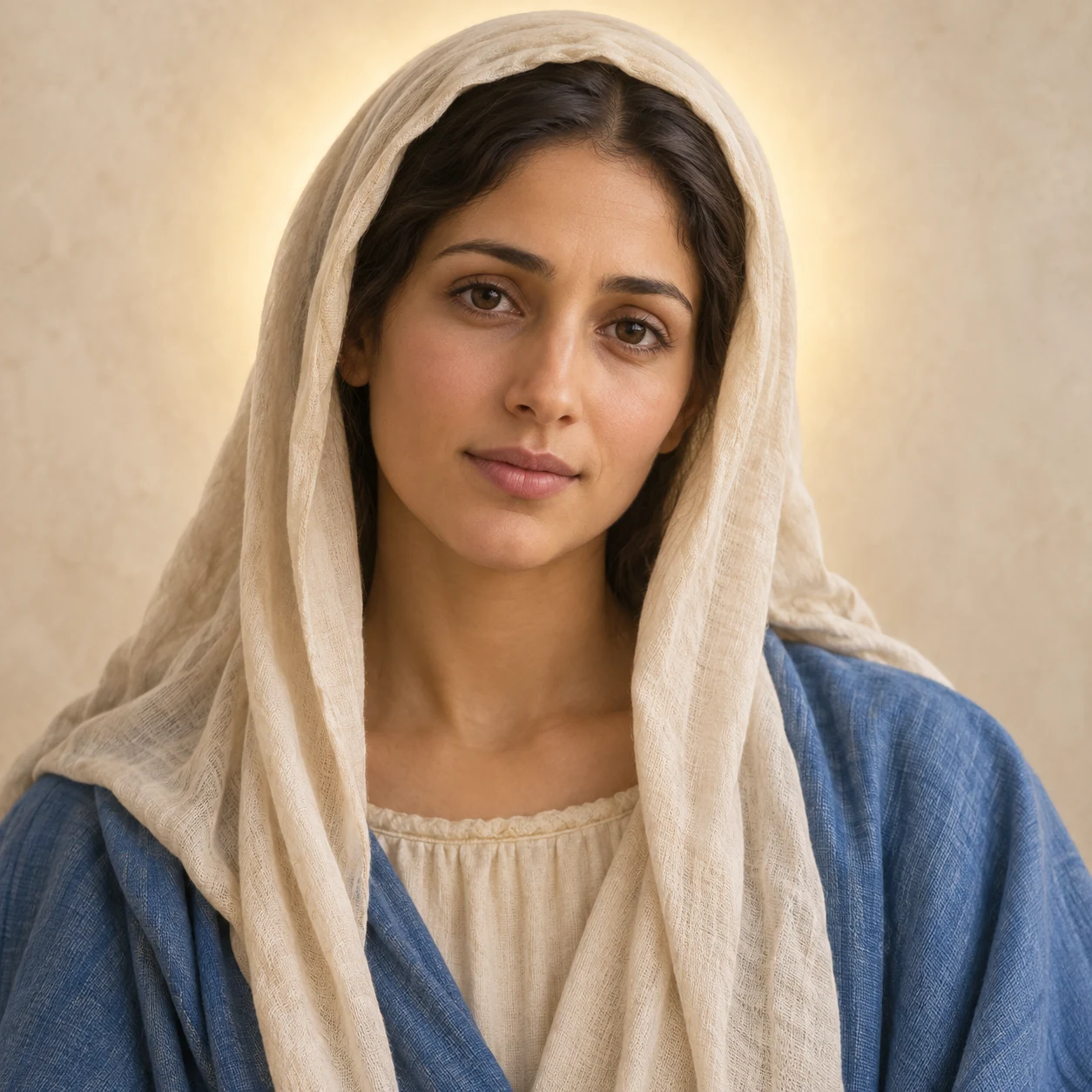
The Virgin Mary
A “Yes” in the midst of ordinary life
Feast day January 1
Tap to step inside
The Virgin Mary
A “Yes” in the midst of ordinary life
Map of a life
This life told in 8 chapters
Begin the journey OpeningOpening1 min
 Chapter 1 of 8The girl from Nazareth2 min
 Chapter 2 of 8Setting out in haste, and the song of the lowly2 min
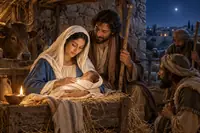 Chapter 3 of 8A winter night in Bethlehem, and a sorrow foretold in the Temple2 min
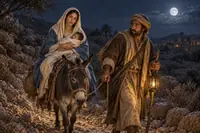 Chapter 4 of 8A flight in the night, and the years in Nazareth1 min
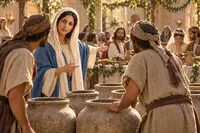 Chapter 5 of 8Cana: a mother’s tact1 min
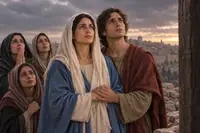 Chapter 6 of 8Standing firm at the foot of the Cross1 min
 Chapter 7 of 8Mother at the heart of the early Church, and the day she was taken to heaven1 min
 Chapter 8 of 8The Mother in the heart of Vietnam2 min
Feast day
Mary, Mother of God
A solemnity in the Roman calendar; the calendar in Vietnam celebrates it on January 1
January 1
SolemnityOther feast days
- Our Lady of Lourdes · February 11
- The Annunciation · March 25
- Our Lady of Fátima · May 13
- The Visitation of Mary to Elizabeth · May 31
- The Assumption of Mary · August 15
- The Nativity of Mary · September 8
- Our Lady of Sorrows · September 15
- Our Lady of the Rosary · October 7
- The Presentation of Mary · November 21
- The Immaculate Conception · December 8
Patron of
- Mother of the Church (proclaimed by Paul VI in 1964)
- All Christians, especially mothers and families
- Many countries, dioceses and parishes around the world, including Vietnam with Our Lady of La Vang
Often depicted with
- A blue mantle and white veil
- A crown of twelve stars
- White lilies and the Rosary
- Crushing the serpent’s head
Opening
Opening
People have always raised monuments and carved statues to emperors who held armies and whole lands in their hands. But when God chose to enter the world, He came in through the door of a simple mud-brick house in a village few had ever heard of, where a country girl knelt in prayer beside an oil lamp.
That young woman had no silks to welcome her, no cheering escort when she stepped out of her door. The only thing she had to offer God was a heart with no hidden agenda, a trust that asked for no proof, and a reply as soft as a breath — yet it turned the whole of human history in a new direction.
She was Mary — mother of the Savior, and mother of each one of us.
To understand her, we cannot simply stand far off and gaze at her on a splendid throne. We have to walk beside her along each dusty road:
- a teenage girl’s bewilderment before a future beyond anything she could imagine;
- days on foot over mountain slopes to help a relative in need;
- a freezing winter night giving birth in a stable far from home;
- footsteps fleeing through the dark night in fear of a tyrant;
- and an afternoon standing frozen at the foot of the cross, watching her son die.
She lived a fully human life of flesh and blood. She knew tears and gnawing worry, yet above all she held fast to her trust in God’s love.
Chapter 1 of 8
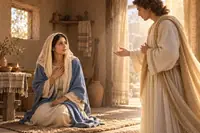
The girl from Nazareth
Saint Luke takes the reader back to Galilee at the end of the first century before Christ. Nazareth then was just a small, poor village tucked away in a limestone valley among the hills of Lower Galilee — so small that a man of the time, hearing the name, blurted out: “Can anything good come from Nazareth?” Later excavations showed that it really was a modest settlement of a few hundred people, living mainly by farming and a little handicraft: nothing any Roman historian would have bothered to record.
In that plain setting lived a Jewish virgin named Mary. Church tradition remembers her as the daughter of a devout couple, Joachim and Anne. Scripture gives no date for her birth, but from ancient times the liturgy has celebrated the Nativity of Mary on September 8, like a gentle dawn announcing that the Sun of Justice is about to rise.
As was the Jewish custom, Mary was betrothed to Joseph, a righteous builder of the line of King David, though by then that line was only a name, with no ties left to any throne. The young woman’s life seemed set to pass as quietly as that of any village girl: weaving cloth, fetching water from the village well, waiting for the day she would go to her husband’s house and keep a small home.
Then one day, something immense broke into that quiet life. The angel Gabriel appeared and spoke a strange greeting:
“Rejoice, you who are full of grace, the Lord is with you.”
Mary was troubled and wondered what the greeting could mean. The angel reassured her and told her that she would conceive and bear a son, and name him Jesus; he would be called Son of the Most High, and his reign would have no end.
Before a mystery so great, Mary did not pretend she understood it all. She asked, very honestly, very humanly: “How can this be, since I have not known a man?” The angel explained that the Holy Spirit would come upon her and the power of the Most High would overshadow her, “for nothing is impossible with God,” and added that her cousin Elizabeth, though old and long childless, was now six months pregnant.
Mary bowed her head and answered:
“Yes, here I am, the servant of the Lord; let it be done to me as you have said.”
One short sentence, yet it set human history on a new course. She did not ask God to guarantee in advance that all would go smoothly. She accepted the call with all the fragility of an unmarried girl, knowing full well that an unexplained pregnancy could, under Jewish law, get her stoned to death, or at the very least leave her living the rest of her life amid the whispers of the whole village. She still said “yes,” not because she knew no fear, but because her trust in the One who had spoken to her was greater than all those fears.
Chapter 2 of 8
Setting out in haste, and the song of the lowly
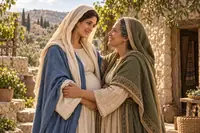
Right after the Annunciation, Mary did not shut her door and sit at home taking pride in the favor she had received. Nor did she sink into her own thoughts. Hearing that her cousin Elizabeth needed help, Mary set out in haste toward the hill country of Judea.
It was not a short journey. From Nazareth to Ain Karim, the village where Zechariah and Elizabeth lived in the hills west of present-day Jerusalem, was more than a hundred kilometers, across the hills of Samaria and then up onto the Judean highlands, some four hundred meters higher than Nazareth. For a young woman, perhaps a few weeks pregnant, walking or riding a donkey over rough stony roads in the Middle Eastern sun, it was a hard journey lasting several days. But love does not shrink from a long road.
As soon as she crossed the threshold of Zechariah’s house, Mary’s greeting made the child in Elizabeth’s womb leap for joy. Filled with the Holy Spirit, Elizabeth cried out: “Blessed are you among women, and blessed is the child you carry.” Then, in wonder:
“Why am I so favored that the mother of my Lord should come to me?”
In reply, Mary began to sing the song we now call the Magnificat. She kept no glory for herself:
“My soul proclaims the greatness of the Lord, my spirit rejoices in God my Savior, for He has looked upon His lowly servant...”
That song is the heart’s cry of the poor who belong to God — those Scripture calls the Anawim: the Almighty has cast down the proud from their thrones, lifted up the lowly, filled the hungry with good things and sent the rich away empty.
Mary stayed with Elizabeth about three months, helping with the shopping and the cooking until her cousin had safely given birth, and only then returned to Nazareth. No record tells exactly what she did in those three months. Probably very ordinary things: lighting the fire, washing clothes, fanning her aging cousin through labor. But in those ordinary things, love was lived to the full: not in fine words, but in feet that dared to walk a hundred kilometers, and in hands ready to get to work in the kitchen when family needed them.
Chapter 3 of 8
A winter night in Bethlehem, and a sorrow foretold in the Temple
When the time of the birth drew near, a census decree from the Roman emperor forced Joseph and Mary to leave Nazareth and go down to Bethlehem, the ancestral home of David’s line.
The long journey in late pregnancy brought the young mother face to face with a harsh reality: when they arrived, the inn had no room for a poor couple. On a cold winter night in Judea, Jesus gave his first cry in a cave used as a shelter for animals.
Scripture tells it very simply: she wrapped her son in swaddling cloths and laid him in a manger. The Maker of all things entered the world without a warm blanket, without a room sheltered from the wind. Mary warmed the newborn against her own body. That night, the first visitors to worship the Son of God were not princes, but poor shepherds keeping watch over their flocks in the fields. She listened as they told of the angels’ message, and then, as Saint Luke records, “treasured all these things, pondering them in her heart.”
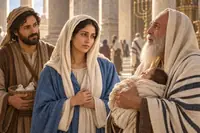
Eight days later the child was circumcised and given the name Jesus. When the time set by the law of Moses was complete, his parents carried him up to the Temple in Jerusalem to present him to God. Their offering was only a pair of young turtledoves, the offering of those who could not afford a lamb.
In the Temple, the devout old man Simeon took the child in his arms and praised God for the salvation of all peoples. But right after that blessing he turned to Mary and spoke words that left the young mother suddenly still:
“This child is destined for the falling and the rising of many... and a sword will pierce your own soul.”
Those words cast a shadow over their new joy. To be the mother of the Savior was not to walk a path strewn with flowers and fame, but to accept a road that would one day tear her heart apart. She did not press for an explanation. She simply kept those words deep in her heart.
Chapter 4 of 8
A flight in the night, and the years in Nazareth
The joy of the birth had barely begun when the storm broke. King Herod, afraid of losing his throne, plotted to find and kill the child. Warned in a dream, Joseph woke Mary in the night, and they carried the little one across the border into Egypt.
A small family adrift in a foreign land, with no relatives and no savings to fall back on. Mary knew all the hardship of a refugee: saving every scrap of bread, gathering every drop of water in a dry land to keep alive a child too small to understand why they had to flee.
When Herod died, the family quietly made their way back to Nazareth. In that little village she spent nearly thirty hidden years. The Gospel records only one event in that long stretch of time: when Jesus was twelve, his parents took him up to the Temple for the Passover, and then lost him for three days. Three days of searching back and forth through crowded streets must have been three days of agony for a mother’s heart. Finding him sitting among the teachers in the Temple, hearing him speak of his duty in his Father’s house, Mary, though she did not fully understand, gently brought him home, and went on “keeping all these things in her heart.”
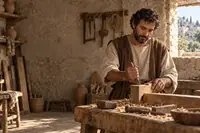
No miracles are recorded in the thirty years at Nazareth. They were thirty years of an ordinary working family’s routine: lighting the fire, grinding flour and baking bread, washing clothes by the stream, teaching the child his first Hebrew prayers and songs, working hard alongside her husband Joseph to raise their son. Her holiness was forged not in great events, but in the daily round of tasks that no one ever noticed.
Chapter 5 of 8
Cana: a mother’s tact
When Jesus began his public life, Mary appears only now and then, but always at the turning points.
At a wedding feast in Cana, a village in Galilee about eight kilometers north of Nazareth (archaeologists still debate whether it was the present-day village of Kafr Kanna or another site nearby), she, Jesus and his disciples were invited to share the celebration. In the middle of the feast, something embarrassing happened: the wine ran out.
In the East, as at Vietnamese weddings too, a wedding without wine for the guests is a deep embarrassment for the newlyweds and for both families. While the hosts were still flustered, not knowing what to do, it was Mary who noticed first. She did not stand aside to gossip or criticize. She quietly went to her son and whispered a few words: “They have no wine.”
It was not a command. It was a plea, full of compassion. Jesus gave a puzzling answer: “Woman, what is that to you and to me? My hour has not yet come.” The reply sounded like a refusal, yet she was not shaken. She turned to the servants and said words that have guided countless generations of believers ever since:
“Do whatever he tells you.”
Six stone jars, the large jars used for the Jewish rites of purification before meals, each holding several dozen liters, were filled with water and turned into fine wine. Jesus’ first miracle happened through his mother’s loving intervention. At Cana she appears exactly like a mother in any family: always watching for her children’s small needs, quietly smoothing over embarrassments before anyone has said a word.
Chapter 6 of 8
Standing firm at the foot of the Cross
Jesus’ mission gradually made its way toward Jerusalem, straight into the shadow of the Passion.
Through all the years her son went about preaching and was acclaimed by the crowds, Mary never appeared to share in the glory or claim any privilege as his mother. But when he was arrested, denied and betrayed by disciples he had trusted, dragged to an unjust trial, flogged until his body was torn, and made to carry the cross up the hill of the Skull amid the jeers and curses of the crowd — she was there.
Saint John wrote just one short sentence, but it has moved generation after generation: “Standing by the Cross of Jesus was his mother...”
She stood there. Scripture does not say she fainted, wailed or cried out in reproach. She stood firm (in Latin, Stabat Mater), though her heart was pierced by the very sword that old Simeon had foretold years before. The one who had once held the tiny body of her baby in the manger at Bethlehem now had to stand and watch her son’s body pierced by iron nails, naked and bloodied on the wood. Every drop of his blood that fell to the ground was a drop of blood seeping from her own heart.
And from the height of the cross, between his last faint breaths, Jesus looked down at his grieving mother and at John, the disciple standing beside her. He spoke his last wish:
“Woman, here is your son.”
Then, turning to John: “Here is your mother.”
From that hour, John took her into his home. And from that hour, Mary’s motherhood opened out to embrace everyone. She was no longer only the mother of Jesus by blood. She became the mother of the whole community of those who believe in her son — and of every suffering human being on earth, even those who have never heard her name.
Chapter 7 of 8
Mother at the heart of the early Church, and the day she was taken to heaven
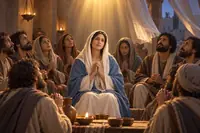
After the Resurrection and the Ascension, the Acts of the Apostles gives us a tender picture: in the upper room in Jerusalem, the Apostles together with some women and Mary were “all of one mind, devoting themselves to prayer” as they waited for the coming of the Holy Spirit.
The mother who had once conceived the Son of God by the power of the Spirit was now present in a young, bewildered community of disciples, a steady presence just as the storm of persecution was beginning. She prayed with them, and perhaps steadied more than a few trembling, frightened souls, so that they found the courage to open the doors and go out into the streets to bear witness to One who had just risen from the dead.
After Pentecost, Scripture tells us nothing more about her last years. Church tradition preserves two memories: some believe she spent her final years in Jerusalem; others say that she went with the Apostle John to live in Ephesus, in ancient Asia Minor — where a small house still stands today on Bülbül hill, believed by many of the faithful to be where she lived at the end of her life.
Wherever it was, the Church believes that her whole life was given to that love. Because she was all-pure, conceived without original sin, and united all her life to the mystery of her own Son’s redemption, when her earthly life was complete, God did not let her body suffer corruption in the earth.
On November 1, 1950, Pope Pius XII solemnly proclaimed the dogma of the Assumption of Mary, body and soul, into heaven, celebrated as a solemnity every year on August 15. Her Assumption does not put her far from us. On the contrary, it gives hope to all of us still on earth: where she has gone, our fragile human nature will one day share in that same glory.
Chapter 8 of 8
The Mother in the heart of Vietnam
In this S-shaped land of Vietnam, perhaps no name is sweeter or dearer to Catholics than “Mẹ Maria,” Mother Mary.
From grand cathedrals in the cities to leaning palm-thatched chapels in remote villages; from family altars wreathed in incense to fishing boats bobbing far out at sea, her image is there, like a mother watching over her own children.
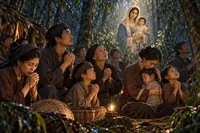
The history of the Church in Vietnam is a long chain of persecutions lasting for centuries. On August 17, 1798, under King Cảnh Thịnh of the Tây Sơn dynasty, an edict against the faith was issued, forcing many Catholics in the Dinh Cát area of Quảng Trị to abandon their homes and flee into the deep forest to escape arrest. In those years of hunger, cold and sickness, according to a belief handed down through many generations, Our Lady appeared to comfort her fleeing children and showed them how to pick a kind of leaf growing nearby, later called “lá vằng,” to brew as medicine. From the name of that plant, the forest where they hid came to be called La Vang, which became one of the largest pilgrimage centers of the Church in Vietnam.
Our Lady of La Vang, Our Lady of Trà Kiệu, Our Lady of Tàpao, Our Lady of Fatima at Bình Triệu — for generations these shrines have been a refuge for millions of pilgrims. Vietnamese people do not come to her mainly to ask for great things. Most often it is a poor mother asking that her child pass an exam, a wife asking that her husband drink less, a sick person asking for strength to endure, or someone far from home asking for a tomorrow a little less hard.
And there is one thread that binds millions of Vietnamese Catholic hearts each evening: the Rosary. Ten calloused fingers moving bead by bead, the Hail Mary rising beside the kitchen fire after a long, tiring day. The Rosary is not a lofty philosophical text. It is the whisper of a child nestled against its mother, turning with her through each page of Jesus’ life, from the manger at Bethlehem to Calvary, and on to the glorious Resurrection.
Mary does not stand far off above the clouds. She passed through almost every shade of joy and sorrow in a human life, from a young girl’s bewilderment before an event beyond understanding, to the hurry of a woman going to help family, to labor pains on a cold night far from home, to the ultimate grief of a mother watching her son die. Perhaps it is because she went through all these very human things that people still come to her today, amid lives full of uncertainty and worry: not as to some distant heavenly being, but like a child coming home to sit beside its mother after a long, exhausting day, where simply sitting there in silence is enough to feel the heart grow lighter.
The end of the story
You have walked with Mary to the end of the story.
Some images will stay with you:
A whispered "yes" in a little house in Nazareth, witnessed by no one, that changed the course of human history.
Young feet crossing more than a hundred kilometers of mountain road, just to be at the side of a cousin who needed a helping hand.
Standing firm, alone, at the foot of the Cross, when everyone else had fled into the dark.
Stay in silence
At the end, one thing lingers: she was never promised a peaceful life. She was promised only one thing: that God would be with her. And she believed, even before she could see anything ahead.
"Yes" is not something said once, but a whole life.
Let us pray
Mother Mary,
you said "yes" in the little house at Nazareth, before you knew what the road ahead would be. Then you hurried over the mountain roads to help your cousin, and stood firm at the foot of the Cross when everyone else had fled.
Teach me to say "yes" on ordinary days: yes when the housework is heavy, yes when my heart does not yet understand God’s will.
Stay beside mothers whose hearts ache for their children, and lead my whole family closer to Jesus, your Son.
Amen.
Sources
- Feast dayCatholic Bishops’ Conference of Vietnam / Vatican
- Patron ofPatronages and symbols, version 1.1
- Often depicted withPatronages and symbols, version 1.1
- Reflectionvatican.va
Meet the next one
 Journey 1