

Journey 6 · Keepers of the Lamp of Faith
Saint Paul VI
The courageous pilgrim of renewal
Feast day May 29
Tap to step inside
Saint Paul VI
The courageous pilgrim of renewal
Map of a life
This life told in 7 chapters
Begin the journey OpeningOpening1 min
 Chapter 1 of 7A son of the cultured land of Brescia1 min
 Chapter 2 of 7Thirty years of service in the Secretariat of State1 min
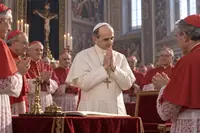 Chapter 3 of 7Steering the ship of the Second Vatican Council1 min
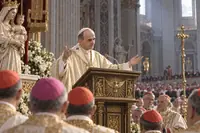 Chapter 4 of 7The first pilgrim Pope in history1 min
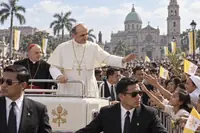 Chapter 5 of 7Two historic encyclicals and the loneliness of a prophet2 min
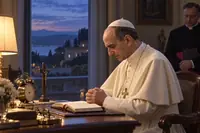 Chapter 6 of 7A bitter cup at the end of his life and the meeting on the hill of Castel Gandolfo1 min
- Chapter 7 of 7A saint of courageous dialogue1 min
Feast day
Saint Paul VI
Some places may celebrate on a slightly different day.
May 29
Often depicted with
- The Pope’s white cassock
- A crozier topped with the crucified Christ
Opening
Opening
One morning in early January 1964, on the Mount of Olives overlooking the old city of Jerusalem, two men in vestments of different colors — one white, one black with the tall cylindrical headdress typical of the Eastern Patriarchs — walked toward each other and embraced as the cameras of the world’s press clicked away. It was the first time since the Council of Florence in 1438 (more than five hundred fifty years) that a Pope of Rome and a Patriarch of Constantinople had stood face to face, not to argue theology, but to exchange an embrace of reconciliation.
That brotherly embrace between Paul VI and Patriarch Athenagoras I seemed to melt part of the wall of ice that had divided the Eastern and Western Churches for nearly a thousand years, since the Great Schism of 1054, when each side excommunicated the other. The Pope who had bravely boarded that historic flight — the first foreign journey by a Pope since the beginning of the nineteenth century — was Paul VI, born Giovanni Battista Montini.
On his far from sturdy shoulders he took up one of the heaviest burdens of the twentieth-century Church: guiding the Second Vatican Council through countless fierce theological debates to a safe harbor, then continuing to steer the ship of the Church through the storm of the cultural and moral crisis after the Council, one of the most turbulent periods in modern Catholic history. He was also the first Pope of modern times to leave Europe, boarding planes to travel all five continents to proclaim the Gospel, opening the way for the worldwide apostolic journeys that his successors would continue and expand still further.
Chapter 1 of 7
A son of the cultured land of Brescia
Giovanni Battista Enrico Antonio Maria Montini was born on September 26, 1897, in Concesio, a small town near the city of Brescia in northern Italy, a region long known for its tradition of Catholic intellectuals committed to social and political life. His father, Giorgio Montini, was a well-known lawyer who also edited a Catholic newspaper and served for a time in parliament. His mother, Giuditta Alghisi, was a devout noblewoman.
Young Giovanni grew up in an intellectual family, absorbing early a sense of social responsibility and a deep love of books and culture. But from childhood his health was very fragile and he was often sick, which made it hard for many at the time to believe that this boy would later carry one of the heaviest burdens the Church has ever entrusted to a human being.
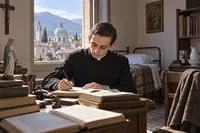
When he entered the seminary of Brescia in 1916, his health was too weak for the strict routine of a boarding seminary, so his superiors made an exception and allowed him to live outside it and study on his own for the exams. On May 29, 1920, he was ordained a priest in Brescia, at only twenty-two.
After his ordination, Father Montini was sent to Rome to study at the Pontifical Gregorian University and the Pontifical Ecclesiastical Academy, the school that trains the Vatican’s future diplomats. One after another he earned doctorates in philosophy, canon law and theology, showing a sharp mind behind his thin, frail frame.
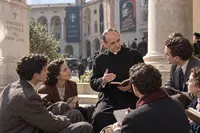
In 1925, he was appointed national chaplain of the Italian Catholic University Federation, known by its initials as FUCI. For eight years alongside those young intellectuals, he taught them how to engage bravely in dialogue with modern culture while holding firm to their faith under ever harsher pressure from Mussolini’s fascist regime, which saw every independent youth organization, Catholic associations included, as a threat to be eliminated.
Chapter 2 of 7
Thirty years of service in the Secretariat of State
In 1924, he began working in the Secretariat of State of the Holy See, roughly the Vatican’s foreign ministry. For thirty unbroken years, from 1924 to 1954, through the pontificates of Pius XI and Pius XII, he gradually became one of the Holy See’s most capable right-hand men, serving as Substitute of the Secretariat of State.
In the dark years of the Second World War, he headed a huge humanitarian relief service of the Vatican: organizing a network to trace millions of missing prisoners of war, coordinating food relief, and, according to many later records, helping to hide thousands of Jews and resistance fighters inside monasteries and buildings belonging to the Holy See, places recognized by international law as neutral territory, out of the direct reach of the Nazi troops occupying Rome. He worked quietly, fourteen to sixteen hours a day, with no thought for personal fame, so that many of his contemporaries knew him only as a diligent official and could not imagine the real extent of the work he was carrying.
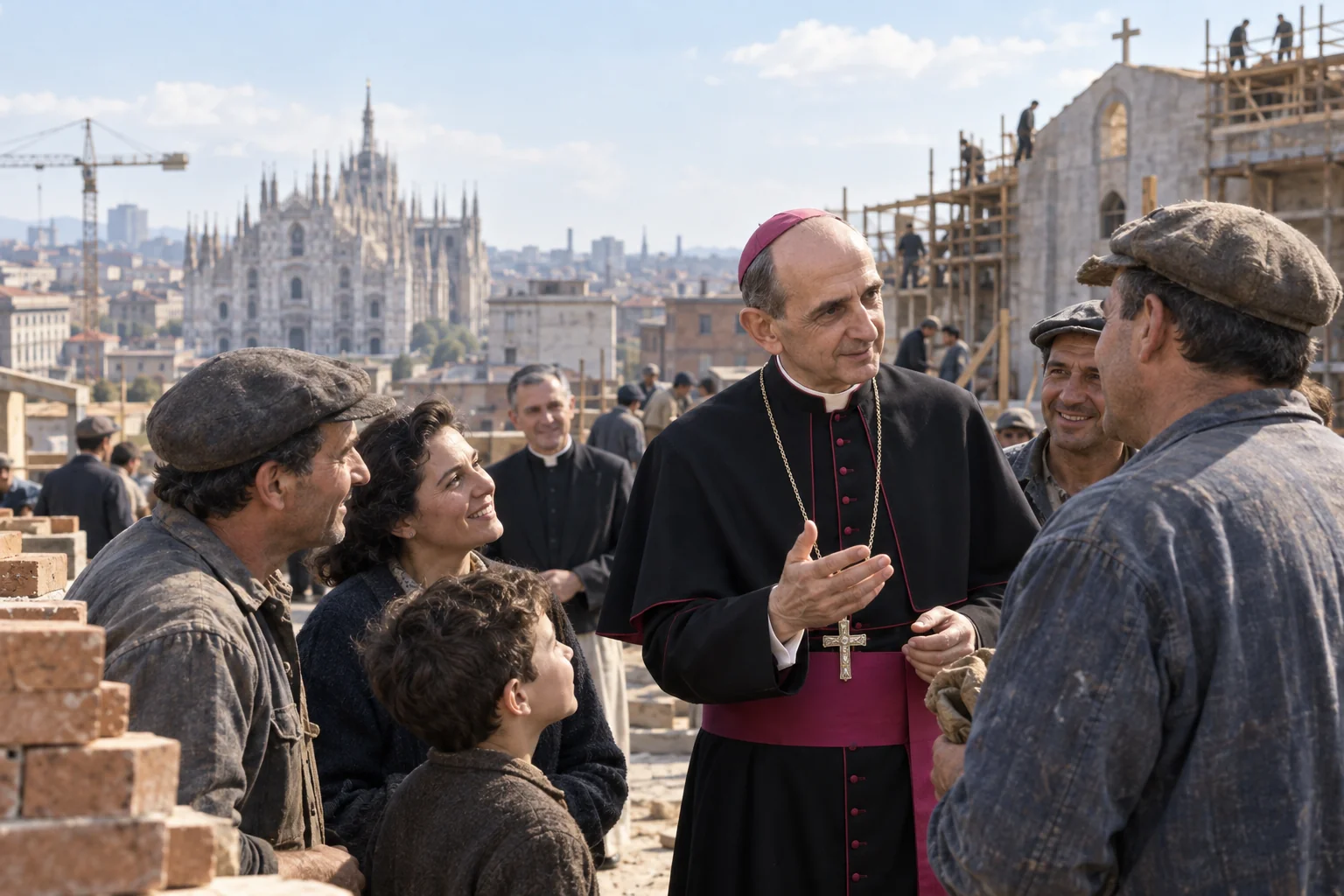
In 1954, Pope Pius XII appointed him Archbishop of Milan, the largest diocese in Italy and home to millions of workers caught up in the tide of industrialization and the growing pull of communism among laborers. Leaving the diplomatic desk he had known for thirty years, he went straight into factories and workshops, even climbing onto construction scaffolding to shake hands with each worker. He had more than a hundred new churches built in the poor industrial areas around Milan, bringing the life of faith closer to workers who felt distant from a Church seen as tied to the upper classes. The people fondly called him “the workers’ archbishop”. In 1958 he was the first cardinal named by John XXIII after his election.
Chapter 3 of 7
Steering the ship of the Second Vatican Council
On June 3, 1963, John XXIII died, when the Second Vatican Council had completed only the first of several planned sessions. A great question hung over the whole Church: would that ambitious work of renewal stall, or even be abandoned altogether, now that the man who began it was gone?
On June 21, 1963, the conclave elected Cardinal Montini. He took the name Paul VI — a name with a clear meaning: to be an apostle going out to all peoples, following the example of Saint Paul long ago. The new Pope’s first act, almost immediately, was to declare that the Second Vatican Council must continue, and must be completed.
With clear judgment, diplomatic skill honed over thirty years in the Secretariat of State, and rare patience, Paul VI steered the Council’s next three sessions through debates that were sometimes fierce between the conservative and progressive tendencies among the bishops, always seeking to reconcile them, protecting the purity of the apostolic faith while opening the door to the pastoral renewal the age was calling for. It was he who guided the voting on and promulgation of the Council’s sixteen historic documents — among them the great Constitutions on the Church (Lumen Gentium), on the Liturgy (Sacrosanctum Concilium), on Revelation (Dei Verbum), and on the Church in the modern world (Gaudium et Spes) — texts that still shape Catholic life today. On December 8, 1965, he solemnly closed the Second Vatican Council; he also proclaimed Mary “Mother of the Church” (Mater Ecclesiae).
Chapter 4 of 7
The first pilgrim Pope in history
Breaking a centuries-old tradition that had kept the Popes almost shut up behind the walls of the Vatican, Paul VI became the first Pope of modern times to board a plane and travel to all five continents. In 1964 he went on pilgrimage to the Holy Land, knelt to kiss the ground where Jesus was born and died, and held the historic meeting with Patriarch Athenagoras I on the Mount of Olives described at the beginning of this story, the first meeting between a Pope and a Patriarch of Constantinople since the Council of Florence in 1438. Also in 1964, he went to Bombay, India, for the International Eucharistic Congress, personally entering the slums to care for the poor.
In 1965 he became the first Pope to address the General Assembly of the United Nations in New York, with a cry that stirred the conscience of a world locked in the Cold War:
“No more war! War never again! Peace must guide the destiny of the peoples!”
He also traveled to Fátima in Portugal, to Colombia in South America, to Switzerland, to Uganda in Africa, and to the Philippines and Australia, turning papal journeys from something unheard of into a normal part of the life of the modern Church. In Manila in 1970, he survived an attempt on his life by a knife-wielding fanatic who had slipped into the crowd, an event few people now remember, overshadowed by greater events of his pontificate.
Chapter 5 of 7
Two historic encyclicals and the loneliness of a prophet
In the sixties, a decade shaken by the sexual revolution and deep social unrest in the West, Paul VI issued two encyclicals whose influence lasts to this day. His 1967 encyclical “Populorum Progressio” (On the Development of Peoples) gave a groundbreaking definition in Catholic social teaching:
“Development is not simply economic growth; true development must be the integral development of the whole person and of every person... Development is the new name for Peace!”
But it was the second encyclical, “Humanae Vitae” (On Human Life), issued in 1968, that truly put him at the center of the fiercest storm of his life. After years of listening, prayer and reflection — including consulting a commission of experts, most of whose members leaned toward relaxing the traditional teaching — he bravely reaffirmed the Church’s position on the sacredness of marriage and of life: forbidding every form of artificial contraception. He also foretold that the normalization of artificial contraception in society would lead to moral decline, the breakdown of the family, and the danger of women being seen as instruments for satisfying desire rather than as whole persons.
That encyclical set off an unprecedented wave of fierce protest within the Western Church itself: many theologians publicly criticized him, not a few priests left the ministry in disagreement, and the secular media attacked him mercilessly, turning him in the public eye from a Pope of renewal, dialogue and peace into the image of a rigid conservative. Paul VI had to endure what his biographers later called a “white martyrdom” — a painful loneliness on his own cross, to defend a truth he believed belonged to the Gospel, knowing in advance the price he would pay in personal reputation.
In 1972, amid those years of crisis, he spoke, in anguish, words that became some of his most quoted: “The smoke of Satan has entered the Temple of God through some crack!” But however painful it was, he never sought to compromise or to withdraw his position. In 1975 he issued the Apostolic Exhortation “Evangelii Nuntiandi” (On Evangelization in the Modern World), with a line that still rings true today:
“Modern people listen more willingly to witnesses than to teachers, and if they do listen to teachers, it is because they are witnesses!”
Chapter 6 of 7
A bitter cup at the end of his life and the meeting on the hill of Castel Gandolfo
In 1978, his cup of sorrow overflowed when Aldo Moro, former Prime Minister of Italy and his close friend for fifty years, was kidnapped by the far-left terrorist group the Red Brigades right in the heart of Rome on March 16, after the five bodyguards accompanying him were shot dead on the spot on Via Fani.
During the fifty-five days Moro was held, Paul VI wrote a heartfelt public letter addressed directly to the kidnappers:
“I write to you, men of the Red Brigades... unknown and implacable enemies of this worthy and innocent man, I beg you on my knees: free Aldo Moro, simply and without conditions.”
He even offered to use the Holy See’s own resources to pay a large ransom in exchange for his friend’s life. But every effort was in vain. On May 9, 1978, Aldo Moro’s body, riddled with bullets, was found in the trunk of a car parked on Via Caetani, only a few steps from the headquarters of the two largest political parties in Italy: a cruelly symbolic gesture by the kidnappers.
The Pope, then eighty, was heartbroken at the funeral Mass for his dear friend. That summer, at the summer residence of Castel Gandolfo, he fell gravely ill with acute pulmonary edema. Lying on his sickbed, he calmly reread the spiritual testament he had written in 1965, as if he had been preparing for this hour for a very long time. On the evening of August 6, 1978, the feast of the Transfiguration, just as the old alarm clock in his room rang to mark the hour of evening prayer, Pope Paul VI died peacefully, at the age of eighty.
In keeping with the humble wish written in his testament, he was buried in a simple grave in the earth beneath the floor of the crypt of Saint Peter’s Basilica, with no splendid monument, only a flat slab of stone engraved with his name, in clear contrast with the elaborate tombs of quite a few of his predecessors.
Chapter 7 of 7
A saint of courageous dialogue
On October 19, 2014, Pope Francis beatified him, at the close of the Synod of Bishops on the Family, a meaningful choice of date, since “Humanae Vitae” itself had been at the center of the controversy over questions of family and life. And on October 14, 2018, Pope Francis himself solemnly canonized Paul VI in Saint Peter’s Square. The Church celebrates him on May 29 each year, the anniversary of his priestly ordination nearly a century earlier.
Saint Paul VI leaves a lesson of courage for the Church in every age: being faithful to Christ does not mean shutting ourselves in out of fear, but daring to step out bravely into dialogue with the world with all our love, as he did when he flew to Jerusalem to embrace an Eastern Patriarch after more than five centuries without such a meeting. But he also taught that amid the storms of history, a disciple must sometimes stand firm beside the Cross alone, daring to accept loneliness and even the misunderstanding of fellow believers, in order to keep the light of truth and the dignity of human life shining, even at the cost of his own good name.
The end of the story
You have walked with Saint Paul VI to the end of the story.
Some scenes you keep turning over:
On the Mount of Olives, he embraced Patriarch Athenagoras I — the first time in more than five hundred years that a Pope and an Eastern Patriarch had stood face to face in reconciliation.
Amid the storm of fierce protest after the encyclical Humanae Vitae, he cried out in pain: "The smoke of Satan has entered the Temple of God through some crack!"
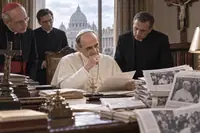
He wrote a letter begging the Red Brigades on his knees to free his close friend Aldo Moro, but every effort was in vain.
Stay in silence
You understand more about the price of courage: some shepherds must stand alone amid the misunderstanding of their own fellow believers, simply to guard a truth they believe belongs to the Gospel.
No more war! War never again! Peace must guide the destiny of the peoples!
Let us pray
Saint Paul VI,
you embraced the Eastern Patriarch, the first such meeting in more than five hundred years, and you stood firm amid so much misunderstanding to hold to what you believed was right.
Pray for the unity of Christians, and for those who must defend the truth alone.
Pray for families, that they may respect life and the dignity of marriage.
Amen.
Sources
- Feast dayAuthor’s edited profile
- Often depicted withPatronages and symbols, version 1.1
- Reflectioncausesanti.va
- Reflectionvatican.va
Meet the next one
 Journey 6