

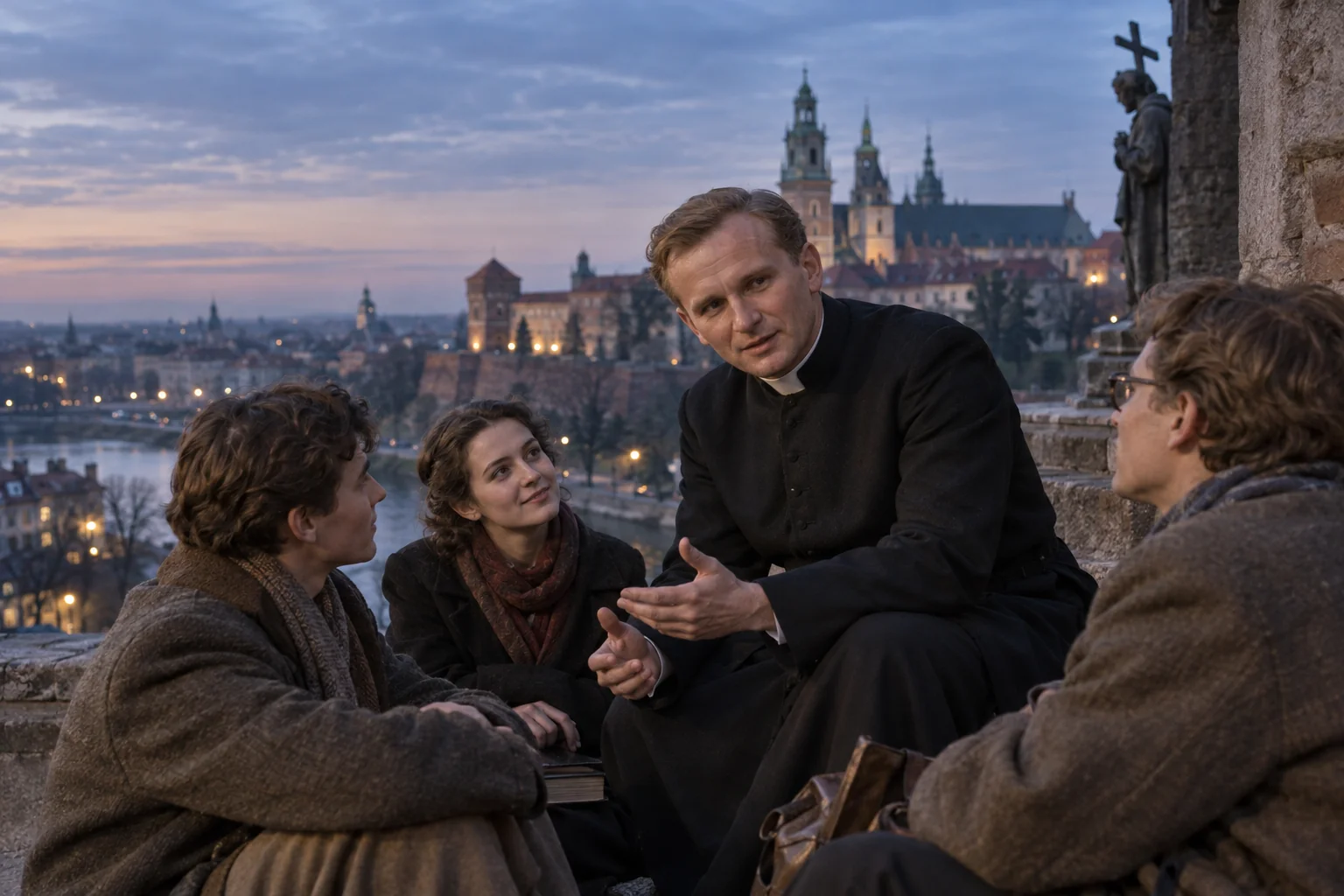
Journey 6 · Keepers of the Lamp of Faith
Saint John Paul II
The tireless pilgrim of hope
Feast day October 22
Tap to step inside
Saint John Paul II
The tireless pilgrim of hope
Map of a life
This life told in 6 chapters
Begin the journey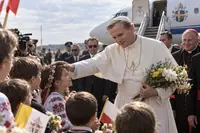 OpeningOpening1 min
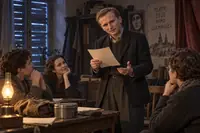 Chapter 1 of 6A childhood in tears in the town of Wadowice2 min
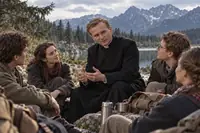 Chapter 2 of 6An underground seminary and the flame of Totus Tuus2 min
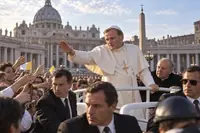 Chapter 3 of 6The bullet of May 13 and an extraordinary forgiveness1 min
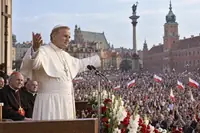 Chapter 4 of 6The fall of the Berlin Wall and World Youth Day1 min
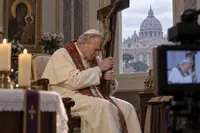 Chapter 5 of 6His final Passion before the television cameras1 min
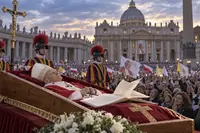 Chapter 6 of 6“Santo Subito!” – Saint of Divine Mercy1 min
Feast day
Saint John Paul II
Some places may celebrate on a slightly different day.
October 22
Patron of
- Young people and World Youth Days
- Families
- The city of Kraków (Poland)
Often depicted with
- A crozier topped with the crucified Christ
- The Pope’s white cassock
Opening
Opening
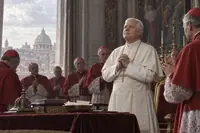
One chilly morning in October 1978, in Saint Peter’s Square, at the Mass that opened his pontificate, a new Pope of fifty-eight, built like an athlete, with bright eyes and a broad smile, stood before a world holding its breath. He was the first non-Italian Pope in four hundred fifty-five years, since the Dutchman Adrian VI in the sixteenth century, and a son of Poland, a country groaning under an atheist communist regime.
He raised his pastoral staff high and called out in a voice that rang like a trumpet, scattering the fears that weighed on the world in the days of the Cold War:
“Do not be afraid! Open, open wide the doors to Christ! Open the borders of nations, political systems and economies to His saving power!”
That call set the tone for the whole pontificate of Pope Saint John Paul II, born Karol Józef Wojtyła: nearly twenty-seven years, the second-longest in the history of the Church. Many of the faithful later called him “John Paul the Great” (Ioannes Paulus Magnus), a title given to very few Popes before him. During his pontificate he made one hundred four international apostolic journeys, set foot in one hundred twenty-nine countries, and traveled more than a million kilometers in all, about thirty times around the earth, to sow hope in the most distant places. He played a decisive part in bringing down the Berlin Wall and the communist dictatorships of Eastern Europe without a shot being fired. He founded World Youth Day, and his name is closely linked with devotion to Divine Mercy and to Our Lady.
Chapter 1 of 6
A childhood in tears in the town of Wadowice
Karol Józef Wojtyła, whom his family called Lolek, was born on May 18, 1920, in the small town of Wadowice, about fifty kilometers southwest of Krakow, Poland. The house where he was born stood on the town’s main square, just a few steps from the basilica, a fitting picture of the deep faith in which the boy grew up. His father, also named Karol, was a model non-commissioned officer in the army, strict but full of love; his mother, Emilia Kaczorowska, was a devout woman.
But Lolek’s childhood was a chain of losses such as few children ever know. When he was nine, his mother died. Three years later his only brother, Edmund, a doctor whom Lolek looked up to, died of scarlet fever caught while caring for patients during an epidemic. Then, when Karol was twenty, his beloved father, the only family he had left, died suddenly in a cold rented room in the middle of winter. The young man knelt beside his father’s body all night, sobbing, knowing he was now completely alone in the world, without a single close relative left.
In 1938, Karol went to study Polish philology and philosophy at the famous Jagiellonian University in Krakow, one of the oldest universities in Central Europe. He loved theater and poetry, was a gifted amateur actor, and had a deep love for Polish culture that stayed with him all his life, even as Pope.
But in September 1939, Nazi Germany invaded Poland, and the Second World War broke out. The university was forced to close, and many professors were arrested and sent to concentration camps. To avoid being deported to Germany for forced labor, the fate of a great many young Poles at the time, Karol worked as a laborer in the Solvay limestone quarry and later in a chemical factory of the same name. Hands used to pens and books now swung a sledgehammer, breaking stone in the bitter Polish winter. Those years of hard, anonymous labor taught him the worth of sweat and the dignity of the worker, the ground of much of the social teaching he would write decades later.
Chapter 2 of 6
An underground seminary and the flame of Totus Tuus
In 1942, after his father’s death, and as he saw many of his Jewish friends taken away to death camps such as Auschwitz, Karol decided to knock at the door of a secret major seminary in Krakow, run by Archbishop Adam Sapieha in his own residence. It was a very dangerous step, since the German occupiers had outlawed the training of Polish priests. By day the young man went to work in his laborer’s clothes; by night he studied theology in secret by the light of an oil lamp, in constant danger of discovery. Once he was hit by a German military truck and nearly died, yet he survived in a way that is hard to explain.
It was in these dangerous years, under the guidance of a lay tailor named Jan Tyranowski (a man almost unknown to history, but a deep spiritual influence on a whole generation of young people in Krakow), that Karol read “True Devotion to Mary” by Saint Louis-Marie de Montfort. The book changed him deeply. He consecrated his whole life to Our Lady and took as his motto two Latin words the whole world would later know: “TOTUS TUUS”, “Totally yours”.
On November 1, 1946, Karol Wojtyła was ordained a priest in Krakow. He was sent to Rome to continue his studies and brilliantly defended a doctoral thesis in theology on faith in Saint John of the Cross; later he completed a second thesis, in philosophy.
Back in Poland, his first assignment was as curate in the parish of Niegowić, a poor village about twenty-four kilometers from Krakow. It is said that when he arrived, right at harvest time, his first act was not to go into the rectory but to kneel and kiss the ground where he was to serve, a humble gesture he would repeat many times as Pope on arriving in countries around the world. He taught ethics at the Catholic University of Lublin, and quickly became a friend to university students. He went camping, kayaking and mountain climbing with them (on those trips, they recall, an upturned kayak sometimes served as an altar for Mass in the open air), and he talked with them about love, marriage and family. Those conversations laid the foundation for one of his most influential later works, the Theology of the Body.
In 1958, at thirty-eight, he was consecrated auxiliary bishop of Krakow, the youngest bishop in Poland at the time. In 1964, he succeeded as Archbishop of Krakow, and in 1967 he was made a cardinal. He took an active part in the Second Vatican Council, contributing key ideas to the Constitution Gaudium et Spes on the Church in the modern world. With rare wisdom and steadfastness, he led the Church in Poland to stand firm against the subtler persecution of the communist regime: not open repression as in the Nazi years, but systematic control, surveillance and obstruction.
Chapter 3 of 6
The bullet of May 13 and an extraordinary forgiveness
On October 16, 1978, he was elected the two hundred sixty-fourth Pope.
Then came the afternoon of May 13, 1981, which shook the whole world. As the open car carrying the Holy Father moved through the crowd in Saint Peter’s Square, as it did at every general audience, the Turkish professional gunman Mehmet Ali Ağca drew a pistol and fired four shots at point-blank range. Two bullets tore through his abdomen and his arm, and blood soaked his white cassock. He collapsed into the arms of his private secretary, Stanisław Dziwisz, amid the horrified screams of the sea of people watching.
He was rushed to the Gemelli Hospital in critical condition; his heart had almost stopped and his blood pressure was close to zero. After surgery lasting more than five hours, he was saved in a way that many of the doctors involved still call miraculous: the bullet had missed the main artery by just a few millimeters.
The attempt on his life had happened on May 13, the anniversary of Our Lady’s first appearance at Fátima, and the Pope was deeply convinced:
“One hand fired the shot, but another, a Mother’s Hand, guided the bullet!”
In 1984 he gave that very bullet to the Shrine of Fátima in Portugal, and in 1989 it was set in the crown of the statue of Our Lady venerated there, as a visible act of thanksgiving.
Then came a gesture straight from the Gospel. From his hospital bed, he said that he forgave the man who had tried to kill him. On December 27, 1983, he personally walked into Ali Ağca’s cell in Rebibbia prison in Rome. The two men sat side by side in a small room; he held the hand of the man who had shot him, listened to what he wanted to say, and embraced him as a father. The photograph of the Pope talking quietly with his would-be assassin became one of the most powerful images of Christian forgiveness of the twentieth century.
Chapter 4 of 6
The fall of the Berlin Wall and World Youth Day
In 1979, his first journey back to Poland lit a longing for freedom in the heart of a whole nation living under communism. Standing before millions of his countrymen in Victory Square in Warsaw, he spread his arms and prayed words that would echo for years afterward:
“Let Your Spirit descend and renew the face of the earth... the face of this land!”
That journey helped spark the birth of the Solidarity trade union, led by Lech Wałęsa at the Gdańsk shipyard, just a year later. With nothing but moral authority, without violence or direct political pressure, he became one of the decisive forces behind the fall of the Berlin Wall in 1989 and the freeing of hundreds of millions of people from dictatorship across Eastern Europe.
In 1985 he launched something that changed how a whole generation of young people around the world experienced their faith: World Youth Day. Many sociologists were skeptical at first, convinced that modern youth had drifted away from organized religion. Yet millions of young people from every continent poured in to gather around the aging Pope: from Buenos Aires, Santiago and Denver to Manila — where in 1995 more than five million people came, then the largest gathering in human history, and on to Paris, Rome and Toronto. He often told those young people:
“You are the hope of the Church; you are my hope!”
He also promulgated the Catechism of the Catholic Church in 1992, the first complete catechism since the Council of Trent, and wrote fourteen encyclicals of great theological depth. At the Great Jubilee of 2000 he courageously faced the past and publicly asked forgiveness for the wrongs the Church’s own children had committed, something no Pope had ever done on that scale.
Chapter 5 of 6
His final Passion before the television cameras
In his last years, John Paul II suffered from worsening Parkinson’s disease: hands that shook uncontrollably, a halting step, a voice ever more slurred and hard to understand. But he refused to rest or withdraw from public life. He kept appearing before billions of people on television, making no attempt to hide his failing body. That sick body became a living sermon, more eloquent than words, on the dignity of every human life, from conception to the last breath.
On Good Friday 2005, no longer strong enough to go to the Colosseum to lead the Way of the Cross as usual, he was seen on television sitting in his private chapel, holding the cross tightly and resting his forehead against it, a picture of shared suffering that needed no sermon. On Easter Sunday that year, he still made the effort to appear at the balcony of Saint Peter’s Basilica to give the traditional Urbi et Orbi blessing. He tried to speak but could not utter a word; the illness had taken even his voice. He could only raise his trembling hand and make the Sign of the Cross over the crowd, as moved as those who watched him. Many have described it as the greatest silent sermon of his whole pontificate.
On the evening of April 2, 2005, the eve of Divine Mercy Sunday, the feast he himself had established, Pope John Paul II died peacefully at the age of eighty-four. His last words, whispered in his native Polish, were:
“Let me go to the Father’s house!”
Chapter 6 of 6
“Santo Subito!” – Saint of Divine Mercy
His funeral, on April 8, 2005, was like nothing the world had seen: four million pilgrims packed Rome, and more than two hundred heads of state and religious leaders from all over the world gathered beside his coffin. As a strong wind turned the pages of the Book of the Gospels laid on the plain wooden coffin, the crowd raised banners reading “SANTO SUBITO!”: “Make him a saint now!”
On May 1, 2011, Pope Benedict XVI, his successor and for many years his close collaborator, beatified him. On April 27, 2014, Pope Francis canonized John Paul II in Saint Peter’s Square, on the same day as Pope Saint John XXIII. The Church celebrates him on October 22 each year, the day his pontificate was inaugurated in 1978.
Pope Saint John Paul II leaves the world a message of hope, summed up in a saying he often repeated:
“The future starts today, not tomorrow!”
He was the orphan who knelt weeping alone beside the body of his last relative, and the Pope who stood before the whole world with trembling hands and still gave his blessing. He reminds each of us never to let fear paralyze our souls: walk bravely in faith, throw open the door of your heart to Christ, and entrust your whole life to the boundless mercy of God and the gentle care of Mary.
The end of the story
You have walked with Saint John Paul II to the end of the story.
Three moments that are hard to forget:
In the middle of Saint Peter’s Square, four shots from a professional gunman tore through his abdomen and arm, missing the main artery by only a few millimeters.
He walked into the prison cell himself, held the hand of the man who had shot him, and gave him a fatherly embrace of forgiveness.
On his last Easter Sunday, the illness had taken away even his voice; he could only raise his trembling hand to bless the crowd with the Sign of the Cross, as they wept with him.
Stay in silence
You see how deep forgiveness can go: a man who once knelt weeping beside his father’s body in utter loneliness later taught the whole world how to embrace the very man who had tried to kill him.
Do not be afraid!
Let us pray
Saint John Paul II,
you went into the prison yourself and held the hand of the man who had shot you, and forgave him. And at the end of your life, when you could no longer speak, you still raised your trembling hand to bless.
Pray for young people, that they may not be afraid, as you always said: "Open wide the doors to Christ."
Teach me to forgive those who have hurt me, and to accept old age and illness in peace.
Amen.
Sources
- Feast dayAuthor’s edited profile
- Patron ofPatronages and symbols, version 1.1
- Often depicted withPatronages and symbols, version 1.1
- Reflectionvatican.va
- Reflectionvatican.va
Meet the next one
 Journey 6