

Journey 8 · Faith with a Vietnamese Face
Saint Paul Lê Bảo Tịnh
A seminary rector and a letter written in blood from prison
Feast day April 6
Tap to step inside
Saint Paul Lê Bảo Tịnh
A seminary rector and a letter written in blood from prison
Map of a life
This life told in 6 chapters
Begin the journey OpeningOpening1 min
 Chapter 1 of 6A boy from the village of Trinh Hà1 min
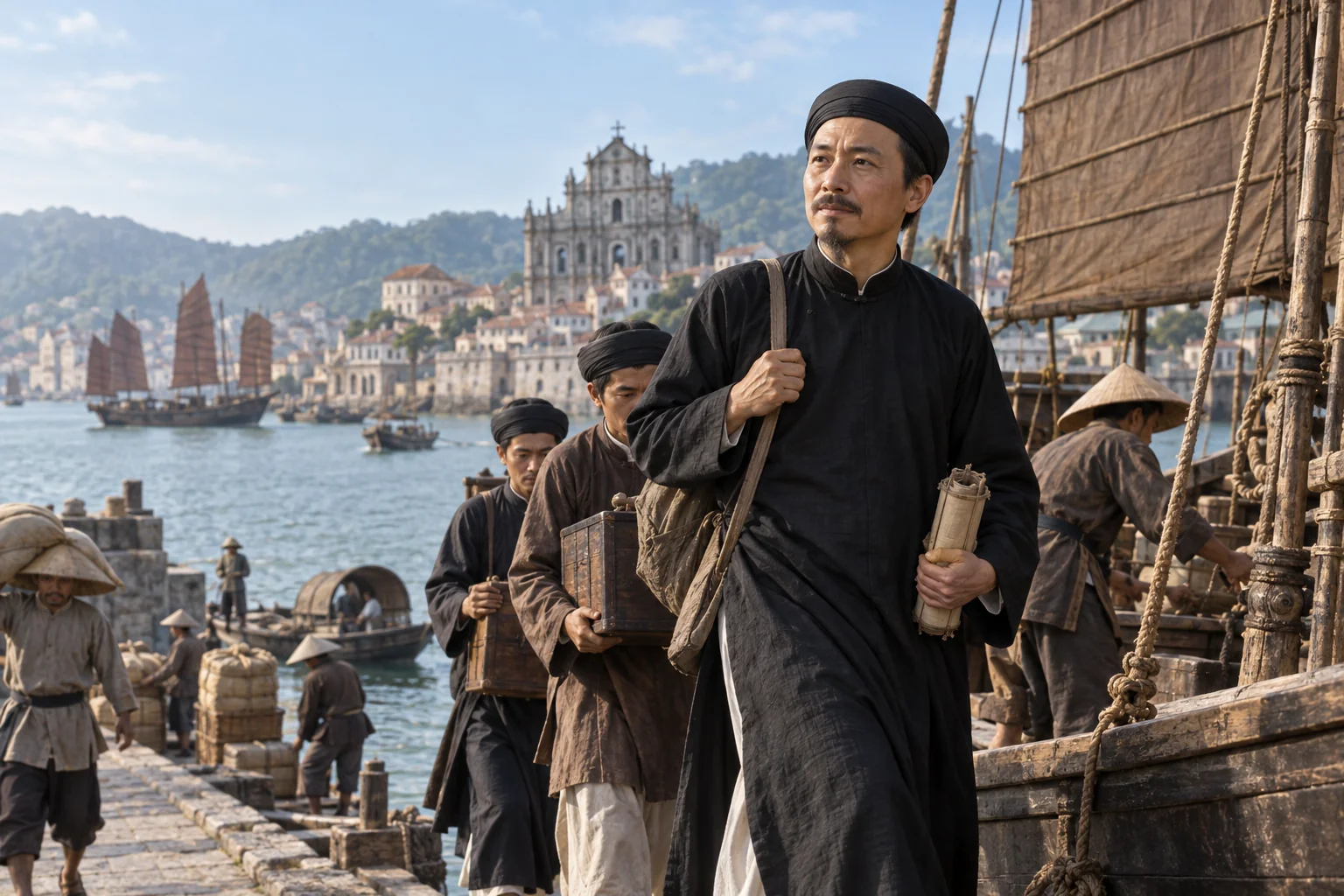
 Chapter 2 of 6A mission to Macau and years in prison with no release in sight1 min
 Chapter 3 of 6Rector of the Seminary of Vĩnh Trị1 min
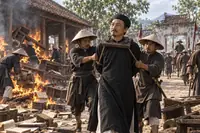 Chapter 4 of 6The raid on Vĩnh Trị and the sentence of beheading1 min
 Chapter 5 of 6The day of triumph at the execution ground of Bảy Mẫu1 min
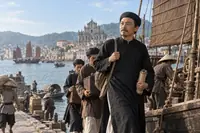 Chapter 6 of 6The patron saint of seminaries1 min
Feast day
Saint Paul Lê Bảo Tịnh
Some places may celebrate on a slightly different day.
April 6
Often depicted with
- A palm branch
- A cangue and chains
- A letter written in prison
Opening
Opening
In the spring of 1843, in a corner of a damp cell in the prison of Hà Nội, a fifty-year-old catechist sat bent over a flickering oil lamp. A heavy wooden cangue pressed on his neck and shoulders, and iron chains bound his legs. But his eyes shone with a light that did not belong to the darkness around him. With a worn-down brush he carefully wrote, line after line, a letter in Latin to his seminarians.
“This prison is truly a living image of the eternal hell,” he wrote. “It is full of chains, cangues, floggings, shouts and curses, filth and death. And yet, right in the middle of this hell on earth, the living God is still with me. He turns the dark prison into a paradise of joy. I write these lines to you from prison to encourage you to stand firm in the faith... Carry the Cross of Christ with me.”
That letter, written in almost unimaginable conditions, came to be seen by many as one of the most heroic pieces of spiritual writing in the history of the Church in Vietnam. Its author was Father Paul Lê Bảo Tịnh, Rector of the Seminary of Vĩnh Trị and one of the finest classical scholars in the Church of northern Vietnam in the nineteenth century. He went through more than seven years of imprisonment under two emperors before shedding his blood at sixty-four.
Chapter 1 of 6
A boy from the village of Trinh Hà
Lê Bảo Tịnh was born in 1793 in the village of Trinh Hà, Hoằng Hóa district, Thanh Hóa province — a coastal region in the center of the country, where salt fields mingle with rice paddies and where a Catholic community took root quite early. His father, Paul Lê Bảo Ngôn, was a Confucian scholar respected in the area for his virtue; his mother, Maria Nguyễn Thị Thanh, kept a devout home. Tịnh was the third child in a family with a long tradition of Confucian learning.
From childhood Tịnh had a rare sharpness of mind. Taught by the best scholars of the area, he mastered the Four Books and Five Classics and wrote verse in classical Chinese with ease. At twelve he went to live with a priest in the parish of Bạch Phát to learn Latin and test his vocation. Three years later, seeing his gifts, his superiors sent him to the Seminary of Vĩnh Trị, and soon afterward he became a catechist.
But the young Paul Tịnh had an unusual longing: while his classmates were heading toward the priesthood in the usual way, he wanted a life of complete austerity. With the permission of Bishop Havard (whom the Vietnamese called Đức cha Du), he took a little dry rice and withdrew to a lonely cave on Mount Bạch Bát, in what is now Ninh Bình, to live as a hermit for a whole year, fasting, wearing rough cloth, praying day and night and studying the Word of God alone amid the silent mountains and forests.
That year alone in the cave, cut off from every comfort and even from the support of a community, gave him an iron will and a deep inner life. It was what would carry him through his long years of imprisonment later on, when there would be no cave to withdraw to, only the four walls of a dark cell.
Chapter 2 of 6
A mission to Macau and years in prison with no release in sight
In 1837, with Emperor Minh Mạng’s persecution at its height, Bishop Havard gave the catechist Paul Lê Bảo Tịnh a dangerous mission: to travel secretly to Macau, make contact with the mission house there, and bring back funds and letters for a vicariate that was completely cut off. The slightest slip could cost him his life, to say nothing of the dangers at sea and in a foreign land. With good sense and courage, Tịnh carried out the mission and returned home safely in 1838.
But in the winter of 1841, while teaching catechism to new converts in the parish of Thạch Tổ, in the Kẻ Đầm area of Hà Nam, he was arrested by the village headman himself and handed over to the soldiers, who took him to the prison in Hà Nội.
The mandarins tortured him savagely: hundreds of strokes of the rattan, iron pincers tearing at his flesh, attempts to force him to step on the Cross. Paul Tịnh answered only:
“I would rather have my bones broken and my flesh crushed than ever offend the Cross of my Lord.”
Emperor Thiệu Trị’s court sentenced him to death by beheading.
But the sentence was not carried out at once. Tịnh was held in the dark prison of Hà Nội for more than seven long years, from 1841 to 1847, waiting for an execution day that never came. In 1847, as he was being taken with other prisoners to Huế to be sent into exile in Phú Yên and Bình Định, something unexpected happened: Emperor Thiệu Trị died. Emperor Tự Đức succeeded him and granted an amnesty to some prisoners. Tịnh was released just before his exile began, escaping both death and exile by a hair’s breadth after years of not knowing what tomorrow would bring.
He returned to the Seminary of Vĩnh Trị, where he had studied as a youth, now fifty-four years old, his hair white from the years in prison.
Chapter 3 of 6
Rector of the Seminary of Vĩnh Trị
Around 1848, Bishop Retord — whom the Vietnamese called Đức cha Liêu, the famous Vicar Apostolic of Western Tonkin — saw in Tịnh a rare combination of learning and virtue and decided to ordain him a priest, though he was by then over fifty, a late age for ordination in those days.
Right after his ordination, Bishop Retord gave Father Paul Tịnh a heavy responsibility: rector of the major seminary of Vĩnh Trị, now in Yên Trị commune, Ý Yên district, Nam Định province — the largest place of priestly formation in the North at that time, with more than two hundred seminarians studying at once.
In nearly ten years as rector, Father Paul Lê Bảo Tịnh led the seminary through what many later called its golden age. He was a model teacher, himself teaching Chinese characters, Latin, philosophy and theology in a way that was both learned and easy to follow. Drawing on the classical learning of his youth and on his years of trial in prison and at sea, he compiled catechisms in Nôm script, among them the “Sách Bổn Cả,” which set out the catechism in plain language, and the “Phép Dọn Mình Rước Lễ,” on preparing for Holy Communion. These books nourished the faith of Catholics in the North for decades.
He lived as poorly as the seminarians he was forming, ate sparingly, and spent many sleepless nights before the Blessed Sacrament praying for each of his students. He often reminded the seminarians of something his own life had proved: a future priest must be a man of broad learning, but above all a man in love with the Eucharist, ready to climb Calvary and die for his flock.
Chapter 4 of 6
The raid on Vĩnh Trị and the sentence of beheading
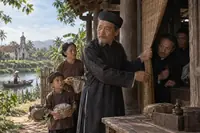
At the beginning of 1857, egged on by some hostile local officials, a mandarin led thousands of royal troops in a sudden raid on the village of Vĩnh Trị. To give the more than two hundred seminarians time to escape into the marshes behind the seminary, Father Paul Lê Bảo Tịnh calmly put on his black cassock and stood at the seminary door, waiting for the soldiers instead of hiding.
The soldiers rushed in and tied him up, wrecked most of the seminary and burned its books and papers, probably including many of his own manuscripts. Then they put a cangue on his neck and took him to the prison in Nam Định.
At the court in Nam Định, the governor and his officials questioned him in person. They were astonished by the old priest’s composure and dignity and by the brilliance of his answers in classical Chinese. They tried both flattery and lavish promises: a ministerial post at court with a generous income, if only he would give up the priesthood and step over the cross.
Father Paul Lê Bảo Tịnh raised his head and answered:
“Your Excellencies, all my life, from my youth until my hair turned white in prison, I have worshiped only God, the common Father of all creatures. I have taught thousands of students to live honestly, to be loyal to the king and his officials and to love their fellow countrymen. I gave this old body to God long ago; if you wish to behead me, go ahead, but I will never betray my faith.”
Unable to shake him, the officials sent the case to the court, and Emperor Tự Đức signed the sentence of beheading.
Chapter 5 of 6
The day of triumph at the execution ground of Bảy Mẫu
At noon on April 6, 1857, the sentence was carried out at the execution ground of Bảy Mẫu, outside Nam Định. The procession passed through the main streets of the town. Father Paul Lê Bảo Tịnh walked with his head high, his face shining with a joy the onlookers could not explain, as if he were coming home from a victory rather than walking to his death.
At the place of execution he knelt on a patterned mat and joined his hands in a last prayer, commending to God not only himself but the whole Church and the seminarians he had left behind. After three strokes of the gong, the sword came down. So ended the life of the sixty-four-year-old rector, years of which had passed in cangues and prisons, and much of the rest in forming new generations of priests.
Catholics bravely took his body and buried it beneath the floor of the church of Vĩnh Trị, the place to which almost the whole of his short but remarkable priesthood had been given. In 1880 his remains were moved to the cathedral of Sở Kiện in Hà Nam.
Chapter 6 of 6
The patron saint of seminaries
On May 2, 1909, Pope Pius X beatified Father Paul Lê Bảo Tịnh. And on June 19, 1988, Pope John Paul II canonized him, together with one hundred sixteen other Vietnamese Martyrs, in Rome. The Church celebrates him on April 6 each year.
Few of the Vietnamese Martyrs left writing in their own hand from prison, as Father Paul Lê Bảo Tịnh did. His letter from that dark prison, calling it an image of hell yet insisting that God had turned that very place into paradise, was not polished at leisure. It was written by a man with a cangue around his neck who did not know how many days he had left. Perhaps it is precisely because it could not have been faked that those lines still carry weight today. They remind us that however dark and suffocating the place life pushes us into, there is always a gap wide enough for the light to get in, if we are willing to believe that we are not alone there.
The end of the story
You have walked with Saint Paul Lê Bảo Tịnh to the end of the story.
Three stages of his life fill you with admiration:
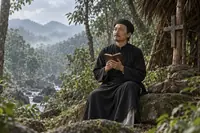
As a young catechist he asked to withdraw to a lonely cave for a whole year to live as a hermit, forging a will that would carry him through more than seven years of imprisonment later.
After seven years in prison under sentence of death, he was freed by an unexpected amnesty just before his exile was to begin.
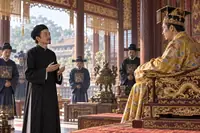
From his cell he wrote to the seminarians: "This prison is truly a living image of the eternal hell... And yet, right in the middle of this hell on earth, the living God is still with me."
Stay in silence
You understand what he wanted to tell us from his dark prison: however dark and suffocating the place life pushes a person into, there is always a gap wide enough for the light to get in.
This prison is truly a living image of the eternal hell; and yet, right in the middle of this hell on earth, the living God is still with me.
Let us pray
Saint Paul Lê Bảo Tịnh,
in the midst of your years of imprisonment, you still wrote from your cell that in the midst of that darkness, the living God was still with you.
Pray for those who are imprisoned, and for those living in suffocating situations with no way out.
Pray for seminarians and for the priests who teach in seminaries.
Help me believe that however dark life may be, there is still a gap through which God’s light can enter.
Amen.
Light a candle for Saint Paul Lê Bảo Tịnh
Sources
- Feast dayAuthor’s edited profile
- Often depicted withPatronages and symbols, version 1.1
- Reflectiongiaophanbaria.org
- Reflectionchungvienthanhhoa.net
Meet the next one
 Journey 8