

Journey 8 · Faith with a Vietnamese Face
Saint Andrew Nguyễn Kim Thông
A canton chief of patient endurance and a death on the road to exile
Feast day July 15
Tap to step inside
Saint Andrew Nguyễn Kim Thông
A canton chief of patient endurance and a death on the road to exile
Map of a life
This life told in 6 chapters
Begin the journey OpeningOpening1 min
 Chapter 1 of 6A son of the coconut country of Gò Thị1 min
 Chapter 2 of 6A firm pillar of the Church in Cochinchina1 min
 Chapter 3 of 6Betrayal and the day of his arrest1 min
 Chapter 4 of 6The old official’s noble spirit before the court2 min
 Chapter 5 of 6The last journey and a meeting in Bình Thuận1 min
- Chapter 6 of 6A model canton chief among the saints1 min
Feast day
Saint Andrew Nguyễn Kim Thông
Some places may celebrate on a slightly different day.
July 15
Often depicted with
- A palm branch
- Bare feet on the road to exile
Opening
Opening
In the summer of 1855, a small column trudged south along the long road that ran the length of the country. Among the soldiers with their swords and spears walked an old man of over sixty, once upright and vigorous, now bent by the road and by hunger, his bare feet bleeding from the stones.
A heavy wooden cangue weighed on his neck and shoulders, and iron chains clanked on his legs with every step. His coarse brown tunic was in tatters from the floggings at the courthouse months before. Whenever he collapsed from exhaustion, the soldiers’ rattan whips came down until he struggled to his feet and walked on, not because they hated him, but because their orders had to be carried out on time.
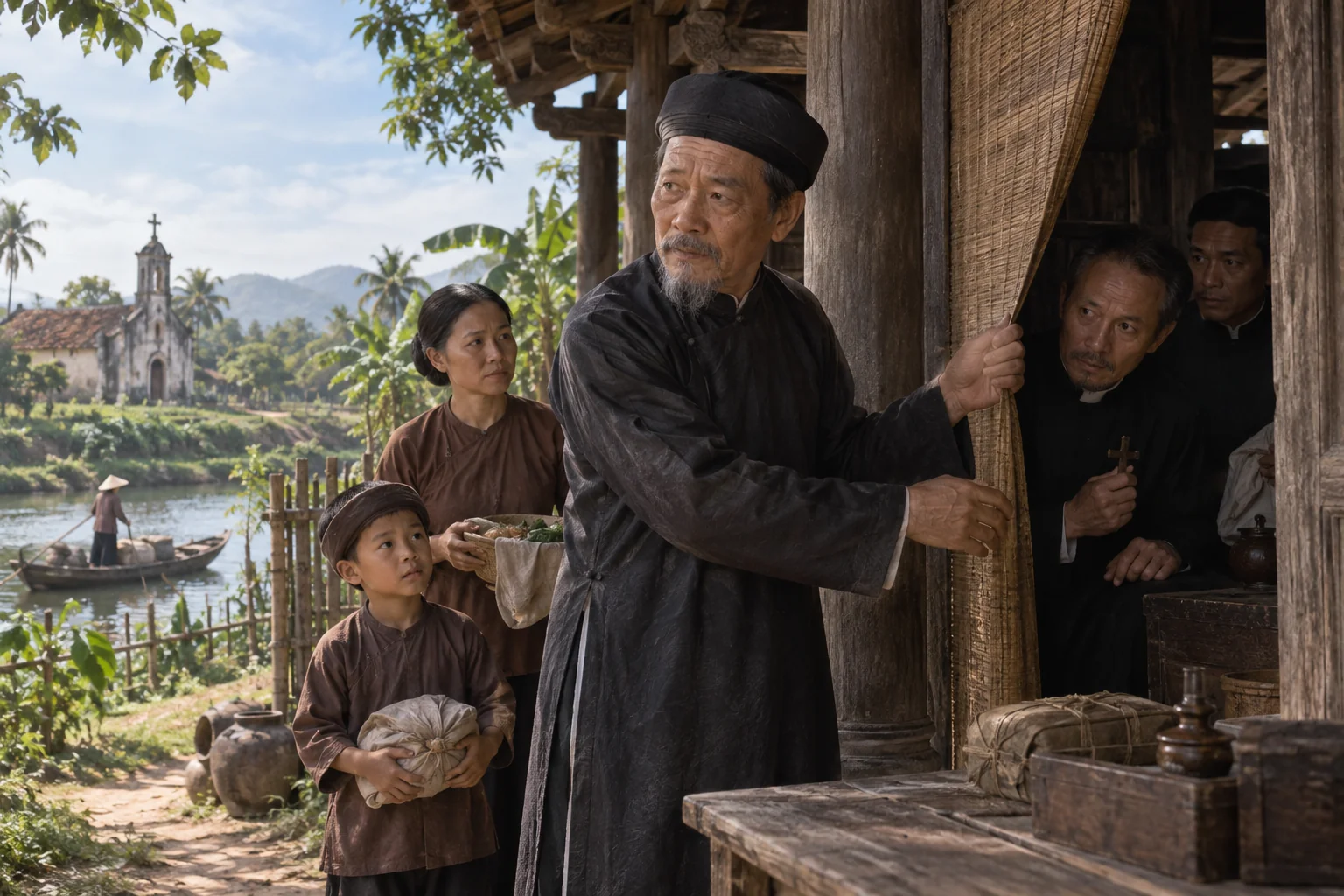
The old man was no dangerous criminal. His name was Andrew Nguyễn Kim Thông, and the people of the area called him Ông Năm Thuông — once a highly respected canton chief and head of the Catholic parish of Gò Thị, one of the oldest communities of the diocese of Quy Nhơn. For decades he had used his authority and wealth not to feather his own nest, but as a shield for the missionaries, the seminarians and the poor of the area. And when the storm of persecution finally broke, he met it with the same patient endurance he had shown all his life.
Chapter 1 of 6
A son of the coconut country of Gò Thị
Nguyễn Kim Thông was born around 1790 in the village of Gò Thị, Xuân Phương hamlet, Phước Sơn commune, Tuy Phước district, Bình Định province — a land famous for its martial arts tradition, where green rows of coconut palms stand among rice fields stretching to the horizon. He was baptized as a child with the name Andrew and grew up in a family that had kept the faith for generations.
Intelligent, upright and outspoken, yet full of compassion, Andrew Thông studied Chinese characters from childhood and knew both the classics and local custom well. He married a devout Catholic woman of the parish, and they had two children, both of whom gave themselves to God: the son became a priest, Father Nguyễn Kim Thủ, and the daughter entered a religious congregation. Through hard work and shrewd planning he built up a comfortable farming and trading business, but unlike many rich men of his time, he never used his wealth to throw his weight around. Whenever bad harvests or drought struck, he opened his granaries to feed the hungry villagers, Christian or not.
Because of his ability, virtue and standing, the people and the court together made him canton chief, the head of a canton of many villages. Under his honest rule, thieves and bandits were brought under control and the poor were protected, and Christians and non-Christians alike called him by a respectful nickname: “Old Cai Thông.” At the same time, the Catholics of Gò Thị chose him as their Ông Trùm, the head of the parish lay council, so that he became the mainstay of a large Catholic community.
Chapter 2 of 6
A firm pillar of the Church in Cochinchina
Throughout the 1840s and 1850s, under Thiệu Trị and then Tự Đức, the edicts against the faith grew ever harsher, and the central provinces saw some of the fiercest manhunts. The parish of Gò Thị, tucked away among coconut groves and vast rice fields, became one of the most important hidden centers of the Vicariate Apostolic of Eastern Cochinchina, forerunner of today’s diocese of Quy Nhơn.
As both canton chief and parish head, Andrew Thông skillfully used his position to shield a whole underground network of faith:
- he secretly took in and hid Bishop Stéphane Cuénot (whom the Vietnamese called Đức cha Thể), the relentlessly hunted vicar apostolic;
- he protected a small seminary that quietly trained dozens of seminarians and catechists right in Gò Thị;
- he sheltered a community of Lovers of the Holy Cross sisters who were also hiding in the area.
Whenever word came that troops were about to search the village, he raised the alarm in time for the missionaries and sacred objects to be moved safely into the deep forest before dawn.
He often told his children, his grandchildren and the people of the parish what his whole life had shown: earthly wealth will vanish like smoke and clouds, and office is only a garment worn for a while — only faithfulness to God and to the Church is worth keeping to the end.
Chapter 3 of 6
Betrayal and the day of his arrest
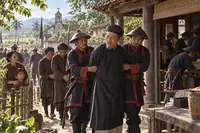
The betrayal, a painful one, came from within the parish. A dishonest man named Khương, whom the canton chief had once sternly rebuked for gambling and stealing, wanted the large reward the authorities were offering. He slipped off to the provincial capital of Bình Định and denounced Nguyễn Kim Thông as the ringleader protecting the “Western religion masters,” hiding both a seminary and a religious community in the village.
At the beginning of 1855, on receiving the report, the governor of Bình Định at once sent hundreds of soldiers to surround Gò Thị. They searched the seminary and the convent from end to end. Bishop Cuénot and the seminarians managed to escape in the night. But the soldiers burst into Andrew Thông’s house and arrested him, together with four other members of the parish council.
As the cangue was fastened around his neck, his family and parishioners rushed out weeping, ready to use bribes or even clubs to get him back. But he raised his hand to stop them:
“Brothers, children and grandchildren, be calm. Do nothing against the law of the land. All my life I have served the court and served the community with an upright conscience. Now, if God wants me to wear a cangue for His name, I gladly accept. Go home and look after your families, keep the faith firmly, and pray for me.”
Then he let the soldiers tie his hands, lock his chains and take him to the provincial prison of Bình Định.
Chapter 4 of 6
The old official’s noble spirit before the court
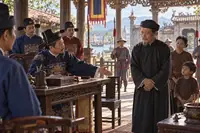
At the court in Bình Định, many officials who had once worked alongside him and had long respected his integrity tried to go easy on him. The governor offered him a seat and urged him kindly:
“Canton chief, we know you are a virtuous notable who has served the people and the country all your life. Harboring priests is a serious matter that the court cannot overlook. But out of regard for your age and frailty: you need only declare that you renounce the religion, or let someone carry you over the Cross once, and we will at once petition the emperor to pardon you and restore your rank.”
He knelt upright, looked the mandarins in the eye and answered with the dignity of a man who had lived an honest life:
“Your Excellencies, I am over sixty; earthly fame and rank mean nothing to me anymore. For more than sixty years I have worshiped God, who made me, and I have been wholeheartedly loyal to the king and his officials. I have never done anything deceitful or harmful to the people or the country. The Cross is the holy sign where my Savior died for me; I worship and adore Him — how could I dare trample on the One who is the source of life for my soul? If you wish to behead or kill this old body, go ahead, but I will never deny my God.”
When persuasion failed, the mandarins, who had to satisfy the court in Huế, ordered torture. They stripped off his outer garment, tied him to a wooden post, flogged him with thorny rattan whips, tore his flesh with pincers and tried to drag him over the cross. But the lash could not break the will of this man in his sixties. He clenched his teeth and endured it in silent prayer. Seeing that he was too old and frail to survive more floggings, the judge petitioned the capital for a sentence of exile for life, all the way to Vĩnh Long, a strange land thousands of kilometers south of his home in Gò Thị.
Chapter 5 of 6
The last journey and a meeting in Bình Thuận
In the summer of 1855 the sentence was carried out. A death march began: with a heavy cangue on his neck and chains on his legs, the old prisoner had to walk thousands of kilometers down the long coastal road of central Vietnam, under the burning sun, all the way to the South. The soldiers, concerned only with keeping to schedule, showed no mercy for his age. His body, barely healed from the floggings, had to drag itself over sharp stones for weeks on end. There was not enough rice to fill him, not enough water to quench his thirst, and his bare feet swelled and bled at every stage of the way.
When the column reached Bình Thuận, something no one expected happened: he met his own son, now Father Nguyễn Kim Thủ, who happened to be in that region. In his cangue and chains, surrounded by soldiers, the old father was able to make his last confession to his own son. Back in the days when the father taught his boy Chinese characters in Gò Thị, neither of them could ever have imagined a reunion like this.
The column went on south. On July 15, 1855, just as they reached Mỹ Tho, in the old province of Định Tường, the final destination of his exile, the sixty-five-year-old canton chief, his strength completely spent, died. He never lived to serve his sentence; he arrived only as a witness who had walked his road to the end.
The local Catholics buried him at Cái Nhum. In 1857 his son, Father Nguyễn Kim Thủ, obtained permission to bring his father’s remains back for burial in Gò Thị, bringing the canton chief home to the place where he was born and which he had spent his whole life protecting.
Chapter 6 of 6
A model canton chief among the saints
On May 2, 1909, Pope Pius X beatified the canton chief Andrew Nguyễn Kim Thông. And on June 19, 1988, Pope John Paul II canonized him, together with one hundred sixteen other Vietnamese Martyrs, in Saint Peter’s Square. The Church celebrates him on July 15 each year.
Among the Vietnamese Martyrs, the story of Andrew Nguyễn Kim Thông has a shape of its own: not a swift death by the sword, but a slow wearing away over thousands of kilometers on foot, until his last breath gave out just as he reached the end. On that harsh road, meeting his priest son and making his last confession to his own child was perhaps the most precious gift a father, and a witness of faith, could receive before leaving this world. All his life he had used his authority to protect others; in his very last steps he himself was protected, not by power, but by the sacrament of reconciliation from the hands of the son he had once taught.
The end of the story
You have walked with Saint Andrew Nguyễn Kim Thông to the end of the story.
A few moments in his life move you:
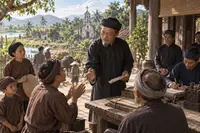
Using his own office as canton chief, he secretly sheltered Bishop Cuénot, a hidden seminary and a whole community of sisters for many years.
Past sixty, he was forced to walk thousands of kilometers into exile, his bare feet bleeding at every stage on the stony road.
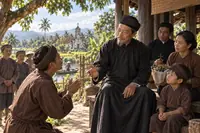
On the road to exile he unexpectedly met his own son, now a priest, and made his last confession to him, before dying just as he reached the end of the road.
Stay in silence
You understand the last gift he received: after a whole life of using his authority to protect others, in his very last steps he himself was protected, not by power, but by the sacrament of reconciliation from the hands of the son he had once taught.
Earthly wealth will vanish like smoke and clouds, and office is only a garment worn for a while; only faithfulness to God and to the Church is worth keeping to the end.
Let us pray
Saint Andrew Nguyễn Kim Thông,
you used your office as canton chief to shelter the bishop, the seminary and the sisters. Past sixty, you walked barefoot on the road to exile, and made your last confession to your own priest son.
Pray for those in authority, that they may use their power to protect the weak.
Pray for parents whose children are priests or religious. And help me to walk patiently to the end of the road God gives me.
Amen.
Light a candle for Saint Andrew Nguyễn Kim Thông
Sources
- Feast dayAuthor’s edited profile
- Often depicted withPatronages and symbols, version 1.1
- Reflectiongiaophanthanhhoa.net
- Reflectiongpquinhon.org
Meet the next one
 Journey 8