

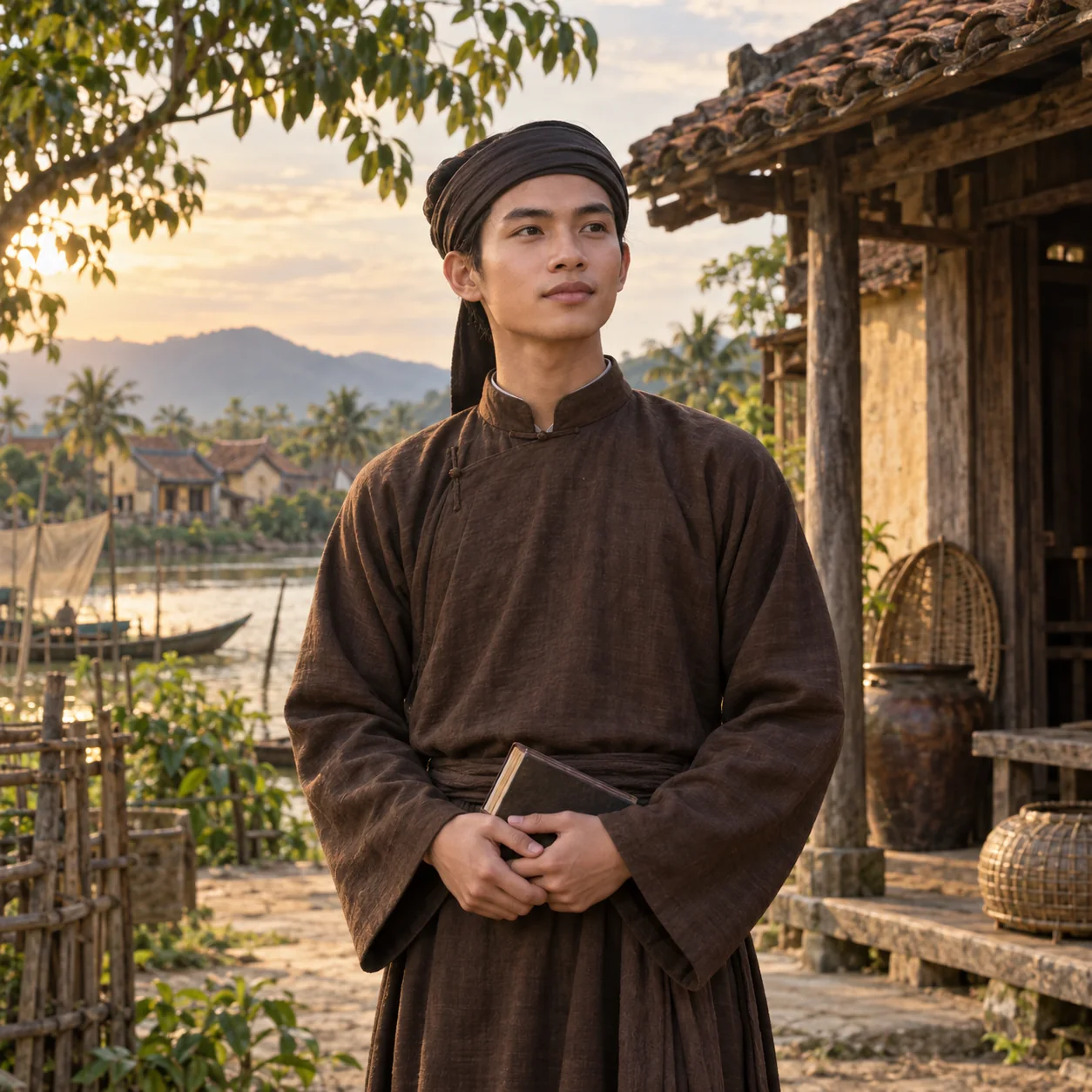
Journey 8 · Faith with a Vietnamese Face
Blessed Andrew of Phú Yên
The first witness, and the first blood shed for the faith in Vietnam
Feast day July 26
Tap to step inside
Blessed Andrew of Phú Yên
The first witness, and the first blood shed for the faith in Vietnam
Map of a life
This life told in 5 chapters
Begin the journey
Feast day
Blessed Andrew of Phú Yên
Memorial of Blessed Andrew of Phú Yên in Vietnam
July 26
Patron of
- Vietnamese catechists
Often depicted with
- A bamboo cangue
- A rosary
- A palm branch
Opening
Opening
On the afternoon of July 26, 1644, on an open stretch of ground outside the gate of the citadel of Kẻ Chàm — now in the town of Điện Bàn, Quảng Nam province — a nineteen-year-old knelt inside a ring of the Nguyễn lords’ soldiers, their drawn swords and spears glinting in the sun. A bamboo cangue weighed on his neck and chains bound his legs. He was slight, with the look of a student, yet his face held a calm hard to believe at that age.
Beside him stood a much older man, his eyes brimming with tears: the priest Alexandre de Rhodes, known to the Vietnamese as Cha Đắc Lộ. For three years he had been the teacher and spiritual father of the young man kneeling before him. Now he could only stand and watch.
The young man turned and smiled at Father de Rhodes, the smile of someone on his way to a feast, not to his death. Then he spoke, loud and clear, to his spiritual father and to everyone standing by. More than three and a half centuries later, his words are still repeated in churches up and down Vietnam:
“Brothers and sisters, let us answer the love of Jesus our Savior with love. He died for us; let us be ready to give our lives for Him. Keep faith with Jesus to your last breath, to the end of your life.”
A soldier rushed in and drove a spear through his back. The young man staggered but still tried to keep kneeling upright, his eyes lifted to heaven, his lips moving:
“Jesus... Jesus...”
Then three sword strokes fell, and his earthly life was over.
His name was Andrew, and Vietnamese Catholics came to know him by the name of his home province: Andrew of Phú Yên. He is the protomartyr of the Church in Vietnam, the first of the hundreds of thousands of martyrs who would follow in his footsteps over the next three centuries and more. One hundred seventeen of them have been canonized; countless others are remembered only by the small Catholic communities where they lived and died.
Chapter 1 of 5
A bright boy from Phú Yên
Andrew was born around 1625 in a small village in Phú Yên province — then the southern edge of Cochinchina, where the border with the old kingdom of Champa had only recently been pushed south. History has not kept his birth name before his Baptism. He was the youngest child of a poor but devout family; his father died early, and he was raised by his good mother, Joanna.
In 1641, Father de Rhodes and another Jesuit missionary came to preach in Phú Yên. Joanna, now a widow, brought her fifteen-year-old son to the missionary to ask for instruction in the faith. The boy was slight, bright-eyed, and unusually gentle and humble. Mother and son were baptized together at that meeting; the boy took the baptismal name Andrew.
Seeing in the boy a quick mind that grasped things at once, together with a rare purity of heart, Father de Rhodes asked his mother’s permission to take Andrew as his disciple and brought him to Hội An to raise him. There Andrew eagerly studied Chinese characters, Latin, and the new Romanized script for Vietnamese, then still in its infancy, which Father de Rhodes himself did much to shape. He served at the altar with a reverence that caught the attention of the adults around him.
In 1642, seeing that Andrew had matured remarkably in character and spiritual life, Father de Rhodes chose him for the Association of Catechists — a group of local lay people who freely vowed celibacy, poverty and obedience, giving their whole lives to proclaiming the Gospel alongside the foreign missionaries. Though he was the youngest member of the group, Andrew always stood out for his diligence, his humility, and a habit few noticed but that said a great deal: he always took the hardest tasks for himself, leaving the lighter ones for the older catechists. He followed Father de Rhodes through the villages of Quảng Nam, teaching catechism to thousands of new converts, baptizing newborns in danger of death, and reconciling many families at odds.
Chapter 2 of 5
A surprise raid at Kẻ Chàm
In 1644, Lord Nguyễn Phúc Lan of Cochinchina, urged on by some officials and foreign traders who had their own interest in removing the missionaries’ influence, grew fiercely suspicious of the Catholic faith. In July of that year a new provincial governor was sent to rule Quảng Nam — history records his name as Nghè Bộ — a man who openly hated the faith and was determined to root it out of his province.
On July 25, 1644, the governor sent armed soldiers to raid Father de Rhodes’s lodging at Kẻ Chàm. Their main target was an older, better-known catechist named Ignatius. But both Father de Rhodes and the catechist Ignatius were away on mission elsewhere. In the simple lodging house, only the young catechist Andrew sat absorbed in his reading.
The soldiers ransacked the house and carried off the sacred objects. A soldier grabbed Andrew and shouted: “Where is the catechist Ignatius? Where is the Western priest?” Andrew answered calmly:
“They are away; there is only me here.”
The soldier held a sword to his neck, threatening to behead him instead if he would not show where the others were hiding.
Andrew smiled and answered with a courage far beyond his small frame and his years:
“I am a Christian, I am a catechist of God’s religion. If you want to arrest me, go ahead; I am ready to go to prison and die for the name of Jesus, but I will never betray my brothers.”
The soldiers at once tied him up, put a cangue on him, chained his legs, and took him under guard to the governor’s residence.
Chapter 3 of 5
The last night’s vigil in prison
When Father de Rhodes returned and learned that his young pupil had been arrested in his own place, the old missionary was stricken with grief. He hurried to the governor’s residence and offered himself in Andrew’s place, but was refused. Through the intervention of some sympathetic officials, Father de Rhodes was allowed into the cell to see his pupil one last time.
In the darkness of the prison, the spiritual father and his spiritual son embraced. Father de Rhodes’s face was etched with grief, but Andrew was filled with a joy that astonished even his teacher. “Father, don’t cry,” he said, holding Father de Rhodes’s hand tightly.
“I thank God for giving me so great a blessing as to wear chains for His name. Please pray that I may stay faithful to the last drop of my blood.”
The night of July 25, 1644, was the young catechist’s last. He knelt all night in the dark prison, praying the Rosary in thanksgiving to God and Our Lady. A few Christians risked their lives to slip in to see him, unable to hold back their tears. Andrew looked at them with eyes full of love and urged them:
“Brothers and sisters, do not cry for me. Thank God that our land has someone allowed to shed his blood as a witness to Him. Hold fast to the faith, love one another, and remember that life in this world is only passing; life in the world to come, in Heaven, is eternal.”
Chapter 4 of 5
The first blood at the execution ground of Kẻ Chàm
On the morning of July 26, the governor Nghè Bộ announced the death sentence. That afternoon the guards led Andrew out to the open ground outside the citadel gate of Kẻ Chàm. He walked steadily, his face as bright as it had been the night before. Father de Rhodes and hundreds of the faithful followed in silence.
At the place of execution he knelt on a small mat spread out for him and spoke the words that became the best-remembered saying in the whole history of the Vietnamese martyrs:
“Keep faith with Jesus to your last breath, to the end of your life.”
A soldier rushed forward and drove a spear through his body. Trembling with pain, he still tried to stay kneeling upright, his eyes lifted to heaven, his lips calling on the name of Jesus, until the third sword stroke ended it all.
Father de Rhodes and the faithful knelt beside the body and used cloths to soak up every drop of blood, the first blood of a martyr on Vietnamese soil. Father de Rhodes later had the body buried for a time in Hội An and took the head to Macau; in the end part of his relics was enshrined at the Jesuit headquarters in Rome, where it is still venerated today, more than ten thousand kilometers from his homeland of Phú Yên.
Chapter 5 of 5
Patron of catechists
Andrew’s death did not put out the faith in Cochinchina. It became the first seed sown in a land that, for more than three hundred years, would never stop bringing forth martyrs. Many who saw the nineteen-year-old die that day asked to be taught the faith soon afterward.
On March 5, 2000, during the Great Jubilee Year, in Saint Peter’s Square in Rome, Pope Saint John Paul II beatified Andrew of Phú Yên and proclaimed him patron of Vietnamese catechists. The Church celebrates him on July 26 each year. In Vietnam, shrines bearing his name have been built at Mằng Lăng, Phú Yên province (his own home parish) and at Phước Kiều, Quảng Nam province, near the place where he shed his blood. About two kilometers from the church of Mằng Lăng, at a place called Lò Giấy, relics connected with the young catechist are still kept.
Through all the saints in this app, from Saint Joseph, the silent father of Nazareth, to the nineteen-year-old who fell on the ground of Kẻ Chàm, runs a single red thread. They lived thousands of years and thousands of kilometers apart: a carpenter, a fisherman, a nun, a king, a young man never ordained. Yet they all did exactly the same thing: they kept their promise to the One they believed in and loved, to their last breath. Andrew of Phú Yên, the youngest of them and the first of Vietnam’s martyrs, summed it all up in a saying so short that a child can learn it by heart, yet it takes a whole lifetime to live out: keep faith with Jesus, to your last breath, to the end of your life.
The end of the story
You have walked with Blessed Andrew of Phú Yên to the end of the story.
Three moments in this young man’s life stay with you:
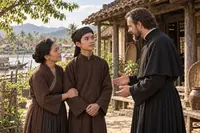
Simply because he happened to be alone when the soldiers burst in looking for the catechist Ignatius, the nineteen-year-old catechist declared himself a Christian and accepted being arrested in his place.
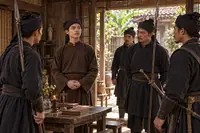
On his last night in the dark prison, instead of being afraid, he held the hand of the weeping Father de Rhodes and said: "I thank God for giving me so great a blessing as to wear chains for His name."
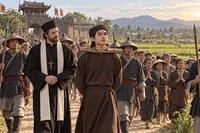
Kneeling at the execution ground of Kẻ Chàm, he left the words that have never been forgotten: "Keep faith with Jesus to your last breath, to the end of your life."
Stay in silence
You understand why those words still ring out: the youngest, and the first of Vietnam’s martyrs, wrapped a whole life of faith in a saying so short that a child can learn it by heart.
Keep faith with Jesus to your last breath, to the end of your life.
Let us pray
Blessed Andrew of Phú Yên,
at only nineteen you declared yourself a Christian and were arrested in place of another catechist. At the place of execution you left us these words: "Keep faith with Jesus to your last breath, to the end of your life."
Pray for Vietnamese catechists, and for young people growing up in the faith.
Help me, whether young or old, to keep faith with Jesus to my last breath.
Amen.
Sources
- Feast dayCatholic Bishops’ Conference of Vietnam / Vatican
- Patron ofPatronages and symbols, version 1.1
- Often depicted withPatronages and symbols, version 1.1
- Reflectionvatican.va
- Reflectionpress.vatican.va
Meet the next one
 Journey 8