

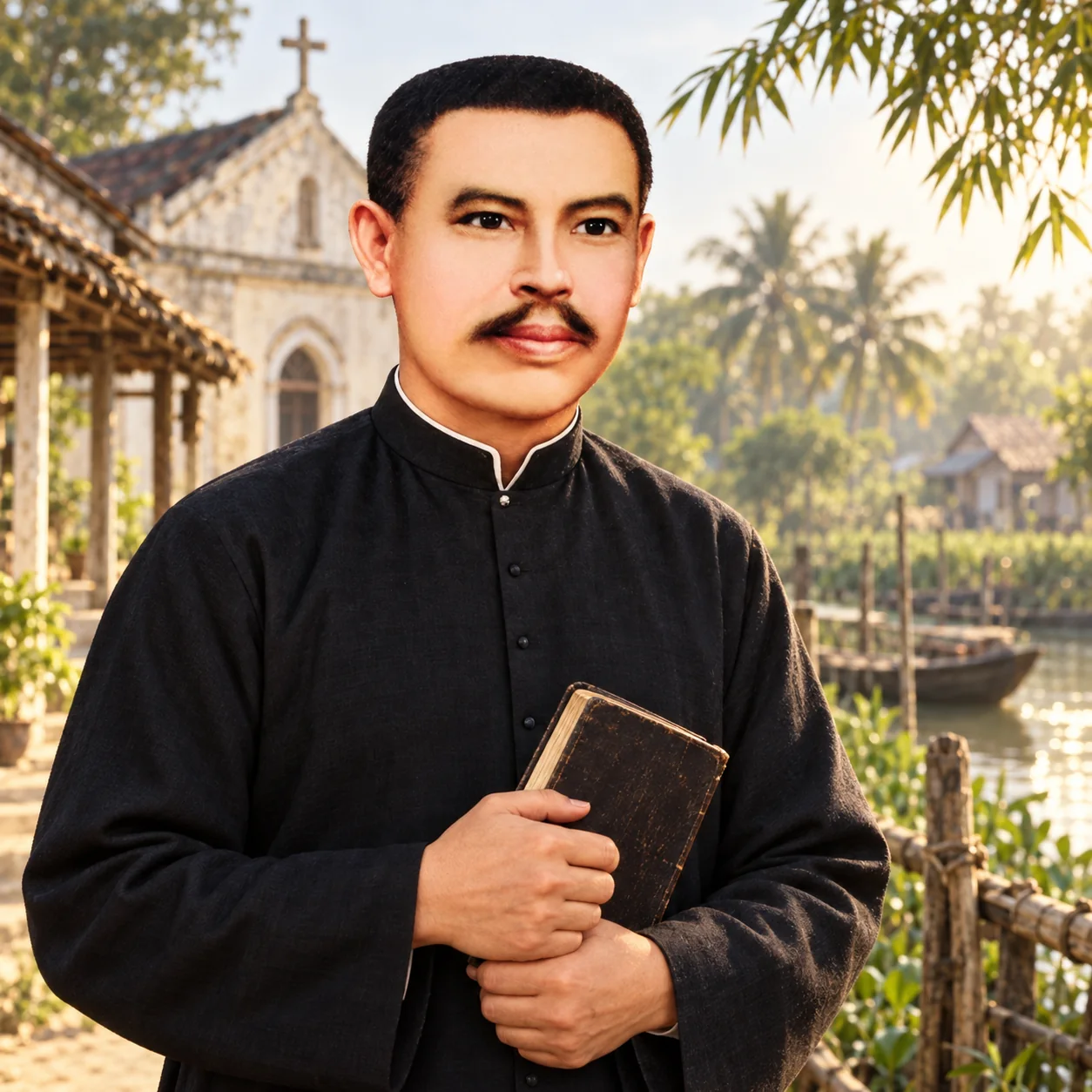
Journey 8 · Faith with a Vietnamese Face
Blessed Francis Xavier Trương Bửu Diệp
A country priest who lived and died among his people
Feast day March 12
Tap to step inside
Blessed Francis Xavier Trương Bửu Diệp
A country priest who lived and died among his people
Map of a life
This life told in 11 chapters
Begin the journey OpeningOpening2 min
 Chapter 1 of 11An orphan by the waters of An Giang2 min
 Chapter 2 of 11The long road from Cồn Phước to the seminary1 min
 Chapter 3 of 11First assignments, and the call to Tắc Sậy1 min
 Chapter 4 of 11Sixteen years among the poor of the rice fields2 min
 Chapter 5 of 11A boundless heart: no one who knocked at Father’s door went away empty-handed2 min
- Chapter 6 of 11Clean hands in a time of turmoil1 min
 Chapter 7 of 11An unshakable vow: “Live or die, I stay among my people!”1 min
- Chapter 8 of 11March 12, 1946: a love greater than life1 min
- Chapter 9 of 11A shepherd who gave himself: what really happened2 min
 Chapter 10 of 11From a cold grave by the canal to a shrine of mercy2 min
- Chapter 11 of 11A day of grace: the beatification at Tắc Sậy2 min
Feast day
Blessed Francis Xavier Trương Bửu Diệp
Memorial of Blessed Francis Xavier Trương Bửu Diệp in Vietnam
March 12
Often depicted with
- A priest’s black cassock
- A rice granary
Opening
Opening
Travel down into the Mekong Delta, along the highway through the wide waterlands of Bạc Liêu, and ask the way to Tắc Sậy. Whether you ask a motorbike-taxi driver, a woman selling drinks by the road or an old woman rowing a ferry, you will hear the same familiar name at once: Cha Diệp, Father Diệp.
Few priests in this land have a name so deeply bound up with the spiritual life of ordinary people. Catholics come to pray the Rosary and bring him their intentions. Non-Christians, people who venerate their ancestors, also make the long trip, bowing to light a stick of incense before his tomb. Some come weighed down by the struggle to make ends meet, some bring their sick children, some are trapped by debts or family quarrels. And not a few come back just to say thank you, for a kindness they have carried in their hearts for years.
Everyone calls him by the tender name “Father”, though most of those kneeling before his tomb today never once saw his face while he was alive.
That love does not come from wealth or high office. All his life Father Francis Xavier Trương Bửu Diệp was a simple country priest, plain as a stalk of rice or a mangrove branch, who spent his days among the rice fields, the tangled canals and the poor hamlets. He got about on bare feet wading through mud, on a rickety bicycle over bumpy dirt roads, and in a small three-plank boat that rose and fell with the tides. He went down every lane and knocked on every door, visiting the old and the lonely, sharing bowls of rice with the hungry, finding scraps of fallow land for wanderers with nowhere to settle.
Then, when war swept through and gunfire tore the skies over his homeland, when people fled in panic looking for safety, he chose to stay. And in the end he fell, on the very land he had vowed never to leave until his last breath.
That life could fill countless pages. But if only one image were kept, it would be the plain figure of a father standing among his poor children, refusing to leave even when death was at the door.
Chapter 1 of 11
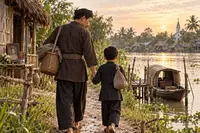
An orphan by the waters of An Giang
Francis Xavier Trương Bửu Diệp was born on January 1, 1897, at Cồn Phước, in the village of Tấn Đức, now Long Kiến commune, Chợ Mới district, An Giang province. His father was Michael Trương Văn Đặng, born in 1860, and his mother was Lucia, whom many records name as Lê Thị Thanh, born in 1862. The family farmed rice in the Catholic community of Cồn Phước, one of the oldest on the rich island country between the Tiền and Hậu Rivers.
Exactly one month after his birth, on February 2, 1897, his parents carried the baby to the church to be baptized, giving him the name Francis Xavier, after the famous Jesuit missionary saint who crossed the seas to India and Japan to preach the Gospel. Looking at the newborn lying quietly in his parents’ arms that day, in the little Catholic hamlet beside the Tiền River, no one could have imagined the road that lay ahead of him, or that nearly half a century later his name would mean mercy to the whole Mekong Delta.
But little Diệp’s childhood was far from peaceful. In 1904, when he had just turned seven, an age when a child still loves to curl up beside his mother through the hot summer noons, his mother died. The home suddenly felt empty. Left alone with the struggle, his father took the boy all the way to Battambang, in Cambodia, where they worked as hired laborers to scrape a living. Some time later his father remarried, to Nguyễn Thị Phước, and the whole family made their way back to Cồn Phước. A daughter, Trương Thị Thìn, was born to the new marriage.
No one recorded how many nights the seven-year-old boy cried for his mother. But anyone orphaned young knows the emptiness of a child too small to grasp why the person he loves most has suddenly vanished. Through all that hardship, young Diệp kept growing, nourished by the faith of his family and his parish. And out of that early loss, a path unlike that of other boys his age took shape in his heart: he wanted to give his whole life to God and become a priest.
Chapter 2 of 11
The long road from Cồn Phước to the seminary
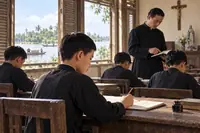
In 1909, at twelve, Francis Xavier Trương Bửu Diệp was accepted into the minor seminary of Cù Lao Giêng, on that same green island amid the waters of An Giang — one of the oldest places of formation for native clergy in the Mekong Delta.
Looking at a map today, many people might wonder: why would a son of Vietnam have to travel all the way to Phnom Penh, in Cambodia, to study for the priesthood? But under the Church’s boundaries at the beginning of the twentieth century, the part of Vietnam beyond the Hậu River, including the area that later became the dioceses of Long Xuyên and Cần Thơ, was in the care of the Vicariate of Phnom Penh, an arrangement that lasted until 1955.
So, after years of hard study at Cù Lao Giêng, the seminarian Trương Bửu Diệp packed his bags once more for the long road to the major seminary of Phnom Penh to complete his theology. It was a long, hard road for someone from a poor farming family of the late nineteenth century: a motherless boy from the orchard country of An Giang, who had followed his father to work in a foreign land, came home to enter the seminary, then went upriver again to the land of the pagodas for long years of philosophy and theology.
In 1924, in Saigon, Francis Xavier Trương Bửu Diệp was ordained a priest by Bishop Valentin Herrgott. From that moment, the neighbors no longer called him “Thầy Diệp”. The plain black cassock now carried a new mission: from that day his whole life belonged to his flock.
Chapter 3 of 11
First assignments, and the call to Tắc Sậy
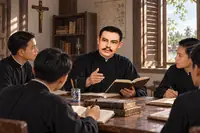
Right after his ordination, Father Diệp received his first assignment: assistant priest at Hố Trư, a parish with many Vietnamese in Kandal province, Cambodia. There, far from home, he gave himself to comforting and caring for poor Vietnamese families who had left their homeland to earn a living. The young priest’s devotion and kindly smile left such a deep mark on the people there that decades later the old people of Hố Trư still told stories about him.
In early 1928 he was called home to teach at his own old school, the minor seminary of Cù Lao Giêng. But the classroom and the theology books did not seem to be where God meant to keep a shepherd whose heart always went out to the poor who toiled in the fields.
In March 1930 came the appointment that would bind his life and name to a wild corner of the Delta forever: he was made parish priest of Tắc Sậy. He was thirty-three, full of zeal and eager to serve.
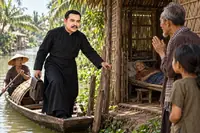
As he stepped into a small boat to go to his new parish, with reeds stretching endlessly on every side and the wind whistling across the open fields, perhaps no one, himself included, imagined that this marshland would be his home for the last sixteen years of his life. Here he would pour out his sweat, his blood and his last breath, and decades later it would become a place of refuge for millions of pilgrims from all over the world.
Chapter 4 of 11
Sixteen years among the poor of the rice fields
Tắc Sậy in the 1930s was not the splendid pilgrimage center it is today. It was only a small, poor Catholic community in the Bạc Liêu region, tucked beside a tangle of canals and marshes, with reeds growing thick, just as its name says. The people were few, scattered in clusters along small creeks, and travel was difficult. Besides Tắc Sậy itself, Father Diệp also cared for the community of Khúc Tréo and many small mission stations scattered across the area.
In those days there were no paved roads, no motorbikes or cars. To reach the faithful he had only two ways: pedaling his rickety bicycle along slippery dirt embankments, or paddling a three-plank boat along the canals, through rain and sun, day after day, month after month. Some Catholic hamlets lay deep in the fields, and reaching them meant paddling for hours until his arms and legs ached. But Father Diệp’s work never ended with saying Mass and going back to his room.
After Mass, he set off. Into every lane, stopping at every leaning thatched house, sitting down on the floor, asking whether there was still rice to cook, whether the harvest had been good or bad, whether any of the children were sick. Lonely old people confined to bed, thin and hungry children, families just struck by misfortune or fire: they were always the first to feel his help.
Many decades later, when the Diocese of Cần Thơ gathered testimonies for the cause of beatification, the elderly witnesses all agreed on one point: they remembered Father Diệp as a gentle, simple, approachable man whose heart was open to everyone. When the poor came asking for help, he opened his cupboard and emptied his pockets for them. For those with no land to farm, he found ways to share out the parish land and encouraged them to clear it, so they had a foothold to make a living. When non-Christians came to him in hard times, he welcomed them as warmly as his own family.
For Father Diệp, hunger and misery knew no religion. A person standing before him trembling with hunger was first of all a human being who needed a bowl of rice to live, and that was all.
Chapter 5 of 11
A boundless heart: no one who knocked at Father’s door went away empty-handed
One of the things people in the Mekong Delta still tell about Father Diệp is his aching tenderness for anyone in misery.
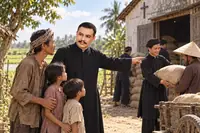
In 1944–1945 the country went through a terrible famine, the great famine that killed millions of people in the North and sent streams of starving people drifting all the way south in search of a way to survive. When those ragged, exhausted people reached Tắc Sậy, Father Diệp opened his arms to them. The parish had some rice in store. Instead of keeping it, he opened the granaries and gave rice to the poor, the displaced and the jobless to take home, husk and cook. And he did more than hand out fish in hard times; he gave them a fishing rod, finding ways to help destitute families clear wasteland so that they had fields to farm and a steady living.
An elderly witness later told a simple story. Once a poor man came with a carrying pole on his shoulder and a worn bamboo basket hanging from each end, and in each basket sat a little child, ragged and hungry. The father knocked at Father Diệp’s door, knelt and wept, asking for a patch of fallow land to farm so he could feed his two children, who had just lost their mother. Father Diệp did not hesitate. He helped the man up, pointed toward the parish’s fallow land, and said in his warm Mekong Delta voice:
“Take your little ones over there, and clear as much land as your strength allows to plant rice and corn. In the first days, before there is anything to harvest, come over here and I will give you rice to cook for the children — don’t let them go hungry. For now, cut some leaves and poles and put up a hut to keep off the rain and sun so you and the children have somewhere to rest. Then later, when the land yields rice, you will feed your family yourself.”
No grand speeches about charity. Only a patch of fallow land, a few sacks of rice against hunger, a simple thatched hut, and a man on the edge of despair given back his life. Father Diệp’s compassion was sometimes as simple as a grain of rice or a sweet potato from the southern earth. He never asked those who came begging whether they were Catholic or whether they went to Mass. His heart went out equally to everyone who suffered, Christian or not. It was that wide, unconditional kindness that took root in people’s memory, until Tắc Sậy became a home for countless people from every walk of life.
Chapter 6 of 11
Clean hands in a time of turmoil
Father Diệp’s last years as a priest fell in one of the most turbulent periods of modern Vietnamese history. The Second World War had just ended. The Japanese army announced its surrender. The French were preparing to return and retake Indochina. Political and armed groups of every stripe rose up at once. In the South, order broke down in many villages, with looting and armed clashes one after another. The remote countryside of Tắc Sậy could not escape the whirlwind.
Through all these upheavals, Father Diệp held firmly to what he was: a priest. Later historical investigations all confirm that he took no part in politics or in any armed faction. He shared the pain of an oppressed people and longed for peace in his country, but he refused the path of violence and sided with no armed group. When French troops came, he was ready to speak up to protect innocent people from unjust repression. When resistance fighters passed by, he treated them decently, as he would any fellow Vietnamese. Witnesses still remember how a few resistance soldiers, faint with hunger, stopped to ask for sticky rice cakes, and he at once had the people wrap some for them, without prejudice or fear.
At one point people urged him to bring in guns, arm the young men of the parish and turn the church of Tắc Sậy into a fortified post. Father Diệp flatly refused. He said clearly that he was a priest sent by God to shepherd the flock; his task was to bring peace and to care for people’s souls and bodies, and he would never let the house of God become a fortress for bloodshed. But in a time of war and chaos, keeping clear of the guns did not mean the guns would spare him.
Chapter 7 of 11
An unshakable vow: “Live or die, I stay among my people!”
As 1945 gave way to 1946, the shadow of danger crept ever closer to the church of Tắc Sậy. The atmosphere grew tense and stifling. False rumors spread, and those close to him knew that a man as respected as Father Diệp could easily become a target for the shadowy forces at work in the area.
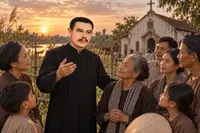
The faithful were frantic with worry. They knelt and begged him to take refuge for a while in a safer town and come back when the storm had passed. The shepherd shook his head and refused. The historical inquiry of the Diocese of Cần Thơ still records his words, blunt in the true manner of a man of the southern river country:
“Live or die, I stay among my people. Whoever wants to kill the old Father, let them kill him!”
Another version passed down among the people puts it more gently, but no less bravely: a true shepherd must live among his flock and be ready to die with them.
This was not blind recklessness. A man of flesh and blood, Father Diệp knew very well the danger that hung over him every hour. He knew people were targeting him. On some nights when things were too tense, the faithful secretly paddled him across to the other bank to sleep in hiding. But early the next morning, as soon as the sun rose, he would quietly pole his boat back to the church. If he went off to save himself, whom would his poor, bewildered flock lean on in their panic? Leaving would be cowardice; staying meant accepting the risk. He chose to stay, the last support of people trembling with fear.
Chapter 8 of 11
March 12, 1946: a love greater than life
Early on the morning of March 12, 1946, while the mist still hung over the canal, an armed band suddenly burst into the grounds of the church of Tắc Sậy. They surrounded and seized Father Francis Xavier Trương Bửu Diệp along with more than seventy people, Catholics and others staying nearby.
All of them were marched under guard to Cây Gừa. There the armed men herded more than seventy people, old and young, into two rice granaries, the big storehouses of those days, with thick, solid wooden walls. The wooden doors slammed shut and were bolted fast. Outside, the captors got straw, dry firewood and oil ready, meaning to set fire to the granaries and burn everyone inside alive. Inside, the granaries filled with the muffled sobs of women, the terrified screams of children and the despairing groans of men facing death.
At that moment Father Diệp gave no thought to his own escape. He moved among the panicked crowd, comforting them and giving absolution to strengthen them. Then he decided to act. According to the investigation of the Diocese of Cần Thơ, three times he went to the door of his own accord to bargain with the captors, pleading as their shepherd for the innocent to be set free. In exchange for the lives of his flock, he declared that he was ready to stay behind himself, offering his own life as the only guarantee.
After the first two attempts he came back into the granary and looked at his people with anguish in his eyes. The third time he stepped out, the wooden door closed behind him, and Father Diệp never came back into that granary. Soon afterward, something strange happened: the doors of both granaries were suddenly thrown open, and the guards withdrew. More than seventy people, snatched back from death, poured out into the fields, joyful and terrified at once. Only the kindly father in his familiar black cassock was gone, vanished into the darkness forever.
Chapter 9 of 11
A shepherd who gave himself: what really happened
After two agonizing days of waiting, on March 14, 1946, the people at last found Father Diệp’s body lying in a pond near Cây Gừa.
After decades of gathering legal and historical testimony, the official investigation of the Diocese of Cần Thơ established the painful truth: Father Trương Bửu Diệp was killed with a sword by two Japanese deserters, struck from behind on the back of his neck, and his body was thrown into the pond to hide the evidence. He was just forty-nine, with so many plans for the poor of the countryside still unfinished.
For decades afterward, amid war and the confusion of word-of-mouth accounts, differing versions and false rumors circulated about who was responsible for Father Diệp’s death, some even unjustly blaming the resistance forces. But the official judicial and historical investigation of the Diocese of Cần Thơ, based on archival documents and the direct testimony of living witnesses, rejected those groundless claims and stated firmly that the killers were Japanese deserters.
The investigation also uncovered a more tangled background to the killing: a hidden conflict over land. In his lifetime, Father Diệp always stood on the side of tenant farmers and destitute peasants, using his influence and the parish land to let the poor clear and farm it, and shielding them from exploitation by some powerful landlords and local strongmen. Standing up for the poor put him, without his ever intending it, in the way of a few powerful men of the time. His death thus came out of a tangle of causes: postwar chaos, class conflict, land disputes and the brutality of armed men who had lost all humanity.
But above every worldly motive stands one plain truth: Father Diệp had countless chances to run away and save himself, but he did not leave. When more than seventy poor people were about to be burned alive, he freely offered his own life in exchange for theirs. His death goes beyond every ordinary explanation; it is living proof of the words of Jesus: “Greater love has no man than this, that a man lay down his life for his friends.”
Chapter 10 of 11
From a cold grave by the canal to a shrine of mercy
After recovering the father’s body, the faithful and the people of Tắc Sậy carried him home and buried him, inconsolable. But that cold grave could not bury such love. People could not forget the priest paddling out to visit the poor under the blazing noon sun, the man who carried bowls of rice to the hungry, found every scrap of land for the homeless, and in the end died to save so many people from the fire at Cây Gừa.
What is remarkable is that this devotion was not started by any campaign or directive from Church authorities. The Diocese of Cần Thơ itself says that it sprang up quite naturally from the hearts of poor working people, and then spread quietly like an underground stream through the southern earth. At first it was only people from around Tắc Sậy, Cây Gừa and Bạc Liêu stopping by the father’s grave to light a stick of incense and tell him their troubles. Then word spread, and people came from Cà Mau, Cần Thơ, Saigon and every province. And Vietnamese living in the United States, Australia, France and Canada make a point of traveling to Bạc Liêu to visit him whenever they come home.
Countless moving stories have been passed on: people with incurable illnesses who found peace after praying; families on the brink of breaking up suddenly reconciled; people at the end of their rope with debts suddenly finding a way out and the strength to start again. In the eyes of science and canon law, the simple faith of pilgrims is one thing; a miracle examined and officially recognized by the Holy See is another. The Church never rushes to call every story that goes around a miracle. But this much is plain: over nearly a century, a small, lonely grave in a corner of the rice fields at Tắc Sậy has become one of the largest and holiest places of pilgrimage in Vietnam.
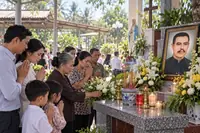
What is most striking about Tắc Sậy is that the people who come to the father’s grave are not only Catholics. Buddhists, followers of Cao Đài and Hòa Hảo, people of no religion: all come, standing together under the same roof, bowing together before the same grave. They may not know the theology or the rites of the liturgy. But anyone with a heart that can be moved can feel one thing: here was a father who lived, loved with all his heart, and died for others.
Chapter 11 of 11
A day of grace: the beatification at Tắc Sậy
In the eighty years since Father Diệp fell by the cold waters of Cây Gừa, the incense and prayers of millions of people have never stopped.
In 2012–2013 the Diocese of Cần Thơ formally opened the diocesan inquiry. Priests and historians went back through old registers page by page, interviewed every living witness and gathered thousands of documents into a thick dossier for the Dicastery for the Causes of Saints in Rome. After years of rigorous examination by theologians and historians and by the bishops and cardinals of the Holy See, the Holy Father approved the decree recognizing the martyrdom of the Servant of God Francis Xavier Trương Bửu Diệp, the shepherd who gave his life for the faith and for his flock.
The day millions had waited decades for came on the morning of Wednesday, July 2, 2026, at the Tắc Sậy Pilgrimage Center itself. For the first time in the history of the Church in Vietnam, a beatification was celebrated not in the faraway halls of the Vatican but, with the permission of the Holy See, on the very land of Tắc Sậy, where the father had once paddled his boat, ridden his bicycle, shared out rice can by can and breathed his last. Cardinal Luis Antonio G. Tagle, Prefect of the Dicastery for Evangelization, came as the envoy of Pope Leo XIV to preside at the Mass.
In the days before the celebration, more than seventy thousand people, from every region of the country and from Vietnamese communities on every continent, streamed into Bạc Liêu. Sixty-nine cardinals and bishops and more than eighteen hundred priests concelebrated, joined by thousands of religious sisters, brothers and seminarians. The crowds packed every road around Tắc Sậy, yet no one pushed or shoved; there was only deep emotion.
When the Holy Father’s representative solemnly proclaimed the Apostolic Letter of beatification, declaring that from now on the Servant of God Francis Xavier Trương Bửu Diệp would be called Blessed, his image in the familiar black cassock, with his kindly smile, was slowly unveiled. The vast crowd wept and broke into applause that rang across the Delta sky. The church bells pealed, mingling with prayers of thanksgiving that rolled like waves.
From a nameless grave in a corner of a marshy field in 1946, the kindly country father has now been raised to the altars by the universal Church. But though he now bears the title Blessed Francis Xavier Trương Bửu Diệp, deep in the hearts of the hard-working people of the Mekong Delta he will always be simply “Cha Diệp”: a father as close as family, gentle and forgiving, ready to listen to every sorrow of his children and to shelter anyone who comes to him for refuge, just as he once sheltered more than seventy people in that dark rice granary, eighty years ago.
The end of the story
You have walked with Blessed Francis Xavier Trương Bửu Diệp to the end of the story.
Some moments in the life of this country priest are hard to read without tears:
In the famine of 1944-1945 he opened the community’s granary, gave rice to the displaced and showed them fallow land to clear, never asking who was Catholic.
When people proposed turning the church into an armed stronghold, he flatly refused and declared: "Live or die, I stay among my people. Whoever wants to kill the old Father, let them kill him!"
When more than seventy of the faithful were locked in the rice granary to be burned alive, he stepped out three times to negotiate, and after the third time the granary doors were thrown open and everyone was saved, but he never came back.
Stay in silence
Now you know what a vow to stay can cost: a true shepherd lives among his flock and, when the hour comes, is ready to die in their place.
Live or die, I stay among my people. Whoever wants to kill the old Father, let them kill him!
Let us pray
Blessed Francis Xavier Trương Bửu Diệp,
in a time of famine you opened the granary to everyone, never asking who was Catholic. And when more than seventy of your people were locked in the rice granary, you stepped out so that they might live, and you did not come back.
Pray for the needy and the sick who turn to you in their distress.
Pray for parish priests, that they may stay with their flock, to live and die among them.
Amen.
Sources
- Feast dayCatholic Bishops’ Conference of Vietnam
- Often depicted withPatronages and symbols, version 1.1
- Reflectionvaticannews.va
- Reflectionhdgmvietnam.com