

Journey 3 · Young Lives Freely Given
Saint Lucy of Syracuse
A light that was kept
Feast day December 13
Tap to step inside
Saint Lucy of Syracuse
A light that was kept
Map of a life
This life told in 4 chapters
Begin the journey
Feast day
Saint Lucy of Syracuse
Some places may celebrate on a slightly different day.
December 13
Patron of
- The blind and those with eye trouble
- The city of Syracuse (Italy)
Often depicted with
- Eyes on a dish
- A lamp
- A crown of candles (Swedish tradition)
Opening
Opening
Every December, when many lands around the world enter cold winter days with little sunlight, the name of Saint Lucy comes back, together with images of light and warmth. A candle flickering in the long night, a radiant young face and an unshakable faith have carried the image of the virgin martyr across countless seas to believers on every continent.
Yet before she became a figure of poetry and art, Lucy was a real person of flesh and blood who lived and shed her blood in witness to Christ in Syracuse — a beautiful port city on the island of Sicily in southern Italy, once one of the most famous ancient Greek cities of the Mediterranean, with temples and stone theaters still standing today. She belonged to the generation of witnesses of the early Church, who gave up their young lives to keep the flame of faith alive under the brutal persecution of the emperor Diocletian.
Chapter 1 of 4
A devoted daughter beside her mother
The old accounts tell that Lucy was born into a wealthy, respectable noble family in Syracuse. Her father died when she was very young, so Lucy grew up in the care of her gentle mother, Eutychia. Her date of birth has been lost, but her martyrdom is generally dated to around the year 304.
As a young girl, moved by God’s grace, Lucy secretly promised to give her whole life to Christ in virginity. Meanwhile her mother, Eutychia — out of love for her fatherless daughter and wanting to secure her future — arranged to betroth her to a wealthy young nobleman who was a pagan. Mother and daughter loved each other dearly, but did not yet see the future in the same way.
Then illness struck the family. Eutychia suffered from a dangerous hemorrhage that lasted four years. Though she spent a great deal of money on treatment from famous physicians, her illness was beyond cure, and her body wasted away day by day.
When all hope seemed gone, Lucy gently persuaded her mother to make a pilgrimage with her to the nearby city of Catania, to the tomb of Saint Agatha, the famous virgin martyr who had died for her faith a few decades earlier.
Chapter 2 of 4
A pilgrimage that changed a home
At Saint Agatha’s shrine, while mother and daughter were praying earnestly, Lucy had a vision: Saint Agatha appeared, radiant among the angels, called her “my dear sister”, and told her that her own steadfast faith had healed her mother, and announced that Syracuse would be glorified through Lucy’s own martyrdom.
When Lucy opened her eyes, the miracle had happened: Eutychia could feel that the hemorrhage of so many years was gone. Her health came back remarkably.
That pilgrimage healed more than a body; it opened both their hearts. Faced with so great a gift from God, Eutychia fully understood and accepted her daughter’s wish to give her whole life to God.
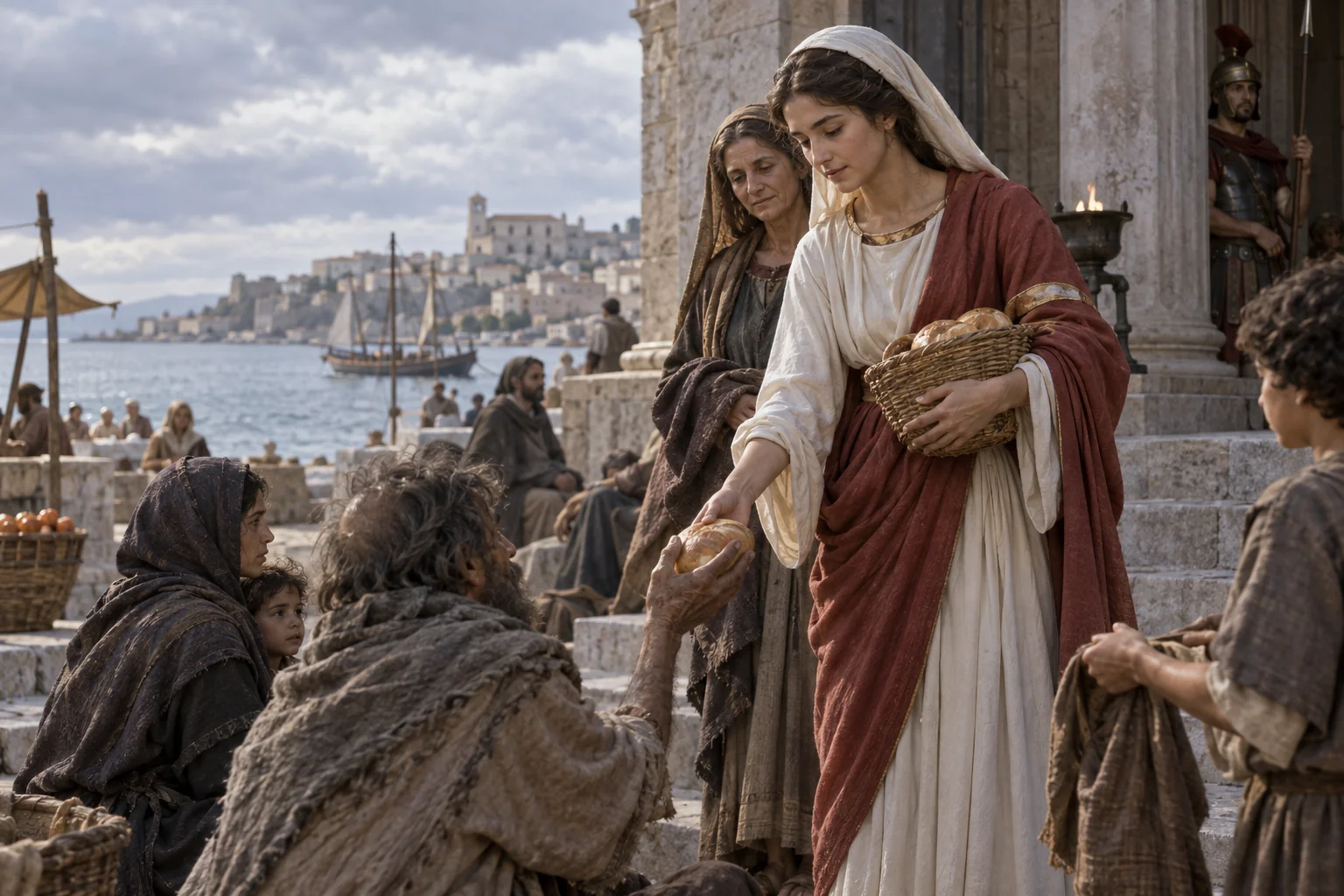
Back in Syracuse, Lucy asked her mother’s permission to sell her whole precious dowry, with her gold, silver and jewels, and distribute everything to the poor, the widows and the orphans of the city. Wealth once set aside to secure the family’s future became bread broken for the poorest of the poor.
Chapter 3 of 4
Betrayal, and courage before tyranny
When Lucy sold her entire fortune for the poor, the pagan young man who had been promised her hand flew into a rage. He had lost a huge dowry, and he knew he would never win the heart of the Christian virgin. Bitter and resentful, he denounced Lucy as a Christian to the prefect Paschasius.
Ironically, Lucy’s very generosity — which ought to have been praised — became the excuse that drove her to her death. People who do good in any age may run into the same paradox: not everyone who sees an act of generosity knows how to value it; some see only the gain that has been taken from them.
At that time, the persecuting edicts of the emperor Diocletian were being enforced harshly. The prefect had Lucy arrested at once and brought before the court.
At first, the judge tried to coax her with sweet words into offering incense to the gods and returning to a comfortable noble life. But Lucy answered firmly:
“The pure sacrifice most pleasing to God is to visit and help the poor and widows in their distress. I have given all my material wealth to God, and now I am ready to offer my very self as a living sacrifice to Him!”
The prefect angrily told her she must obey the emperor’s decree. Lucy calmly replied:
“You keep the laws of earthly emperors, but I must keep the law of the living God. You fear mortal kings, but I fear God alone, the Lord of life and death!”
Seeing that he could not break the young woman’s will with threats, the judge gave a vile order: he sent soldiers to drag her to a filthy brothel to be dishonored by lecherous men, to defile the virgin’s purity.
Yet her story tells that the power of the Holy Spirit protected her in a wonderful way: Lucy’s body suddenly became as immovable as a massive rock, so that dozens of soldiers pulling together could not move her even an inch. They even tied ropes to her and harnessed teams of oxen, and still she stood unmoved, praying in peace.
Beside himself with rage, the prefect ordered dry wood and pitch piled around her to burn her alive. But the leaping flames did not harm the virgin’s body. Finally, an executioner rushed in and drove a sword through her throat.
Lucy lingered on until priests could come and bring her Holy Communion one last time. She foretold the fall of the persecuting tyranny and the peace soon to come to the Church, then died peacefully on the very spot where the people of Syracuse later built a church bearing her name — Santa Lucia al Sepolcro. Beneath that church lies a whole system of catacombs dug from the second century, so vast that it is considered the second-largest complex of ancient Christian catacombs in all of Italy, after Rome. Because Roman law forbade burial within the city walls, the early Christians followed abandoned underground water channels from ancient Greek times to dig deep into the limestone, turning the suburb of Tyche into a shared resting place for the whole community.
Chapter 4 of 4
Eyes on a silver dish, and the light of the soul
In paintings and sacred art over many centuries, Saint Lucy is often shown holding a small silver dish with a pair of eyes on it.
From that image, later popular legends grew up telling that the judge ordered her eyes gouged out, or that she herself plucked out her eyes and sent them to her suitor so he would no longer be infatuated with her beauty, and that God then gave her a new and more beautiful pair of eyes. Though these details are not in the earliest historical texts, the symbol of the eyes carries a real meaning: the name Lucy comes from the Latin word Lux, meaning “Light”.
The eyes in the holy pictures remind believers of the eyes of faith: bodily blindness is a pain that needs comfort, but blindness of the soul — having eyes and not recognizing the truth, having eyes and closing them to the pain of others — is the greatest misfortune of all.
From that symbol, Saint Lucy has been honored for generations as the patron of those with eye diseases, the blind and eye doctors. The sick turn to her to ask for the grace of bodily sight, but above all for the grace of clear eyes of the soul, always able to recognize God’s will amid the dark nights of life.
Saint Lucy is named in Eucharistic Prayer I, the Roman Canon. The Church celebrates her on December 13 each year; in the old Julian calendar that date fell on the longest nights of winter, which makes her candle all the more meaningful in the darkness.
For Vietnamese believers, Saint Lucy leaves a clear example: true faith is not something abstract hidden in the heart, but must become eyes that see the hungry and poor around us so as to share our bread. Saint Lucy’s candle still shines bright in the dark winter, reminding each of us to become a spark of kindness, driving away the cold selfishness of today’s world.
The end of the story
You have walked with Saint Lucy of Syracuse to the end of the story.
You surely remember vividly:

Going on pilgrimage with her mother to pray for healing, then giving her whole dowry away to the poor.

Before the judge, she declared: "You fear mortal kings, but I fear God alone."

Bound with ropes and pulled by teams of oxen, she still stood unmoved, not shifting an inch.
Stay in silence
You come to understand: her faith was not something abstract hidden in the heart; it was eyes that could see the hungry and poor around her, and share.
The smallest candle can still drive away a whole long night, if it is willing to burn to the end.
Let us pray
Saint Lucy,
you gave your whole dowry to the poor, and declared boldly before the judge that you feared God alone.
You are the patron of those with eye trouble. Pray for those suffering from eye diseases, for the blind, and for the doctors who treat them.
Open the eyes of my heart, so that I may see the hungry and poor around me and learn to share.
Amen.
Sources
- Feast dayAuthor’s edited profile
- Patron ofPatronages and symbols, version 1.1
- Often depicted withPatronages and symbols, version 1.1
- Reflectionnewadvent.org
- Reflectionvaticannews.va
Meet the next one
 Journey 3