

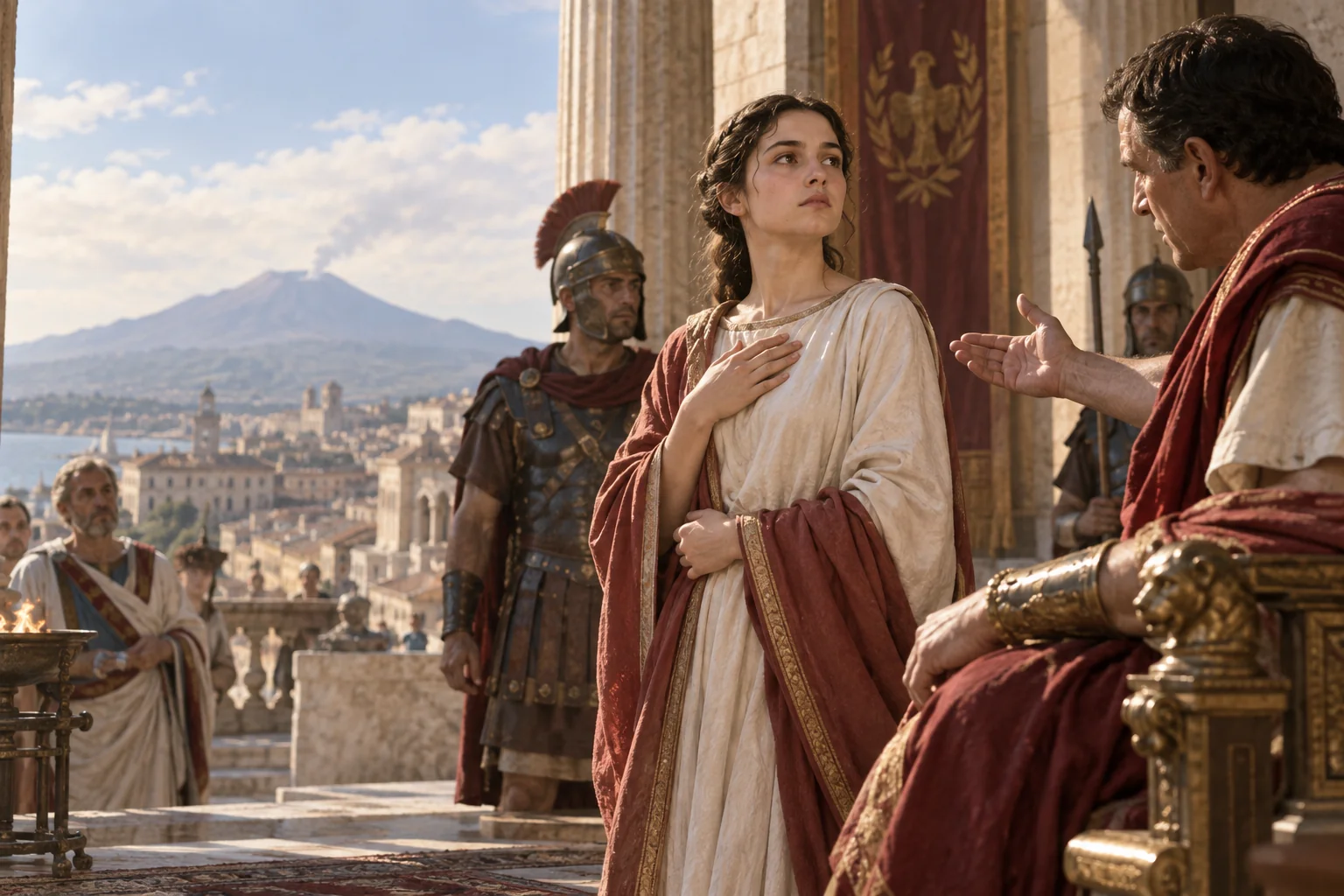
Journey 3 · Young Lives Freely Given
Saint Agatha of Catania
Dignity in the hands of the cruel
Feast day February 5
Tap to step inside
Saint Agatha of Catania
Dignity in the hands of the cruel
Map of a life
This life told in 4 chapters
Begin the journey
Feast day
Saint Agatha of Catania
Some places may celebrate on a slightly different day.
February 5
Patron of
- The city of Catania and the island of Sicily
- Protection against fire and volcanoes
- Those with breast cancer
Often depicted with
- A dish (recalling her torment)
- A palm branch
Opening
Opening
In the shadow of Mount Etna, magnificent and dangerous, the people of Catania in Sicily have known for generations how fragile life is: the ground under the homes they have built with such care can shake at any moment, and the familiar volcano can flare up and pour out lava that buries everything in an instant.
Through every disaster, the people of Catania have set their hope on a daughter of their own city: Saint Agatha.
She lived and died for Christ in the middle of the third century, when confessing the faith could cost a person the cruelest punishments. The Church has always counted her among the first virgin martyrs, and every February 5 her feast is kept with deep gratitude for this brave young witness.
Chapter 1 of 4
A virgin of the volcano’s land
No record survives of the date Agatha was born. The two ancient cities of Catania and Palermo in Sicily each have their own traditions about where she came from, but Catania is where she suffered and shed the last drop of her blood. Her martyrdom is linked to the persecution under the emperor Decius, around the year 251.
The ancient accounts tell that Agatha was born into a wealthy, noble family of deep faith. She grew up remarkably beautiful, but she saw early how fleeting beauty is, and she promised to give her whole life to Christ as his bride.
But her beauty and wealth caught the eye of Quintianus, the Roman governor of Sicily, a man driven by lust, greedy for money and drunk on power. Using the new edicts against Christians as cover, Quintianus had Agatha arrested, meaning to force her to give in to his desires.
Two cruelties were woven together in what followed: persecution for the faith, and the brutal coercion of a defenseless woman by a man with power in his hands.
At that time, a Roman governor held almost complete power of life and death over a vast territory, answerable to no one but the distant emperor in Rome. Against such power, a young woman on her own, even one of noble birth, had nothing to defend herself with but her faith. So Agatha’s story is about more than persecution. It lays bare a bitter truth of every age: power that answers to no one tends to trample those who have no voice.
Chapter 2 of 4
Standing firm against every snare
Hoping at first to break her resolve to stay chaste without using the whip, Quintianus handed her over to a notorious brothel keeper named Aphrodisia and her daughters. For thirty long days this woman tried every trick she knew: honeyed words, lavish and debauched banquets, threats meant to terrify, anything to make the young virgin waver and give in to the governor.
But Agatha’s soul was built on the rock of faith. She kept on fasting and praying and flatly refused every foul temptation. In the end the brothel keeper gave up, handed her back to the judge and complained:
“It would be easier to soften rock than to bend the heart of this girl!”
Humiliated that his plan had failed, Quintianus summoned Agatha to a public trial. He asked haughtily:
“You are of noble birth, so why do you lower yourself to live the base life of the Christians?”
Agatha held her head high and answered like a free woman:
“My true freedom and nobility is to be a servant of Christ!”
That answer must have stunned the whole court. In a society where noble rank was considered the highest honor a person could reach, Agatha overturned that whole scale of values with a single sentence. She did not deny her noble lineage, but she showed that there is a freedom greater than any title: the freedom of a soul with nothing left to lose, because it has freely given itself entirely to the One it loves.
Chapter 3 of 4
A wounded body, a dignity untouched
In a rage, the governor had her thrown into a dark dungeon, and days of savage torture began. She was stretched on a wooden rack, beaten with rawhide whips, and torn with sharp iron hooks.
The most barbaric cruelty came when the tyrant ordered the young woman’s breasts cut off. Agatha faced the inhuman judge and rebuked him:
“Cruel tyrant, are you not ashamed to torture in a woman’s body the very part with which your own mother nursed you and raised you?”
This harrowing detail is why, in sacred art, Saint Agatha is often painted holding a dish bearing her severed breasts, and why women suffering grave illnesses of the breast, especially breast cancer, have always turned to her for help.
To understand the saint, we need not dwell on the executioner’s cruelty. What we need to see is the dignity of the one who suffered: a person worthy of love, respect and protection.
There is something worth pondering in Agatha’s answer to the tyrant: she did not scream curses at her fate, nor beg for pity. She reminded him of the mother who bore him, of the humanity he had perhaps long since lost amid power and lust. Her words cut like a sword, yet they carried a strange compassion for the very man who was tormenting her.
Tradition tells that in the darkness of the dungeon, the Apostle Peter appeared to comfort her and heal her bodily wounds, filling the prison with a wondrous light.
The next day, seeing her healed and still firmly confessing her faith, the judge flew into a frenzy and ordered live coals and sharp potsherds spread on the ground, and her naked body rolled over them.
At that very moment, a violent earthquake shook Catania, bringing down a great wall of the courthouse and crushing two of the judge’s aides. The terrified people rushed in to protest the governor’s cruelty, forcing him to hurry Agatha back to her dungeon.
In the dungeon, dying of her wounds, the young virgin folded her hands and offered her last prayer:
“Lord, my Creator, You have always protected me from my childhood. You have taken from my heart all earthly love and given me strength to endure countless blows patiently. Now, receive my soul into eternal glory!”
Then she died in peace.
Chapter 4 of 4
The daughter who shields her city
One year after Saint Agatha’s death, on February 5, 252, Mount Etna erupted violently. A river of red-hot lava poured down the mountainside, threatening to destroy the whole city of Catania.
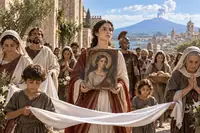
In utter panic, Christians and pagans alike ran to Saint Agatha’s tomb and took the veil that lay over it. People said this very veil had been licked by flames during her torment without being scorched at all. They held it high like a banner and went out to meet the river of fire. To everyone’s wonder, the lava stopped and turned aside, sparing the city at the last moment. From then on Saint Agatha was the patron who protected the people of Catania from fire, disaster and the volcano. That veil, with her other relics, is still kept with honor in the Cathedral of Catania, built at the end of the eleventh century. Whenever the volcano stirs, and every year on her feast, the people of the city carry those relics in procession through the streets for days and nights on end, in one of the largest religious festivals in all of Italy.
Saint Agatha’s name is also among the saints named in Eucharistic Prayer I, the Roman Canon.
For women in pain after surgery, and for anyone scarred by violence or living with incurable illness, Saint Agatha’s life is a deep comfort: a person’s worth and dignity are never lessened by what the body has lost. Whoever has the power to wound our body has no right to decide what our soul is worth.
She kept her heart whole for God in a world full of cruelty. And her prayers still stand like a strong wall around all who put their trust in God.
The end of the story
You have walked with Saint Agatha of Catania to the end of the story.
Some moments you will not forget:
Held for thirty days amid every lavish temptation, she kept on fasting and praying, never wavering.
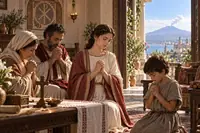
Mocked for following the faith, she held her head high: "My true freedom and nobility is to be a servant of Christ!"

In the midst of the cruelest torture, she still reminded her tormentor of the mother who had given birth to him.
Stay in silence
And you understand: whoever has the power to wound a person’s body has no right to decide what that person’s soul is worth.
A person’s dignity is never taken away by what their body has had to lose.
Let us pray
Saint Agatha,
held captive amid every temptation and torment, you still held your head high: "My true freedom is to be a servant of Christ."
Pray for women who are abused and violated. Let them know that no one has the right to take away the dignity God has given them.
Pray for those suffering from breast cancer, and keep my homeland safe from disaster and fire.
Amen.
Sources
- Feast dayAuthor’s edited profile
- Patron ofPatronages and symbols, version 1.1
- Often depicted withPatronages and symbols, version 1.1
- Reflectionnewadvent.org
Meet the next one
 Journey 3