

Journey 3 · Young Lives Freely Given
Saint Cecilia
A song that stayed in the heart
Feast day November 22
Tap to step inside
Saint Cecilia
A song that stayed in the heart
Map of a life
This life told in 4 chapters
Begin the journey


Feast day
Saint Cecilia
Some places may celebrate on a slightly different day.
November 22
Patron of
- Sacred music
- Choirs, musicians and singers
Often depicted with
- An organ
- A wreath of roses
Opening
Opening
Before Sunday Mass begins in Vietnamese churches, the choir loft is always the busiest corner of the church: someone carefully turning the pages of the hymnbooks, someone tuning an instrument, someone quietly warming up their voice, and the choir director watching the altar for the signal. Those simple sounds, and those long evenings of rehearsal after an exhausting day’s work, have become part of the very fabric of faith for generation after generation of Catholics.
In this world of music offered to God, Saint Cecilia holds a special place. She is painted seated at an organ, and honored as the patron of sacred music.
Yet the story of her life begins with a song that needed no keyboard or earthly instrument at all: the silent song of a heart turned wholly to God while all the noise around it tried to pull it another way.
Chapter 1 of 4
A young noblewoman of Rome
Cecilia is a famous martyr of the Church of Rome. The early centuries left us very few hard facts about her youth. We have no birth date and no year of martyrdom on which historians fully agree; the dates proposed usually fall in the second or third century.
Yet the Christian community’s devotion to her has left deep and clear traces. By the end of the fifth century, a basilica bearing Saint Cecilia’s name stood in the old Trastevere quarter of Rome, built right on the foundations of her family’s former house. Archaeological excavations beneath the church today still reveal the remains of an ancient Roman house from the second century before Christ, a steam bath, and even a small altar to the goddess Minerva from that same house: silent layers of brick and stone that tell her story more clearly than any book. The memory of her tomb in the cemetery of Callistus was also kept by the faithful through all the upheavals of the centuries.
An account of her martyrdom handed down from the fifth century has given later generations a full and moving story of her life. Though written in the devotional style of its day, it has kept intact her ideal of consecration and her steadfast witness as a martyr.
It is worth noting that this ancient Roman house, where Cecilia would later spend the last hours of her life, was no poor, makeshift dwelling, but a fine residence in the heart of an aristocratic quarter. To give up everything such wealth could offer and keep only one thing, faithfulness to Christ, shows a rare inner freedom in Cecilia: not the freedom of someone with nothing to lose, but of someone who had weighed it all and knew for certain what was worth keeping.
Chapter 2 of 4
A song on her wedding day
According to the ancient account, Cecilia was born into an illustrious noble family in Rome. Touched by God’s grace, she came to believe in Christ as a young girl and promised to give her whole life to Him as a virgin.
But according to the social custom of the time, her parents arranged, without consulting her, to marry her to Valerian, a wealthy, virtuous young pagan nobleman.
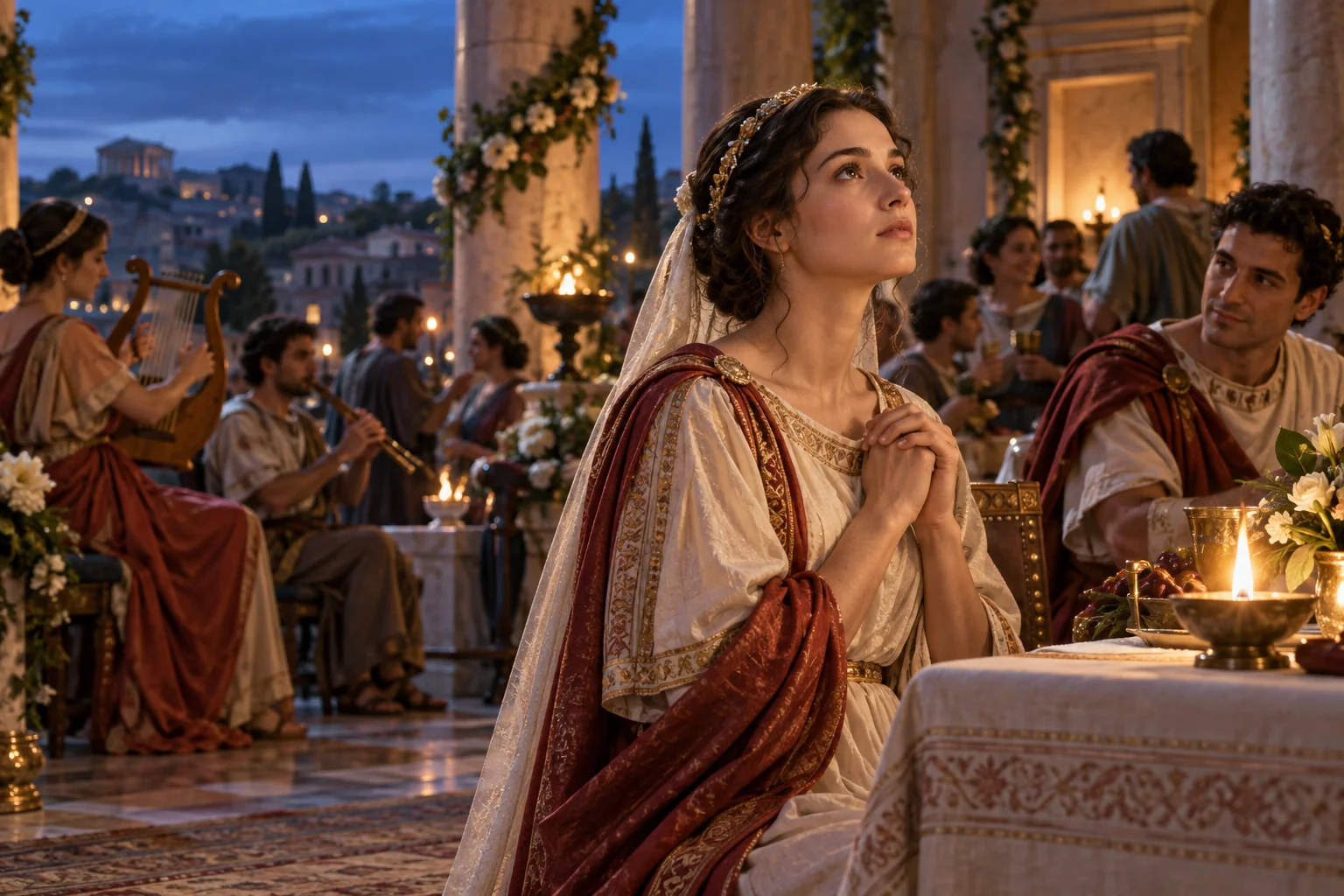
The wedding day was lavish and splendid. Lamps and candles blazed, there was a great banquet, and trumpets and strings rang out merrily through the palace.
It is at this moment that the ancient liturgy gives us a beautiful line:
“While the instruments of the world resounded at the wedding, in the depths of her heart the virgin Cecilia sang to God alone: Lord, keep my heart and my body pure, that I may never be put to shame!”
That line is why the Church honors her as patron of music. Cecilia’s song was not a performance for the wedding guests. It was the song of a praying heart. In a setting where everyone around her thought she belonged entirely to the world, her heart stayed turned toward God.
On the wedding night, when the two were alone, Cecilia bravely opened her heart to her young husband. She spoke to Valerian about the Christian faith, about her vow to give herself to God, and about an angel of the Lord who guarded her purity every day. She urged him to go and see Bishop Urban, who was hiding in the catacombs, to learn about the faith.
Moved by the holiness and pure bearing of his young wife, Valerian went to find the bishop. Touched by grace, he was baptized and came home a new man. Back in their room, he saw a radiant angel standing beside Cecilia, holding out to them two fragrant crowns of roses and lilies.
Valerian’s brother, Tiburtius, then heard the couple share their faith, recognized the truth and asked to be baptized. Cecilia did not keep her faith to herself; it shone out and transformed the people closest to her.
Chapter 3 of 4
Blood that bore witness to faith
In the time of persecution, the brothers Valerian and Tiburtius gave away all their money to the poor, and night after night secretly buried the bodies of martyrs thrown out on the rubbish heaps. That act of charity was soon discovered. The two brothers were arrested, bravely professed their faith and were beheaded for the name of Christ. The Roman officer escorting them, named Maximus, was so moved by their courage that he too came to believe and was martyred the same day.
After carefully burying her husband and brother-in-law, Cecilia knew her own fate was near. Before she was arrested, she managed to do something remarkable: she gave away all the family’s remaining wealth to the poor of the neighborhood, so that not a single coin of it would fall into the hands of those hunting down believers. The prefect ordered her arrested and forced to sacrifice to the gods. She calmly refused, and her wise answers took apart every one of the judge’s clever arguments.
Furious, the judge ordered her shut in a sealed steam bath, with a great fire lit beneath it to suffocate her with smoke and heat. It may well have been the same steam bath whose remains archaeologists later found beneath the church that bears her name. But after a whole day and night had passed, they opened the door and were astonished to find her completely unharmed, as if a cool breeze had been blowing over her.
Finally, an executioner was ordered to behead her right in her house. Trembling, he swung his sword three times at her neck but did not sever her head. Under Roman law at the time, an executioner was not allowed more than three strokes, so he fled in fear, leaving the young woman lying in a pool of blood.
Cecilia lived on, barely breathing, for three more days. Believers from all over the city came and knelt around her. Though she could no longer speak aloud, she comforted everyone with her loving gaze. She asked the bishop to turn her house into a place of worship for the community.
And before she breathed her last, she raised her two hands in a sign: one hand holding up three fingers, the other one finger: a silent but powerful profession of faith, to her last drop of blood, in the one God in three Persons.
Chapter 4 of 4
A song across the centuries
In 1599, during the restoration of the Basilica of Saint Cecilia in Trastevere, her marble tomb was opened. Before the astonished eyes of Cardinal Sfondrati and other witnesses, the body of Saint Cecilia was found wonderfully intact after more than a thousand years: she lay on her side, peaceful as if asleep, the wound on her neck still visible, and her hands still in the position of three fingers and one, professing the Holy Trinity.
The very next year, 1600, the young sculptor Stefano Maderno, who had witnessed the scene, carved a white marble statue showing her exactly as she lay. It became one of the first masterpieces of the Baroque sculpture about to blossom in Rome, and today, beneath the high altar, it still draws millions of pilgrims to prayer.
The Church celebrates Saint Cecilia on November 22 each year. Her name is also among the saints named in Eucharistic Prayer I, the Roman Canon.
For Vietnamese church choirs, Saint Cecilia is like a mother and an older sister. She reminds singers that to sing sacred music is to pray twice, but the words on our lips are worth something only when they come from a pure soul and are joined to a song of love deep in the heart. The technique may be good and the harmonies precise, but if the heart is still full of envy, division or pride, that song cannot rise up to God’s throne.
Cecilia sang the most beautiful song of her life amid earthly hardships. And when the music of the liturgy falls silent, believers are invited to carry Cecilia’s song into everyday life: so that every word we speak, every time we give way to others and every loving gesture may become a quiet hymn of praise to God.
The end of the story
You have walked with Saint Cecilia to the end of the story.
A few moments you will always remember:

Amid the festive music of her wedding day, in her heart she sang for God alone to hear.

On her wedding night, she told her husband about an angel who guarded her purity day and night.

Struck three times without her head being severed, she lived three more days, raising her fingers to profess One God in Three Persons to her last breath.
Stay in silence
One thing slowly sinks in: the most beautiful song is not the one that carries farthest, but the one that rises from a pure soul, even if no one hears it.
Technique may be perfect, but only a pure heart lets the song rise to heaven.
Let us pray
Saint Cecilia,
amid the music of your wedding day, your heart sang for God alone to hear. And to your last breath, you raised your fingers to profess One God in Three Persons.
You are the patron of sacred music. Pray for the singers and musicians of my parish, that their singing may be prayer and not a bid for praise.
May my life too become a song offered to God, even if no one hears it.
Amen.
Sources
- Feast dayAuthor’s edited profile
- Patron ofPatronages and symbols, version 1.1
- Often depicted withPatronages and symbols, version 1.1
- Reflectionnewadvent.org
Meet the next one
 Journey 3