

Journey 3 · Young Lives Freely Given
Saint Joan of Arc
The country girl who carried a banner
Feast day May 30
Tap to step inside
Saint Joan of Arc
The country girl who carried a banner
Map of a life
This life told in 11 chapters
Begin the journey OpeningOpening1 min
 Chapter 1 of 11A girl with no surname1 min
 Chapter 2 of 11Voices in the family garden1 min
 Chapter 3 of 11Eleven days to Chinon1 min
 Chapter 4 of 11The banner at Orléans1 min
 Chapter 5 of 11The coronation at Reims1 min
 Chapter 6 of 11The tower of Beaurevoir1 min
 Chapter 7 of 11The trial at Rouen1 min
 Chapter 8 of 11The fire in the Old Market1 min
 Chapter 9 of 11Twenty-five years later1 min
- Chapter 10 of 11After the fire1 min
 Chapter 11 of 11Our own Joan1 min
Feast day
Saint Joan of Arc
Some places may celebrate on a slightly different day.
May 30
Patron of
- France (second patron, 1922)
- Soldiers
- Women in the military
Often depicted with
- Armor
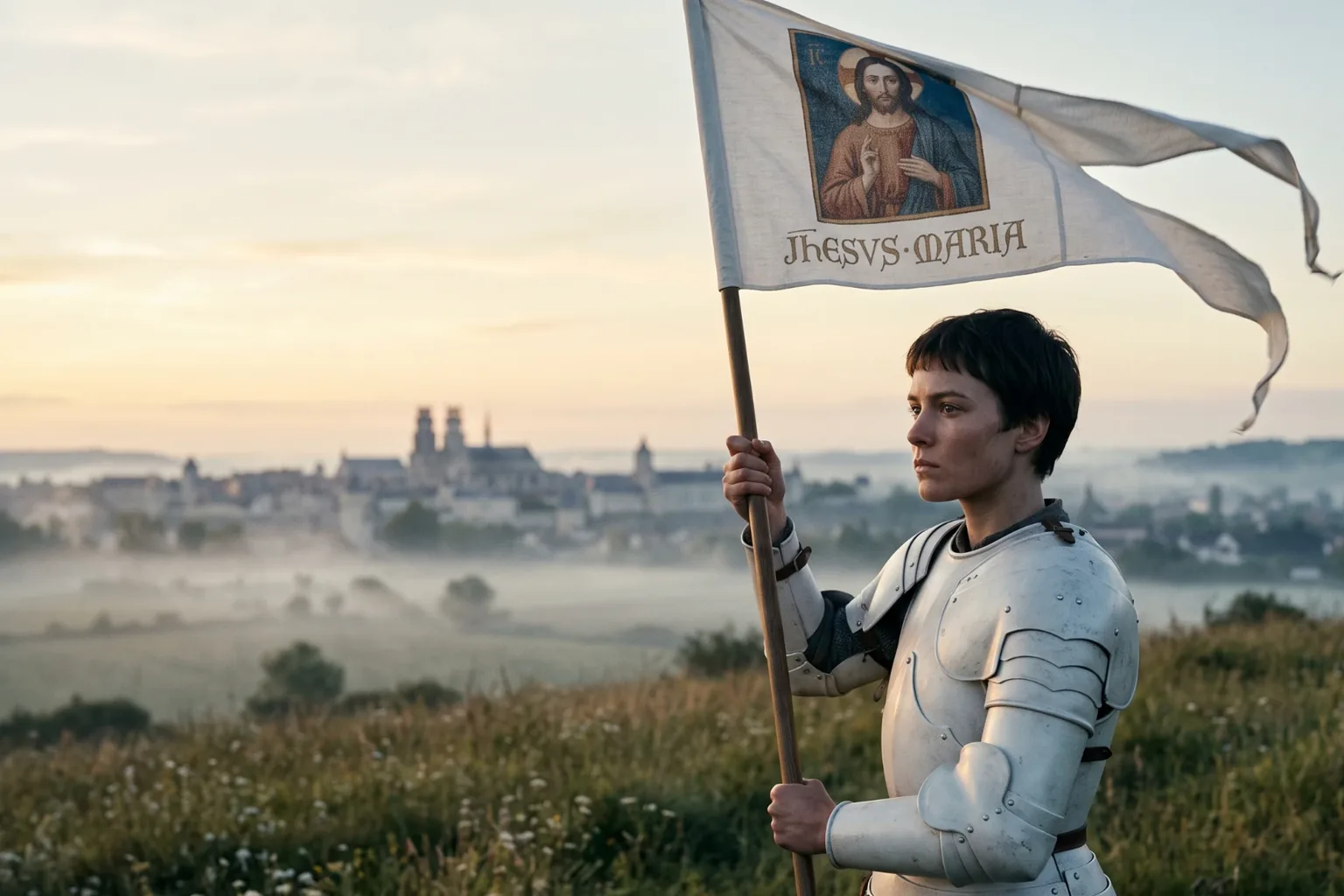
- A banner bearing the names of Jesus and Mary
- A horse
Opening
Opening
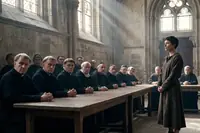
On February 24, 1431, in a courtroom in the city of Rouen, a nineteen-year-old country girl who could neither read nor write was surrounded and questioned by dozens of theologians, university professors and bishops. They wanted to trap her. One asked: “Do you know whether you are in God’s grace?”
It was a treacherous question. If she answered “yes”, they would condemn her for pride, since according to the Church’s teaching no one can be certain of being in God’s grace. If she answered “no”, she would be admitting she was a sinner, and everything she had said about “voices from heaven” would be false.
The girl answered: “If I am not, may God put me there; and if I am, may God keep me there.”
The trial record notes that her questioners were stunned. That girl was Joan, whom later generations call Jeanne d’Arc, and whom Vietnamese Catholics know as Thánh Gioanna Đắc — Saint Joan of Arc.
There are few saints whose very words we know so well. We owe this not to those who loved her, but to those who wanted to kill her: the record of the trial that condemned her, carefully noting every question and every answer, still survives today.
Chapter 1 of 11
A girl with no surname
Joan was born around 1412 in Domrémy, a small village on the river Meuse in northeastern France. Her father, Jacques, was a fairly well-off farmer of the village; her mother, Isabelle, was a devout woman who taught her daughter the Our Father, the Hail Mary and the Creed. That was all the schooling she had. She never spent a day learning her letters.
Few people know that she never called herself “Jeanne d’Arc”. Before the court she said that in her village she was called Jeannette, and after she left home people called her Jeanne. She did not know what her surname was. The name she called herself, and used to sign her letters, was “Jehanne la Pucelle”, Joan the Maid. “d’Arc” was her father’s surname, used later by historians, and it became the name the whole world knows.
At that time France was in the Hundred Years’ War with England. The English and their Burgundian allies held almost half of France, including Paris. The heir to the throne, the Dauphin Charles, had not yet been crowned, and was holed up south of the Loire, mocked by his enemies as “the king of Bourges”. The village of Domrémy lay right in the borderlands, and its people had had to flee when soldiers passed through, burning and looting.
Chapter 2 of 11
Voices in the family garden
One summer noon when she was thirteen, in her father’s garden, Joan heard a voice from her right, toward the church, together with a great light. She told the court that the first time she was very frightened. The voice, she later realized, was that of the Archangel Michael, and the first thing he told her was very simple: be good, and go to church often.
Later she also heard the voices of Saint Catherine and Saint Margaret, two virgin martyrs. Those voices came to her often, especially when the church bells rang. And little by little they told her something unbelievable: she must go and save France, lift the siege of Orléans, and take the Dauphin to Reims to be crowned.
She was a country girl who had never ridden a warhorse or held a sword, and she could not read. She kept the secret for three years, telling no one, not even the parish priest. Her father, knowing nothing of the voices but having once dreamed that his daughter ran off with soldiers, told his sons that if that ever really happened, they should drown their sister in the river before letting that happen.
At sixteen she went to Vaucouleurs, the nearest town with the Dauphin’s troops, and asked to see the commander. He laughed in her face and told her uncle to take her home to her father for a few good slaps. She did not give up. She went back a second time, then a third. In the end, as the townspeople began to believe in her, the commander agreed to give her a horse, a sword and six men as an escort.
Chapter 3 of 11
Eleven days to Chinon
At the beginning of 1429 Joan cut her hair short and put on men’s clothing to travel more safely, and with six soldiers crossed more than five hundred kilometers through territory held by the enemy, mostly traveling by night. Eleven days later they reached the castle of Chinon, where the Dauphin Charles was staying.
Witnesses later said that the court wanted to test her: the Dauphin mingled among his courtiers, dressed like everyone else, to see whether the girl would recognize the heir to the throne. She went straight up to him and knelt to greet him. Then she asked to see him privately, and told him something no one else has ever learned. All we know is that after that meeting, the Dauphin began to believe in her.
But the court remained cautious. They sent her to the city of Poitiers to be examined by theologians for three weeks: was she sent by God, or a witch, or just a mad girl? One theologian asked, in a heavy local accent: “What language do your voices speak?” She answered: “A better one than yours.” They asked whether she believed in God. She said: “More than you do.” They demanded a sign. She replied: “I did not come to Poitiers to make signs. Take me to Orléans, and I will show you the sign I was sent to give.”
The theologians concluded that they found nothing bad in her: only humility, purity, devotion and simplicity.
Chapter 4 of 11
The banner at Orléans
The city of Orléans on the Loire had been besieged by the English for more than six months. If Orléans fell, the whole south of France would lie open to the enemy.
Joan was given a suit of white armor. But she did not carry a sword into battle. She carried a white banner showing Christ enthroned over the world, with an angel on either side, and the words “Jhesus Maria”. Later, before the court, she said she loved her banner forty times more than her sword, and carried the banner into battle so as not to have to kill anyone. She said she had never killed anyone.
Before attacking, she dictated a letter to the English commanders, urging them to go home in peace. She made the soldiers go to confession, forbade them to swear, and sent away the women who followed the army. Hardened soldiers, used to looting, for the first time found themselves going into battle behind a seventeen-year-old girl carrying a banner who made them go to Mass.
On May 7, 1429, in the attack on the fortress of the Tourelles guarding the way into the city, an arrow pierced her between the neck and shoulder. She wept with pain, but pulled the arrow out herself, then went back to the fight as evening came on. Seeing her banner flying again, the French surged forward. The fortress fell. The next morning, May 8, the English withdrew. The siege of Orléans, which had lasted more than seven months, was lifted within nine days of her arrival.
To this day, nearly six hundred years later, the city of Orléans holds a festival on May 8 every year, a tradition that began the very year after the battle. Each year a young woman of the city is chosen to wear armor, ride a horse and play Joan at the head of the procession.
Chapter 5 of 11
The coronation at Reims
After Orléans came a series of victories along the Loire. Then Joan urged the Dauphin to set out for Reims, the city where, by tradition, the kings of France had to be anointed and crowned to be considered lawful kings. Reims lay deep in enemy territory. The courtiers tried to dissuade him. She kept pressing him.
On July 17, 1429, in Reims Cathedral, the Dauphin Charles was anointed and became King Charles VII. Joan stood beside the altar, holding her banner. Later, before the court, she was asked why her banner had been carried into the cathedral at the coronation, when the other commanders’ banners had not. She answered with words the French still know by heart: “It had shared in the toil; it was right that it should share in the honor.”
Her father and mother had come from Domrémy to Reims for the ceremony. It was the last time they saw their daughter.
Chapter 6 of 11
The tower of Beaurevoir
After the coronation, her luck began to turn. The new king preferred negotiating to fighting on. The attack on Paris in September 1429 failed, and she was hit in the thigh by a crossbow bolt. The court gradually distanced itself from her.
On May 23, 1430, in a skirmish outside the town of Compiègne, Joan stayed at the rear to cover the troops retreating into the town. The town gate was shut before she could get in. A Burgundian archer pulled her from her horse by her cloak. She was captured.
She was held in the tower of Beaurevoir. Hearing that the enemy was about to massacre the people of Compiègne, she said she would “rather die than live to see good people killed”, and jumped from the tower, more than a dozen meters up. She did not die, but was badly hurt and unconscious for several days. Later she admitted before the court that the voices had told her not to jump, and that she had asked God’s forgiveness.
King Charles VII, whom she had brought to the throne, did nothing to ransom her. The Burgundians sold her to the English for ten thousand livres.
Chapter 7 of 11
The trial at Rouen
The English wanted her dead, but did not want to kill a prisoner of war. They wanted her condemned as a witch and a heretic, to prove that the French victories were the devil’s work, and that the king she had brought to the throne was the king of a witch.
The trial began in January 1431 in Rouen, presided over by Bishop Pierre Cauchon, a man who sided with the English. For months the nineteen-year-old was held in a cell guarded day and night by English soldiers, her legs in chains, instead of in a Church prison guarded by nuns as the law required. She was interrogated dozens of times, sometimes by several people firing questions at once.
It was during that trial that the girl who could not read said things that left professors of the University of Paris at a loss. When they asked whether Saint Michael wore clothes when he appeared to her, she asked back: “Do you think God has nothing to clothe him with?” When they asked whether God hated the English, she said: “I do not know whether God loves or hates the English. I only know they will be driven out of France, except those who die here.”
They accused her of wearing men’s clothing, against the law. She explained that among guards watching her day and night, men’s clothing, with its tightly fastened laces, was the only way to protect her chastity.
On May 24, before a stake already prepared, frightened and exhausted, she signed a recantation with a cross and promised to wear women’s clothing again. But only a few days later, she was wearing men’s clothing again. Some witnesses later said the guards had taken away her women’s clothing, or that she had been threatened with assault. She told the judges that the voices had reproached her for denying the truth to save her life. And so she was condemned as a “relapsed heretic” and handed over to the secular court to be burned alive.
Chapter 8 of 11
The fire in the Old Market
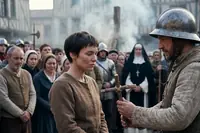
On the morning of May 30, 1431, Joan was brought to the square of the Old Market in Rouen. She asked for a cross. An English soldier, whose name history does not record, broke a stick in two, tied the pieces into the shape of a cross, and gave it to her. She kissed it and put it inside her dress. Then she asked a priest to bring the cross from a nearby church and hold it up high before her, so that she could look at it to the very end.
Those present later testified that amid the flames she called out the name “Jesus” many times, the last time very loudly. Many in the crowd, including some of the English, burst into tears. Some say a secretary of the English king walked away saying: “We are lost; we have burned a saint.”
Her ashes were thrown into the Seine, so that no one could keep them as relics. She was not yet twenty.
Chapter 9 of 11
Twenty-five years later
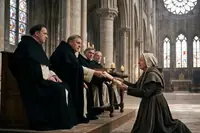
In 1456, at the petition of Isabelle, Joan’s mother, by then elderly, and of the Inquisitor General Jean Bréhal, Pope Callixtus III ordered a retrial. He was the same Pope who, that same year, ordered the bells to be rung at noon when Belgrade was besieged.
More than a hundred witnesses were questioned: villagers of Domrémy, soldiers who had followed her, clergy who had been present in Rouen. On July 7, 1456, the court declared the sentence of 1431 null and void, full of deceit and injustice. Joan was rehabilitated.
But it would be nearly five hundred years more before she was raised to the altars. In 1909 Pope Pius X beatified her. On May 16, 1920, just after the First World War, Pope Benedict XV canonized her. Two years later she was declared second patron of France.
The American writer Mark Twain, famous for his stories about Tom Sawyer and Huckleberry Finn, spent twelve years researching and two years writing a novel about Joan. Near the end of his life he said it was the best of all his books, and the one he loved most.
Chapter 10 of 11
After the fire
Bishop Pierre Cauchon, who presided over the trial, died suddenly in 1442 while being shaved by a barber. The rehabilitation trial of 1456 named him outright as the man who had condemned an innocent person for worldly motives. The English were driven out of almost all of France only a little more than twenty years after Joan’s death, just as she had told the court they would be.
Over the centuries, Joan has become one of the figures most written about, painted and put on the stage in European history. Shakespeare, Schiller, Voltaire and Bernard Shaw all wrote about her, each in his own way, some mocking, some praising. Every age and every faction has wanted to claim her as its own symbol.
In 2011, at a general audience, Pope Benedict XVI devoted a whole catechesis to Saint Joan. He stressed something biographers often forget: the center of that young woman’s life was not battle, but prayer. She had a very personal love for Jesus, always putting the names of Jesus and Mary on her banner and in her letters, and it was that love that made her strong. He also spoke of a painful paradox: she was a saint condemned by a Church tribunal, and it was the Church itself that later recognized that error and raised her to the altars.
Chapter 11 of 11
Our own Joan
In Vietnam, Joan is a common baptismal name for girls, and many who bear it take Saint Joan of Arc as their patron, celebrating her feast on May 30.
People often remember Joan as a heroine leading troops, riding a horse, wearing armor. But perhaps what made her a saint lies not in her victories, but in what she did when every victory was lost. Abandoned by the very king she served, unjustly condemned by men holding office in the Church, she still did not hate the Church. She still asked to go to confession, asked to receive the Body of the Lord, asked for a cross, and called the name of Jesus until her last breath.
She never said she was sure of being saved. She only said: if I am not in God’s grace, may God put me there; if I am, may God keep me there. That is the prayer of a humble person, not of a heroine. And perhaps it is the most beautiful prayer a young person can carry with them every day.
The end of the story
You have walked with Saint Joan of Arc to the end of the story.
Images that will stay with you:
A seventeen-year-old girl pulling an arrow out of her own shoulder, then picking up her banner and going back to the fight.
Before dozens of theologians, the girl who could not read answering: "If I am not, may God put me there."
A nameless English soldier breaking a stick and tying it into a cross to give to her before the stake.
Stay in silence
At the end of her story, you realize that Joan became a saint not because of her victories, but because of how she kept her faith when she had lost everything.
Today, carry Joan’s prayer with you: if I am not in Your grace, Lord, put me there.
Let us pray
Saint Joan,
you were only a country girl who could not read, yet you dared to rise up when God called. Help young people today to listen for God’s voice amid so much noise, and to have the courage to do what is right.
When I am misunderstood, abandoned or judged unjustly, help me not to become bitter, but to keep my faith as you did.
And help me each day to say to God as you did: if I am not in Your grace, put me there; if I am, keep me there.
Amen.
Sources
- Feast dayArticle, version 1.1
- Patron ofPatronages and symbols, version 1.1
- Often depicted withPatronages and symbols, version 1.1