

Journey 7 · Going Far, Standing Firm
Saint Charles de Foucauld
The universal brother in the Sahara desert
Feast day December 1
Tap to step inside
Saint Charles de Foucauld
The universal brother in the Sahara desert
Map of a life
This life told in 6 chapters
Begin the journey OpeningOpening1 min
 Chapter 1 of 6The wild youth of an orphaned aristocrat1 min
 Chapter 2 of 6An expedition to Morocco and a mysterious call in the desert1 min
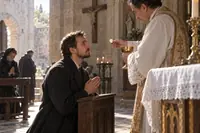 Chapter 3 of 6“As soon as I believed there was a God...”1 min
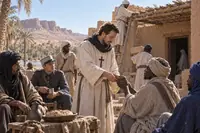 Chapter 4 of 6A universal brother in the Sahara1 min
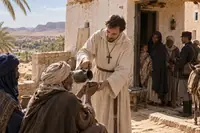 Chapter 5 of 6A grain of wheat buried deep in the earth1 min
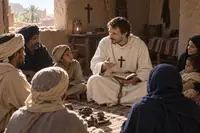 Chapter 6 of 6An abundant harvest from the desert1 min
Feast day
Saint Charles de Foucauld
Some places may celebrate on a slightly different day.
December 1
Often depicted with
- A red heart and cross on a white robe
- The Sahara desert
Opening
Opening
In the remote oasis of Tamanrasset, in the heart of the burning sands of the Sahara at the beginning of the twentieth century, people would see a Frenchman of about fifty wearing a rough white robe with a red heart topped by a cross on his chest. He lived in a crude hut of earth and stone, nearly fourteen hundred meters up in the barren Hoggar mountains; he ground his own flour, baked his own bread, and spent hours prostrate before a simple wooden tabernacle.
Around him lived the poor Tuareg people, leading a nomadic life in the wilderness. In fifteen years living among them, he did not baptize a single adult, did not found a busy parish, and never preached a single public sermon. He simply lived as a little brother, kindly sharing every bowl of water and every bit of medicine, and patiently learning their words one by one.
That silent hermit was Charles de Foucauld, known in religion as Brother Charles of Jesus. His was an extraordinary transformation: a pleasure-loving young aristocrat and officer who had lost all faith was changed by the love of Christ into a “universal brother” to all. He chose the very last place, living in the desert like a grain of wheat buried deep in the earth, and from that hidden life came a harvest that would later produce dozens of religious communities and spiritual movements.
Chapter 1 of 6
The wild youth of an orphaned aristocrat
Charles Eugène de Foucauld was born on September 15, 1858, in the city of Strasbourg, France, into a rich and distinguished noble family. His father, Édouard de Foucauld, was a forestry official; his mother was Élisabeth de Morlet.
When Charles was only six, his father and mother died within a few months of each other. The orphaned boy and his younger sister Marie were taken in by their maternal grandfather, Colonel Beaudet de Morlet, a man who loved them dearly but spoiled his grandson far too much. Heir to a large family fortune, young Charles entered the famous military academy of Saint-Cyr. There he soon became notorious for his extravagant, dissolute life: lavish parties, expensive wine, gambling and women. He said that he had given up the Christian faith at sixteen, and he considered himself a complete atheist.
In 1880 he graduated as a cavalry officer and was posted to Algeria, in North Africa. There he caused a scandal by insisting on keeping his mistress with him in the garrison, and the army disciplined him, removed him from his post and sent him home for conduct unbecoming an officer. But when he heard that his old regiment in Algeria was going into a dangerous campaign against rebels, his pride as a soldier stirred. He broke off with his mistress, volunteered to rejoin, went to the front lines and fought with great courage.
Chapter 2 of 6
An expedition to Morocco and a mysterious call in the desert
When the fighting was over, Charles de Foucauld, captivated by the wild beauty of North Africa, resigned from the army in 1882 to make a daring expedition into Morocco, at that time a closed Muslim land that Christians entered on pain of death. He disguised himself as a poor Jewish rabbi named Joseph Aleman, went barefoot and in rags, and walked thousands of kilometers across the snowy Atlas Mountains and the Sahara. He secretly kept a journal, drew topographical maps and took astronomical measurements.
That eleven-month expedition won him the prestigious Gold Medal of the Geographical Society of Paris in 1885, making him a famous explorer. But what changed Charles’s soul was not scientific fame. In the empty desert he watched Muslims bow to the ground in prayer five times a day, in total reverence before the Most High, and something stirred deep in the dry soul of the young atheist. He began to ask himself whether God existed. Back in Paris, he would often slip into empty churches, kneel hidden behind the stone pillars and whisper a strange prayer:
“My God, if You exist, let me know You!”
Chapter 3 of 6
“As soon as I believed there was a God...”
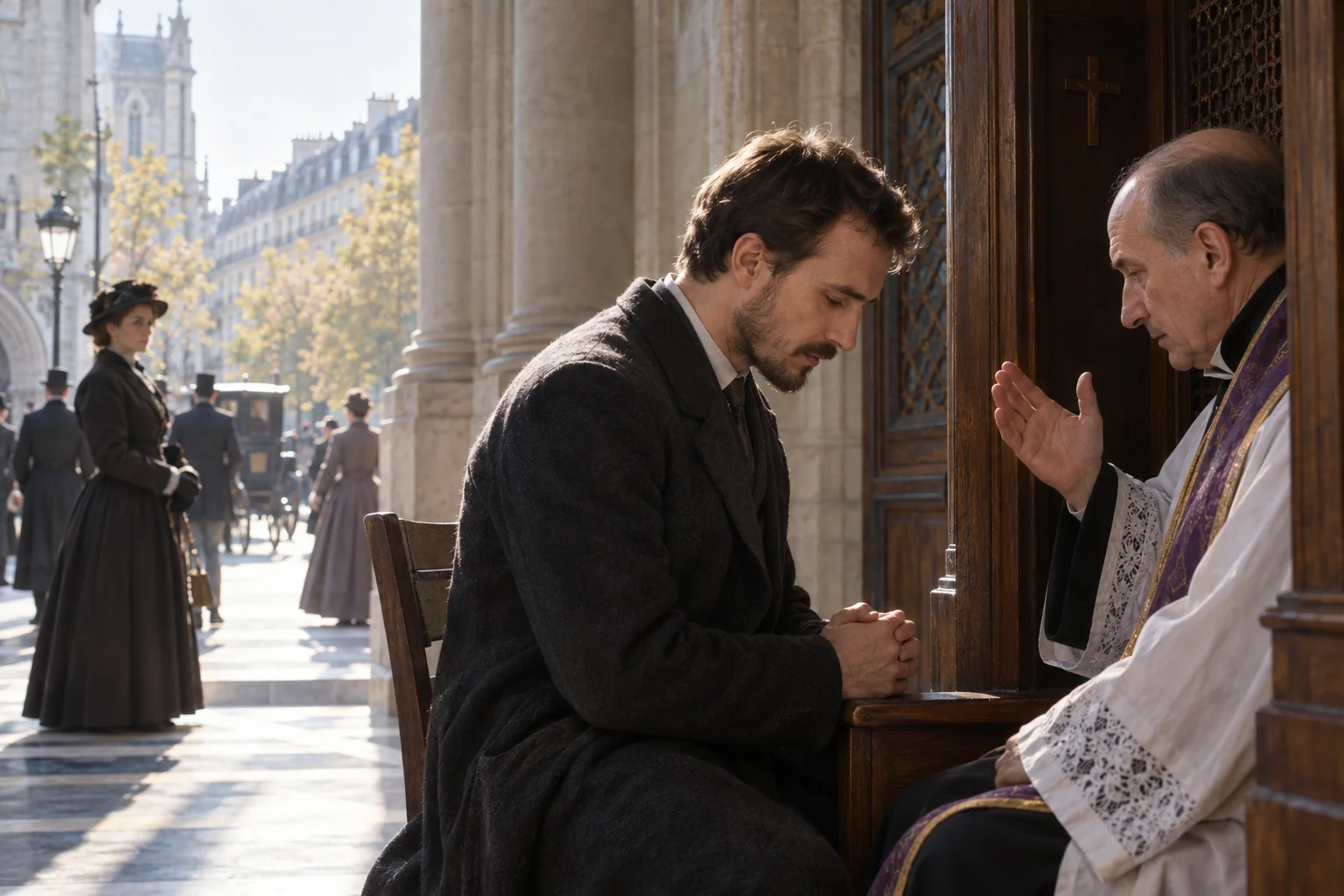
God led him to Father Henri Huvelin, a wise and holy priest at the church of Saint Augustine in Paris. At the end of October 1886, Charles came to Father Huvelin’s confessional wanting to discuss religion. The priest looked deep into the eyes of the twenty-eight-year-old and said:
“You do not need to argue; kneel down, confess and believe in God’s mercy!”
Charles knelt, confessed the sins of his past in tears, and received Holy Communion that very morning.
His conversion was as sudden as lightning. He later wrote the words that shaped the whole rest of his life:
“As soon as I believed there was a God, I understood that I could do nothing else but live for Him alone!”
In 1888 he made a pilgrimage to the Holy Land. Walking the dusty roads of Nazareth, where the Son of God had lived for thirty years as a poor, unknown workman, Charles found the one ideal of his life: to live “the life of Nazareth”. In 1890 he gave away his whole fortune and entered the Trappists (the Cistercians of the Strict Observance) at Notre-Dame des Neiges, later moving to a still poorer monastery at Akbès, in Syria.
But after seven years of monastic life, he felt these monasteries were still too comfortable and secure. He asked permission to leave the order to live a more radical poverty. From 1897 to 1900 he lived in Nazareth as an unknown handyman for the Poor Clare nuns, sleeping in a wooden toolshed, sweeping the yard, gardening and cleaning every day, and spending whole nights in prayer before the tabernacle. Urged by his spiritual director, he returned to France to study theology and was ordained a priest at Viviers on June 9, 1901, at forty-two.
Chapter 4 of 6
A universal brother in the Sahara
After his ordination, Father Charles de Foucauld set out at once for the Algerian desert. He settled at the oasis of Béni Abbès, a remote outpost in the Sahara. There he built with his own hands a “House of Brotherhood”, the Khaoua, open to everyone: lonely French soldiers, travelers crossing the desert, the hungry poor and black slaves. He used money sent by his relatives to buy slaves their freedom. He said:
“I want all the inhabitants here — Christians, Muslims, Jews and unbelievers — to look on me as their brother, the universal brother of everyone!”
In 1905, at the invitation of his old friend General Laperrine, he went still deeper into the southern desert and settled at Tamanrasset, an isolated village in the rocky, barren Hoggar mountains, home of the Tuareg. There he lived completely alone among the nomads. He did not try to convert them with sermons. The way he left to those who would follow him was “mission through presence”:
“I am here not to talk about Christ, but to live Christ... Let us live in such a way that when people see how we live, see our gentleness and our charity, they will ask themselves: who is the One this man worships, that He makes him so good?”
He patiently learned Tamahaq, the language of the Tuareg. In ten years of tireless work he compiled an enormous four-volume French–Tuareg dictionary, a priceless work of linguistics and anthropology that preserved the culture of these nomads and is still consulted by researchers today. He knitted warm clothes and shared every grain of barley with the villagers in years of drought and famine. The Tuareg, once suspicious, came to see him as a “marabout”, a holy man who watched over the tribe.
Chapter 5 of 6
A grain of wheat buried deep in the earth
In 1914 the First World War broke out, bringing unrest even to the Sahara. Armed bands rose up, raiding and fighting the French. Friends urged him many times to withdraw to the safety of the military forts, but Father Charles refused. He said:
“I cannot abandon my poor people now!”
He built a small mud-brick fort at Tamanrasset as a refuge for the villagers whenever raiders came.
On the evening of December 1, 1916, a band of Senussi raiders led by El Madani ag Soba surrounded the fort. A man he knew tricked him into opening the door. They burst in, dragged him outside, tied his arms behind his back and made him kneel on the ground. Then, at a cry that French troops were coming, the fifteen-year-old set to guard him, Sermi ag Thora, panicked, put his gun to Father Charles’s head and pulled the trigger.
Shot through the head, Father Charles de Foucauld fell onto the desert sand without a cry or a word of reproach. He was fifty-eight. The raiders ransacked his mud house. His body was hastily buried in a hole in the sand outside the fort.
Later, when a French officer and his men came to the scene, they found the small monstrance holding the Blessed Sacrament, which Father Charles had adored for so many hours, lying half-buried in the sand a few steps from his body. The priest had died beside the One he had loved passionately all his life.
Chapter 6 of 6
An abundant harvest from the desert
When he died, Father Charles de Foucauld had nothing to show the world: not one disciple had joined him, and the religious community he dreamed of did not yet exist. But the Gospel saying about the grain of wheat came true in full. From the blood he shed in the desert, more than twenty spiritual families (religious congregations, secular institutes and lay movements) have sprung up around the world in his spirit, among them the Little Brothers of Jesus, the Little Sisters of Jesus and the Lay Fraternity of Charles de Foucauld. They live among the poorest of all: poor workers in the slums, in the desert and on the factory floor.
Pope Benedict XVI beatified him in 2005. And on May 15, 2022, Pope Francis solemnly canonized Charles de Foucauld in Saint Peter’s Square. The Church celebrates him on December 1 each year.
Saint Charles de Foucauld left a spirituality for our time:
“Our prayer must make us people who know how to love... Cry the Gospel with your whole life!”
The officer who had lost his faith became a hermit who died alone in the desert, yet his spiritual family now reaches every continent. He teaches each of us that mission does not mean forcing anything on anyone, or winning noisy arguments. It means daring to become everyone’s little brother, living kindly and serving quietly, so that through that gentle presence others may recognize the face of God, who is Love.
The end of the story
You have walked with Saint Charles de Foucauld to the end of the story.
Three moments stay with you:
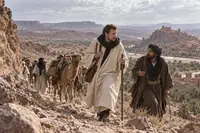
Once an atheist, he knelt quietly behind the stone pillars of a Paris church, whispering: "My God, if You exist, let me know You!"
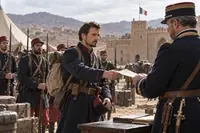
In fifteen years among the Tuareg in the Sahara, he baptized no one, but quietly lived among them as a little brother.
He was shot by a panicked guard of only fifteen, and the monstrance with the Blessed Sacrament was found lying just a few steps from his body.
Stay in silence
You see the quietest way to spread the Gospel: not through sermons, but by living so that others ask themselves who could have made this man so good.
I am here not to talk about Christ, but to live Christ.
Let us pray
Saint Charles de Foucauld,
you were once an atheist, then knelt in a church whispering: "If You exist, let me know You." And you lived as a little brother in the middle of the desert.
Pray for those who are searching for God and have not yet found Him.
Teach me to proclaim the Gospel by my life more than by my words, and to entrust everything into the Father’s hands: "Father, I abandon myself into Your hands."
Amen.
Sources
- Feast dayAuthor’s edited profile
- Often depicted withPatronages and symbols, version 1.1
- Reflectioncharlesdefoucauld.org
- Reflectionvatican.va
Meet the next one
 Journey 7