

Journey 3 · Young Lives Freely Given
Saint Bernadette Soubirous
Beyond the grotto, a life given
Feast day April 16
Tap to step inside
Saint Bernadette Soubirous
Beyond the grotto, a life given
Map of a life
This life told in 6 chapters
Begin the journey OpeningOpening1 min
 Chapter 1 of 6The Cachot and a poor family2 min
 Chapter 2 of 6A morning gathering firewood by the Gave2 min
 Chapter 3 of 6Honesty under endless pressure1 min
 Chapter 4 of 6Leaving fame behind for religious life1 min
 Chapter 5 of 6A sickbed, and the mission of one who suffers1 min
- Chapter 6 of 6An incorrupt body, a hidden life1 min
Feast day
Saint Bernadette Soubirous
In Lourdes itself, the feast is kept on February 18
April 16
Other feast days
- The proper feast in Lourdes · February 18
Patron of
- The sick
- The poor
- The town of Lourdes
Often depicted with
- A rosary
- The grotto of Lourdes
- The spring
Opening
Opening
Millions of people from every continent come to Lourdes each year, drawn by the grotto of Massabielle, the miraculous spring that never stops flowing, and the graces of healing at Our Lady’s feet. Yet the poor little girl who once stood before that grotto spent the rest of her life somewhere completely different: far from the bustling crowds of pilgrims, hidden behind the quiet walls of the convent at Nevers, amid piles of laundry and a long, relentless illness.
To really know Bernadette, we must walk with her along both roads of her life: from the light-filled grotto of Lourdes to the dark infirmary at Nevers; from the admiring applause of crowds to the silence of a nun learning to live the word of God each day.
Chapter 1 of 6
The Cachot and a poor family
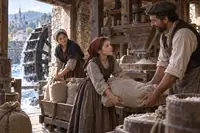
Marie-Bernarde Soubirous, known affectionately as Bernadette, was born on January 7, 1844, at the Boly mill in the town of Lourdes in southwestern France. Two days later she was taken to the parish church to be baptized. Her father, François Soubirous, and her mother, Louise Castérot, were millers. Her earliest years were happy ones, warm with her parents’ love.
But the business failed, and the family slid into poverty. In 1854 they lost the Boly mill and had to scrape by as day laborers. The next year, a terrible cholera epidemic broke out in Lourdes and Bernadette fell gravely ill. The aftereffects of the disease, along with asthma she had from birth, left her lungs permanently damaged, making every breath a struggle.
By the winter of 1857, the family was so destitute that all six of them had to take shelter in a cramped, damp, dark room of just sixteen square meters, called the Cachot. It had once been the town jail, abandoned in 1824 because it was so unsanitary, and a cousin of her mother’s, André Sajoux, took pity on them and let them live there free of charge. The child who had grown up to the sound of rushing water at the mill was now shut inside four moldy stone walls, often going hungry. That room is still preserved today as a small museum in the heart of Lourdes, and visitors are struck by the contrast between that humble beginning and the splendor of the basilicas built later.
Bernadette never went to school. She had to work to earn her keep, and for a time went to the village of Bartrès to herd sheep for people the family knew. When she returned to Lourdes at the beginning of 1858, the fourteen-year-old still could not read or write standard French, spoke only the local dialect, and longed to learn her catechism so she could prepare for her First Communion.
Yet hardship and lack of schooling did not make Bernadette dull or ashamed of herself. Everyone who met her noticed in the girl a complete honesty, a sharp memory and a way of answering that was both plain and remarkably witty. Under her ragged, patched clothes was a free spirit with a quiet dignity.
Chapter 2 of 6
A morning gathering firewood by the Gave
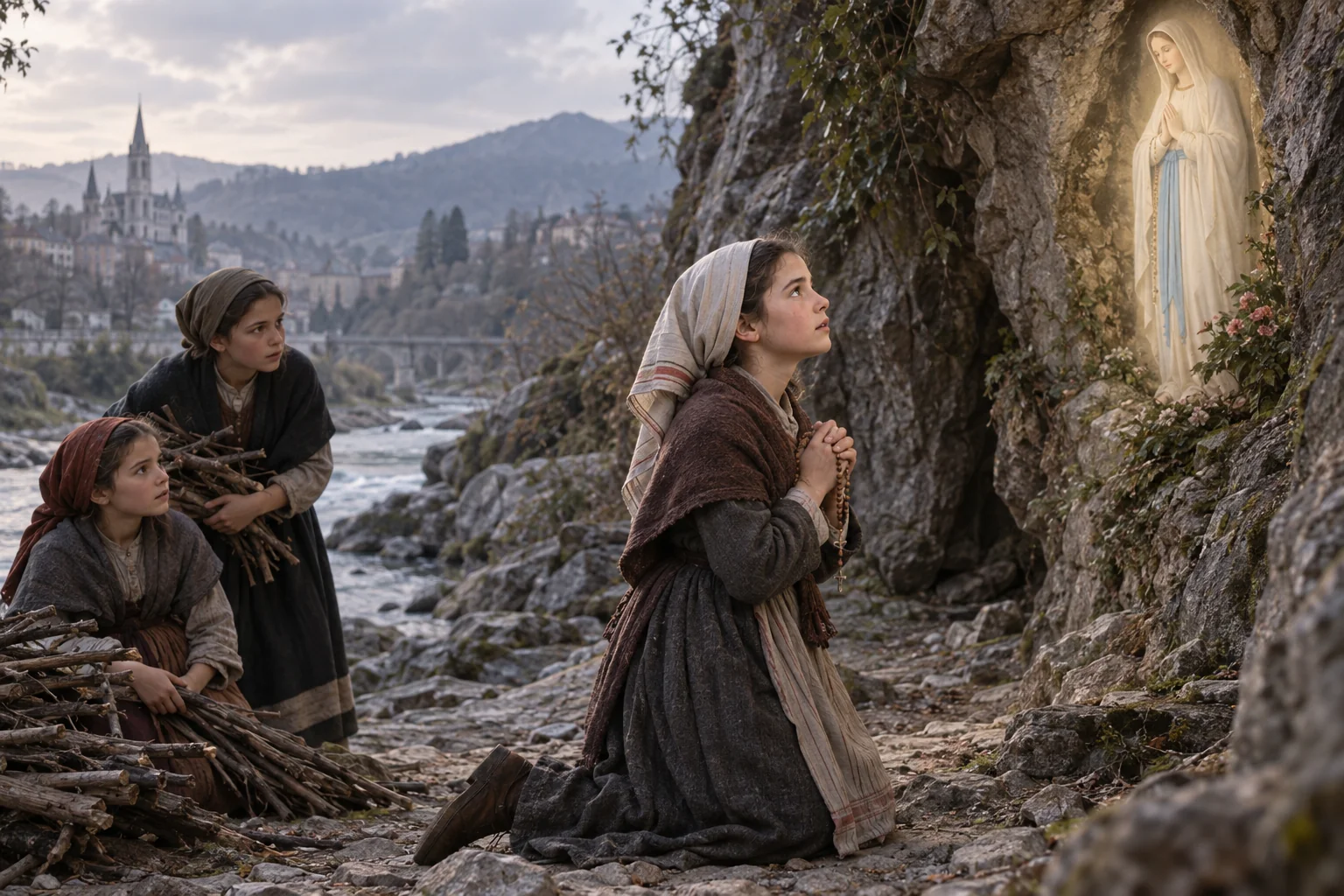
February 11, 1858, was a bitterly cold winter day. Bernadette, her younger sister Toinette and a friend went together to the bank of the Gave de Pau river, near the lonely grotto of Massabielle, to gather dry wood for the fire.
Her two companions had already waded across the icy, shallow channel, but Bernadette hesitated to take off her stockings for fear of an asthma attack. Suddenly she heard a sound like a strong gust of wind. Looking up at a natural hollow in the rock face, she was stunned to see a beautiful Lady dressed in pure white, with a sky-blue sash, and a golden rose on each foot.
She rubbed her eyes, thinking she must be dreaming. She hurriedly took the rosary from her pocket and tried to make the Sign of the Cross, but her arm suddenly trembled and would not lift. Only after she saw the Lady make the Sign of the Cross solemnly could she make it too and begin the Rosary. When the prayers were over, the Lady smiled and vanished.
What began as a poor family’s errand for firewood became the first of eighteen apparitions, from February to July 1858.
On February 25, following Our Lady’s instructions, Bernadette crawled on her knees into a corner of the grotto and dug at the muddy ground with her bare hands, then drank and washed her face. The onlookers jeered that she was mad. But soon afterwards, clear water gushed out from that very patch of mud — the miraculous spring that for more than a century and a half has brought healing to so many of the sick who had lost all hope.
On March 25, after the parish priest, Father Peyramale, had demanded several times that she find out the name of the one appearing to her, the Lady folded her hands at her breast, raised her eyes to heaven and said in Bernadette’s own dialect:
“Que soy era Immaculada Councepciou”
— I am the Immaculate Conception.
An unschooled fourteen-year-old who had never heard of the dogma of the Immaculate Conception, proclaimed by the Pope just four years earlier, kept repeating those words to herself all the way to the presbytery so as not to forget a single difficult syllable. Father Peyramale was stunned, recognized the hand of God, and wept.
On June 3, 1858, Bernadette made her First Communion. On July 16 came the last apparition, as she looked toward the grotto from the far bank of the Gave because the authorities had fenced off the entrance.
Chapter 3 of 6
Honesty under endless pressure
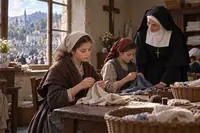
After the apparitions, a storm broke out. The police commissioner, the mayor, the imperial prosecutors, journalists and thousands of curious people questioned and cross-examined the poor girl again and again. Some threatened her with prison, some offered her money, others suspected she was mentally ill and deluded.
Yet Bernadette always held to her simple testimony, never changing. She never added or dropped a single detail to please the adults, and firmly refused every coin pilgrims pressed into her hand. She once said calmly:
“The Lady did not tell me to make people believe; she only gave me the task of telling them!”
That kind of steadiness takes great strength. Suspicion can wear a person down; flattery can spoil her just as easily. Bernadette came through both with her soul untouched.
After a rigorous canonical investigation lasting four years, on January 18, 1862, the Bishop of Tarbes officially issued a decree recognizing the apparitions at Lourdes as worthy of belief. Lourdes was on its way to becoming one of the great pilgrimage sites of the world. Bernadette, for her part, needed a hidden life.
Chapter 4 of 6
Leaving fame behind for religious life
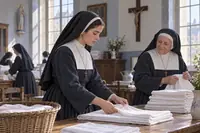
From July 1860, to protect her from the curiosity of the crowds, Bernadette was sent as a boarder to the convent of the Sisters of Charity of Nevers in Lourdes. There she learned to read and write, learned to sew, and helped care for the sick and elderly.
On July 4, 1866, after much thought, Bernadette left her hometown of Lourdes and her beloved grotto to set out for the motherhouse in the faraway city of Nevers. In the convent she received the habit and the religious name Sister Marie-Bernard.
At her superior’s command she told the whole story of the apparitions once, before the entire community; from then on she was not to bring up the grotto herself. She settled into the daily rhythm of an ordinary sister: praying, sweeping, doing laundry and assisting in the infirmary.
Convent life was not a string of peaceful days. Some superiors, wanting to test the virtue of one to whom Our Lady had appeared, treated her very harshly and coldly. Bernadette accepted all those unjust corrections in silent obedience. She never went back to Lourdes, not even once; her beloved grotto now lived only in her prayer.
Chapter 5 of 6
A sickbed, and the mission of one who suffers
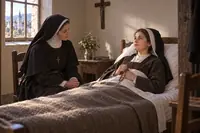
From 1875, Bernadette’s health collapsed completely. Tuberculosis of the bone ravaged her knee, making her leg swell and causing terrible pain, along with suffocating asthma attacks. In her last years she was almost entirely bedridden.
When a visitor, full of pity, asked what she was doing in her sickbed, she smiled and whispered:
“My work is to suffer... I lie here to pray for sinners!”
At the grotto of Lourdes long ago, Our Lady had spoken words that proved prophetic:
“I do not promise to make you happy in this world, but in the next.”
Now those words were coming true to the letter.
At Lourdes, the miraculous spring still flows, healing so many of the sick. But at Nevers, the one who had uncovered that spring had to bear pain to the very end. Set the two pictures side by side and they say something: bodily healing is a gift from God, but suffering borne patiently out of love is a grace nobler still.
On the afternoon of April 16, 1879, the Wednesday after Easter, after making the Sign of the Cross very slowly and fervently, Bernadette spoke her last prayer:
“Holy Mary, Mother of God, pray for me, a sinner... a sinner...”
, then peacefully breathed her last, at the age of thirty-five.
Chapter 6 of 6
An incorrupt body, a hidden life
Thirty years after her death, during the process for her canonization, Bernadette’s tomb was opened. The doctors and witnesses were astonished: her body was completely intact, her skin soft, her face fresh, as if she were only sleeping. Today her incorrupt body still lies in a clear crystal casket in the chapel of the convent at Nevers.
Pope Pius XI beatified her in 1925 and solemnly canonized her on December 8, 1933. The Church canonized Bernadette not because she saw Our Lady, but because she lived a life of heroic virtue, always humble, truthful and steadfast in carrying the Cross after the Lord to the end.
In parishes and Catholic villages in Vietnam, the Lourdes grotto with the statue of Mary in white and little Bernadette kneeling with her rosary has become a deeply beloved image. People go there to weep when they are at the end of their rope, and to whisper thanks when they have come safely through danger.
Saint Bernadette reminds us that, beyond visible miracles, what God asks of each of us is a life given to Him at home and at work: doing small things quietly, and staying faithful to Him even when illness closes in around us.
The end of the story
You have walked with Saint Bernadette Soubirous to the end of the story.
You will keep recalling:
In the biting cold by the river, she was stunned to see a beautiful Lady whom no one else could see.
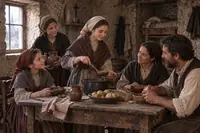
Questioned endlessly by officials of every kind, she only repeated exactly what she had seen, adding nothing and leaving nothing out.
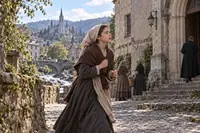
Leaving the grotto forever, she withdrew into a convent and bore illness in silence: "My work is to suffer."
Stay in silence
You understand more clearly: the Church did not canonize her for seeing Our Lady, but for a truthful, humble life to her very last breath.
Visible miracles pass — only a life of quiet faithfulness remains forever.
Let us pray
Saint Bernadette,
you were a poor girl with little schooling who saw Our Lady at the grotto of Lourdes. Questioned without end, you told only exactly what you had seen, adding nothing and leaving nothing out.
Teach me to live honestly and simply, without dressing myself up for others’ praise.
Pray for the sick who suffer in silence, as you suffered in the convent. May Our Lady of Lourdes comfort and heal them.
Amen.
Sources
- Feast daySanctuary of Our Lady of Lourdes
- Patron ofPatronages and symbols, version 1.1
- Often depicted withPatronages and symbols, version 1.1
- Reflectionlourdes-france.org
- Reflectionlourdes-france.org
Meet the next one
 Journey 3