

Journey 3 · Young Lives Freely Given
Saint Thérèse of Lisieux
Love in little things
Feast day October 1
Tap to step inside
Saint Thérèse of Lisieux
Love in little things
Map of a life
This life told in 7 chapters
Begin the journey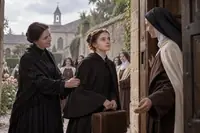 OpeningOpening1 min
 Chapter 1 of 7The youngest of the Martin family1 min
 Chapter 2 of 7The Christmas night of conversion1 min
 Chapter 3 of 7The door of the Carmel1 min
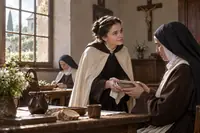 Chapter 4 of 7The little way: small things with great love1 min
- Chapter 5 of 7A heart beyond four walls1 min
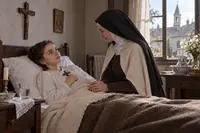 Chapter 6 of 7The night of faith, and her last breath1 min
- Chapter 7 of 7A shower of roses on the earth1 min
Feast day
Saint Thérèse of Lisieux
Some places may celebrate on a slightly different day.
October 1
Patron of
- The missions (declared by Pius XI in 1927)
- France (co-patron, 1944)
- Florists and gardeners
Often depicted with
- Roses
- Holding a crucifix covered with roses
- A brown Carmelite habit and white mantle
Opening
Opening
She did not have many years in this world: twenty-four in all. Nor did she ever travel to faraway lands to preach, like so many famous missionary saints. She spent the last nine years of her life behind the walls of the Carmelite convent in the small town of Lisieux, doing the laundry and the sweeping, beside sisters whose temperaments did not always suit her.
Yet from within those narrow walls a road opened for millions of souls around the world: the “little way of spiritual childhood”. People who feel weak, who know they will never do anything earth-shaking, who are always afraid they are not good enough to come close to God, have found in Thérèse a path that is gentle and yet deeply courageous: to love God through the smallest things placed in our hands each day.
Chapter 1 of 7
The youngest of the Martin family
Marie-Françoise-Thérèse Martin was born on January 2, 1873, in Alençon, France, the youngest daughter of Louis Martin and Zélie Guérin. The family had already lost four little children, so the youngest was welcomed with all the tenderness of her parents and sisters.
But when Thérèse was only four and a half, her gentle mother died of breast cancer. The loss left the little girl oversensitive and with a lasting fear of being parted from those she loved. The family moved to Lisieux, to a house called Les Buissonnets: a red-brick, middle-class French villa of the nineteenth century, its front trimmed with carved woodwork, with a small belvedere upstairs where her father liked to sit and read in silence, a little flowerbed in front, and behind it a shady garden, a yard and a vegetable patch. In that peaceful home her father and sisters surrounded her with love, and Thérèse chose her second sister, Pauline, to be her second mother.
In 1882, when Pauline entered the Carmel, nine-year-old Thérèse suffered another heartbreaking parting. She fell gravely ill, with long bouts of convulsions and delirium that the doctors could do nothing about.
On May 13, 1883, while her father and sisters knelt praying by her bed, Thérèse looked up at the statue of Our Lady beside her and saw Our Lady smile at her. The illness vanished completely.
On May 8, 1884, Thérèse made her First Communion. The Host came into her soul like a kiss of love. Yet she was still very fragile and easily hurt; the slightest harsh word would bring floods of tears.
She was not born with the calm strength of a great saint. Her little way began with a girl who had to struggle against her own weakness and touchiness.
Chapter 2 of 7
The Christmas night of conversion
On Christmas night 1886, when Thérèse was nearly fourteen, a small incident became the great turning point of her life.
As always when she was little, after coming home from Midnight Mass, Thérèse ran upstairs, eager to come back down and find the presents her father had put in the shoes by the fireplace. Just then her father, Louis Martin, tired after a long day, let slip a complaint to her sister Marie:
“Well, fortunately this is the last year, she is far too old for such childish things!”
Normally such a careless remark would have left sensitive little Thérèse in tears. Marie quickly told her not to go down. But suddenly God’s grace flooded her soul with strength. She swallowed her tears, came downstairs smiling, opened her presents with cries of delight, and made her father very happy.
Thérèse called it “the night of my complete conversion”. In one brief moment she stepped out of her touchy, fragile self and began to think of the happiness of others.
Her heart opened wide to the call of mission. In the summer of 1887 she heard that Henri Pranzini, sentenced to the guillotine for a brutal murder, still refused to repent. Thérèse fasted, made sacrifices and had Masses offered for him. Just before he went to the guillotine, the condemned man suddenly turned, seized the crucifix the priest was holding and kissed it three times.
Thérèse took it as a sign: God’s mercy has no bounds, and silent prayer can save souls at the far ends of the earth.
Chapter 3 of 7
The door of the Carmel
Thérèse longed to enter the Carmel of Lisieux at only fifteen. Because she was so young, the superiors and the bishop firmly opposed it.
But the girl had an iron will. On a pilgrimage to Rome in November 1887, during a crowded audience, Thérèse dared to fall on her knees at the feet of Pope Leo XIII and plead:
“Most Holy Father, if you allow it, I will be able to enter the Carmel at fifteen!”
The Pope looked at the young girl and said kindly: “Obey your superiors... You will enter if it is God’s will.”
After a long and trying wait, on April 9, 1888, the door of the Carmel of Lisieux opened to receive her.
Religious life was no romantic dream. Behind the convent door lay hard reality: strict silence, the bitter winters of northern France, long hours of prayer, and above all, living with some very difficult personalities. She made her solemn profession on September 8, 1890, taking the religious name: Thérèse of the Child Jesus and of the Holy Face.
The two titles sum up her whole spirituality: “the Child Jesus” speaks of childlike trust in the loving arms of the Father, and “the Holy Face” draws her into the mystery of the suffering face of Christ, mocked and spat upon in His Passion.
In 1889, her beloved father, Louis Martin, suffered a severe mental breakdown and had to be placed in an asylum. The pain and humiliation fell heavily on the four sisters in the convent. Thérèse carried that pain into silent prayer, learning to see the Holy Face of Jesus hidden in her father’s broken body.
Chapter 4 of 7
The little way: small things with great love
Reading Scripture, Thérèse felt she could never compare with the great saints of old. She saw herself as a tiny grain of sand, unable to climb the steep stairway of perfection on her own.
But she discovered a wonderful secret: the elevator that would lift her to heaven was the arms of Jesus. To be carried by Him she did not need to grow big; on the contrary, she had to stay very little and trust entirely in His mercy.
In community life, Thérèse’s “little way” took very concrete forms:
- smiling and being patient with a difficult sister who was always grumbling beside her;
- patiently putting up with a sister whose habit of clicking her rosary beads distracted her during prayer;
- willingly accepting chipped bowls or the dirtiest cleaning jobs without a word of complaint.
True love does not wait for chances to be heroic. It can be found in picking up a pin from the floor for love of God.
On June 9, 1895, the feast of the Holy Trinity, Thérèse offered her whole life as a “holocaust to the Merciful Love of God”. At her superior’s request she began writing down her childhood memories and the story of her vocation, which became the book now known around the world: Story of a Soul.
Meditating on the First Letter to the Corinthians, she realized that she could not be an apostle traveling everywhere, nor a prophet or a teacher, and she cried out with joy:
“In the heart of the Church, my Mother, I will be love!”
Chapter 5 of 7
A heart beyond four walls
The convent walls could not hold back the missionary fire in her heart. From 1895 her superior gave her two missionaries to support with her prayers and letters: Father Maurice Bellière, and Father Adolphe Roulland of the Paris Foreign Missions Society, who was preparing to set out for China.
She carried the work of those two spiritual brothers into every load of laundry and every weary step along the convent corridors. She understood that each small sacrifice offered to God could bring grace to some soul far away whom she would never meet.
This is a great comfort to ordinary people. Someone sick in bed, or a busy mother at home with her children, can still share fully in the Church’s mission, if they offer their hardships with love.
Chapter 6 of 7
The night of faith, and her last breath
In the early hours of Good Friday 1896, Thérèse suddenly coughed up a mouthful of fresh blood. Tuberculosis had begun its work in her body.
Along with her bodily pain, Thérèse entered a terrifying night of faith. All the sweetness she had once felt in prayer vanished. It was as if a thick wall of fog had blotted out the sky, and temptations whispered that there was nothing beyond death.
The nun so often painted among roses went through months in which she could not see heaven anywhere. Yet in that deep darkness she kept on making acts of faith and love. Faith is not a feeling; it is holding fast to God even when the heart is completely dry and cold.
In July 1897, she was moved to the infirmary. Fever and racking coughs wore down her thin body day by day.
On the evening of September 30, 1897, looking at the crucifix in her hand, Thérèse spoke her last words:
“Oh, I love Him... My God, I love you!”
Then she peacefully closed her eyes, at just twenty-four. Before she died, she had promised: “I will spend my heaven doing good upon earth. I will let fall a shower of roses!”
Chapter 7 of 7
A shower of roses on the earth
Her autobiography, Story of a Soul, published in 1898, spread like wildfire across every continent. Within a few decades it had been translated into dozens of languages and had reached everyone from soldiers in the trenches of the First World War to missionary sisters in faraway Africa.
Thérèse was beatified in 1923 and canonized on May 17, 1925. On December 14, 1927, Pope Pius XI named her Patroness of the Missions throughout the world, alongside the great Saint Francis Xavier. People were astonished that a nun who had never left her convent should be honored beside the saint who had carried the Gospel all over Asia. On October 19, 1997, Pope John Paul II declared her a Doctor of the Church. The Church celebrates her on October 1 each year.
In the hearts of Vietnamese Catholics, Saint Thérèse of the Child Jesus, affectionately called “Little Saint Thérèse” or “Saint Thérèse of the roses”, is present in almost every home and church.
Her rose is not a soft, easy, velvet thing. It blooms among the sharp thorns of quiet daily sacrifice.
Her way reminds each of us that we do not have to wait for extraordinary things in order to please God. Sweep a room, cook a meal, hold back a reply to a hurtful word, and offer it to God with great love: right there, we are scattering rose petals with her, making the Church and the world more beautiful.
The end of the story
You have walked with Saint Thérèse of Lisieux to the end of the story.
A few moments you will want to keep:
On Christmas night, instead of crying as always, she swallowed her tears, smiled and came downstairs, and later called it "the night of my complete conversion".

Kneeling before the Pope, she earnestly begged to enter the Carmel at fifteen.
In the night of faith, feeling nothing at all, she kept on making acts of faith and love.
Stay in silence
What you realize is this: she did not need to travel to faraway lands to become a saint, only to love with her whole heart in the smallest things of an ordinary day.
Love does not wait for extraordinary opportunities. It can be found in picking up a pin from the floor.
Let us pray
Saint Thérèse,
you never traveled far or did great deeds, but you loved with all your heart in each small thing of an ordinary day.
Teach me that little way: a smile for someone hard to like, a small chore done well, a complaint swallowed back.
On the days when my heart is dry and I feel nothing in prayer, remind me that you too went through the night, and still spoke words of faith and love.
Take my hand and lead me, one small step at a time, to God.
Amen.
Sources
- Feast dayAuthor’s edited profile
- Patron ofPatronages and symbols, version 1.1
- Often depicted withPatronages and symbols, version 1.1
- Reflectionarchives.carmeldelisieux.fr
- Reflectionvatican.va
Meet the next one
 Journey 3