

Journey 1 · Those Who Met the Lord
Saint Luke
Keeper of encounters
Feast day October 18
Tap to step inside
Saint Luke
Keeper of encounters
Map of a life
This life told in 5 chapters
Begin the journey
Feast day
Saint Luke
Some places may celebrate on a slightly different day.
October 18
Patron of
- Doctors and health workers
- Painters and artists
Often depicted with
- A winged ox
- A painting of Our Lady
- The book of the Gospel
Opening
Opening
There was once a man who sat down and patiently gathered every account, so that later generations would never lose the most beautiful stories of mercy:
- an old father standing at the door day after day, watching for his prodigal son to come home;
- a Samaritan stranger stopping to bind the wounds of a man left by the roadside;
- and the moment two travelers’ eyes were opened and they recognized the risen Lord as he broke the bread in a lamplit house at Emmaus.
Without those pages, the world would be much poorer.
But before he was a gifted writer, Luke is remembered as a rare and faithful companion. His name appears quietly beside Saint Paul’s: working with him, weathering storms at sea with him, and above all staying with him through the loneliest days of his imprisonment in old age, when almost everyone else had gone.
Chapter 1 of 5
A physician among co-workers
In his Letter to the Colossians, Paul fondly calls Luke “the beloved physician.” The Letter to Philemon also names him among Paul’s fellow workers. Ancient tradition, going back to the historian Eusebius, says he came from Antioch, then the third greatest city of the Roman Empire after Rome and Alexandria: a thriving city where Greek, Roman and Eastern cultures met, and where the followers of Jesus were first called “Christians.” Nothing clear is recorded of his birth, his childhood, or how he came to the faith.
Luke was not one of the original Twelve Apostles. In the opening lines of the third Gospel, he shows a rare honesty, surprisingly humble for an author: he admits that he was not an eyewitness of everything from the beginning, but that he carefully investigated every detail from the first witnesses, then set it down in an orderly way to give to a dear friend named Theophilus.
That honesty is precious. Coming later did not stop him from serving the truth fully. Luke did not need to claim he had known everything from the start; he served the Church with ears that listened carefully, a mind that checked every detail, and a pen faithful to the truth, even when the truth was neither pretty nor comfortable.
Chapter 2 of 5
When the story turns into “we”
In the Acts of the Apostles, telling of Paul’s journey toward Troas, something curious happens to the writing: the pronoun shifts from “they” to “we,” with no explanation. In the Church’s long tradition, this is the quiet sign that Luke had now joined Paul’s missionary band himself, and was no longer just hearing the story from afar. That crossing to Macedonia took place around the year 50 AD.
The group reached Philippi and met some women praying by a river outside the city gate, since there were not yet ten Jewish men there to form a synagogue. Among them was Lydia, a wealthy dealer in purple cloth, who opened her home wide to welcome them all. After that the “we” disappears for a while (perhaps Luke stayed in Philippi to care for the young community while Paul traveled on) and then reappears years later, as the group made its way from Macedonia toward Jerusalem. Luke records the windswept harbors, the tears at each farewell and the warm welcomes along the way as someone who shared every weary step, not as an outside observer.
A true companion, it turns out, is someone who remembers: who opened their door to us in the storm, who wept as they saw us off, even which poor churches scraped together their coins to keep their brothers alive in a foreign land.
As a physician, Luke must often have used his skill to care for the group on those hard journeys: binding wounds after floggings, treating someone with a fever on the road, or simply seeing when a fellow traveler was too exhausted to go on. His Gospel bears the mark of a trained eye: he records the high fever of Peter’s mother-in-law and the Lord’s sweat like drops of blood in the Garden of Olives, details a doctor would readily notice and record.
Chapter 3 of 5
On a ship in the dark, open sea
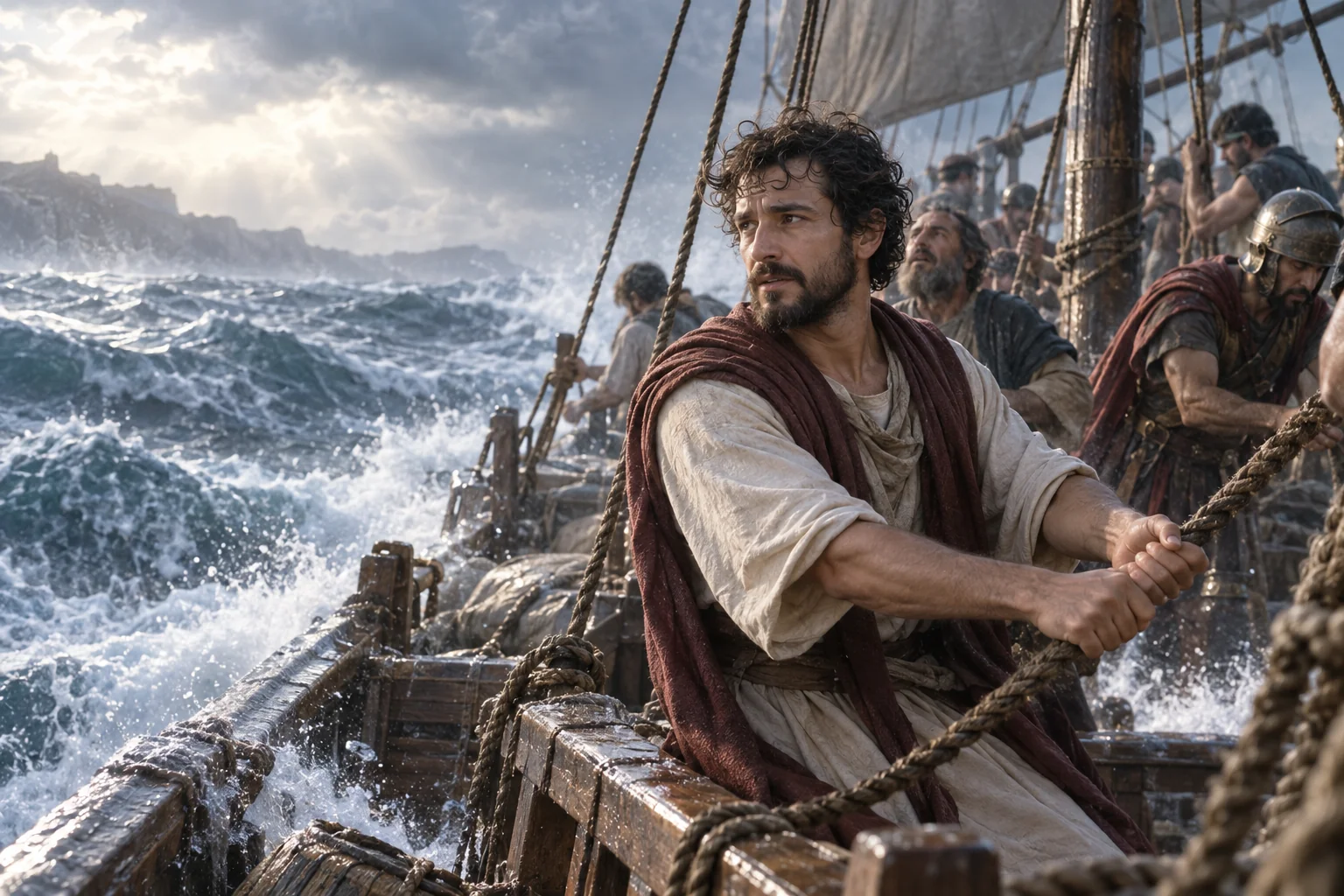
Around the years 60 to 61, the ship taking Paul to Rome as a prisoner ran into a terrible storm. The “we” passages in Acts take the reader straight into those days: the ship battered by wind and waves, the crew throwing all the cargo and then even the ship’s gear overboard to lighten the load, and for days on end no one could see the sun or a single star to steer by.
All hope of survival seemed gone. In the middle of that panic it was Paul, the prisoner, not the captain, who stood up and reassured everyone, telling them to take heart because God had promised to spare all their lives. The ship finally broke apart near Malta, but all two hundred and seventy-six people on board swam safely to shore, where the islanders, complete strangers, welcomed them with great kindness and lit fires to warm them, soaked and shivering as they were.
Luke shared fully in that fear, that bitter cold and that brush with death; he was not standing aside taking notes. The physician who wrote of God’s mercy now learned for himself what it is to have nothing and to be warmed by strangers after escaping death by a hair’s breadth.
In Rome, when Paul was under house arrest in a rented house, Luke stayed faithfully by his side while so many others left. In the loneliest last days of Paul’s life, when he knew he was about to be executed and most of his old friends had scattered for fear of being implicated, Paul wrote one short sentence that can still bring tears to a reader’s eyes:
“Only Luke is with me.”
There is no finer monument to faithful friendship in Christ, built not of marble but of a steady presence to the very end.
Chapter 4 of 5
Writing to hand on the faith
The Gospel of Luke and the Acts of the Apostles are really two volumes of one great work, both dedicated to the same man: Theophilus. The first tells of the life, teaching and saving work of Jesus; the second follows the Gospel as it spreads from Jerusalem out into the Gentile world, all the way to Rome, the heart of the empire.
Many stories Vietnamese Catholics love dearly are found only in Luke: the Annunciation to Our Lady, the Visitation to Saint Elizabeth, the Magnificat sung by a young girl, the poor shepherds keeping watch over their flocks by night and hurrying to the manger at Bethlehem, the parable of the Good Samaritan, the merciful father welcoming home his prodigal son, the short tax collector Zacchaeus scrambling up a sycamore tree just to see the Lord, and the two downcast disciples on the road home to Emmaus.
Luke has a special, almost partial love for the poor, for women, for those pushed to the margins. He pays close attention to Jesus’ quiet life of prayer and to the silent, powerful work of the Holy Spirit throughout the story. He writes the early history of the Church with rare honesty, not hiding the quarrels or the complaints about how food was shared among the widows, to show that God’s grace patiently shapes and leads fragile, imperfect people rather than demanding a perfect community from the start.
Chapter 5 of 5
The saint of mercy
Later tradition also holds that Luke was the first to paint a portrait of Our Lady. No historical evidence confirms it, but that devout memory has made him the patron of artists and painters for centuries. Accounts of his last years mention the region of Boeotia in Greece and an age of eighty-four, but the surviving records cannot tell us the date or exact circumstances of his death.
The Church celebrates Saint Luke the Evangelist on October 18 each year. Doctors and health workers find in him the image of a kind-hearted physician; writers and journalists find in him an example of using the pen to serve truth and faith, not to embellish or distort them.
For ordinary believers, Saint Luke keeps the door to a hope that never goes out. When someone feels their life has gone wrong, their sins piled so high there seems no way back, they can open Luke and read again of the old father standing at the door day after day, watching for his son with forgiving eyes, and find comfort without end. Luke stepped quietly into the shadows behind his own writing so that the merciful Savior could step into the light and open his arms to every suffering soul in the world.
The end of the story
You have walked with Saint Luke to the end of the story.
Perhaps you cannot forget:
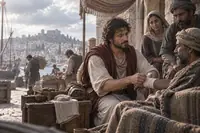
Admitting he had not witnessed it all from the start, he still carefully searched out every detail to write it in full.
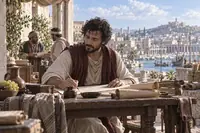
In a terrifying storm on the way to Rome, he did not stand aside watching, but shared the same fate as everyone else.
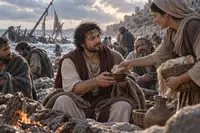
When all his friends had gone, Paul wrote a single sentence: "Only Luke is with me."
Stay in silence
Reading this far, you understand: a faithful friendship is not built of marble, only of a steady presence, to the very end.
A true companion is the one who stays when everyone else has left.
Let us pray
Saint Luke,
you carefully investigated every detail to tell the story of Jesus in full. And when everyone else had left, you alone stayed with Saint Paul in prison.
Teach me to do everything carefully and wholeheartedly, as you did. Make me a friend who stays when others are in trouble.
You are the patron of doctors and of those who make art. Pray for those who heal bodies and bring beauty into the world.
Amen.
Sources
- Feast dayAuthor’s edited profile
- Patron ofPatronages and symbols, version 1.1
- Often depicted withPatronages and symbols, version 1.1
- Reflectiongutenberg.org
- Reflectionnewadvent.org
Meet the next one
 Journey 1