

Journey 5 · Seeking God in Silence
Saint Louis-Marie Grignion de Montfort
Mary’s willing slave
Feast day April 28
Tap to step inside
Saint Louis-Marie Grignion de Montfort
Mary’s willing slave
Map of a life
This life told in 6 chapters
Begin the journey OpeningOpening1 min
 Chapter 1 of 6A son of steadfast Brittany1 min
 Chapter 2 of 6The opposition of Jansenism and a Pope’s commission1 min
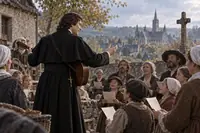 Chapter 3 of 6Fiery missions and the Calvary of Pontchâteau1 min
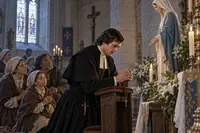 Chapter 4 of 6The secret of a buried book1 min
 Chapter 5 of 6His last breath on the mission field1 min
- Chapter 6 of 6A saint of the reign of Mary1 min
Feast day
Saint Louis-Marie Grignion de Montfort
Some places may celebrate on a slightly different day.
April 28
Patron of
- The Montfort Missionaries and the Daughters of Wisdom
Often depicted with
- A rosary
- A mission crucifix
Opening
Opening
At the beginning of the eighteenth century, on the muddy village roads all over western France, people grew used to the sight of a young priest, tall and sturdily built, in a ragged, patched cassock, clattering along in wooden clogs.
On his back he carried a small bundle with a few Bibles, in one hand a long wooden staff topped with a crucifix, and in the other a rosary he prayed without ceasing. Wherever he went, popular hymns he had written himself to familiar folk tunes rang out through the villages, drawing thousands of poor peasants to hear him preach.
That poor missionary on foot was Louis-Marie Grignion de Montfort, whom Vietnamese know as Saint Mông-pho.
A fiery prophet, he sparked one of the deepest movements of devotion to Mary in the history of the Church through his masterpiece: “True Devotion to Mary”, the Traité de la vraie dévotion à la Sainte Vierge.
He taught the faithful the shortest, easiest, safest and most perfect way to Jesus: to become “a willing slave of Mary”, placing one’s whole body, soul and every good work in Mary’s hands so that she may offer them back to the Lord.
Chapter 1 of 6
A son of steadfast Brittany
Louis-Marie Grignion was born on January 31, 1673, in the small town of Montfort-sur-Meu, in Brittany in northwestern France. His father, Jean-Baptiste Grignion, was a poor lawyer with a fiery temper; his mother was Jeanne Robert. He was the eldest of a large family of eighteen children. Later, out of gratitude for the baptism that had given him new life there, he took the name of his hometown, Montfort, as his surname.
As he grew up, Louis-Marie studied at the Jesuit college in Rennes. He was an excellent student with a natural gift for painting and sculpture, but his heart was always drawn to prayer before Our Lady’s altar.
At twenty, with the support of a devout benefactor, he left home to study at the renowned seminary of Saint-Sulpice in Paris.
The poor young man made the journey of more than three hundred kilometers from Rennes to Paris entirely on foot.
As soon as he crossed the Cesson bridge outside Rennes, Louis-Marie did something decisive:
- he gave away all the money his benefactor had given him to the beggars along the road;
- he exchanged his good clothes with a beggar for his rags;
- and he knelt and vowed from then on to live entirely dependent on the providence of God!
He arrived in Paris as a penniless beggar.
At the seminary of Saint-Sulpice, because his family was too poor to pay the fees, Louis-Marie had to live in shabby lodgings for poor seminarians, sitting up with the dead and waiting on tables to earn his keep.
He was made seminary librarian, and so he read tirelessly, taking in everything the Church Fathers and the saints down the centuries had written about Mary.
On June 5, 1700, he was ordained a priest at the age of twenty-seven.
Chapter 2 of 6
The opposition of Jansenism and a Pope’s commission
After his ordination, Father Montfort longed to go to Canada as a missionary to the Native peoples. But his spiritual director advised him to stay in France.
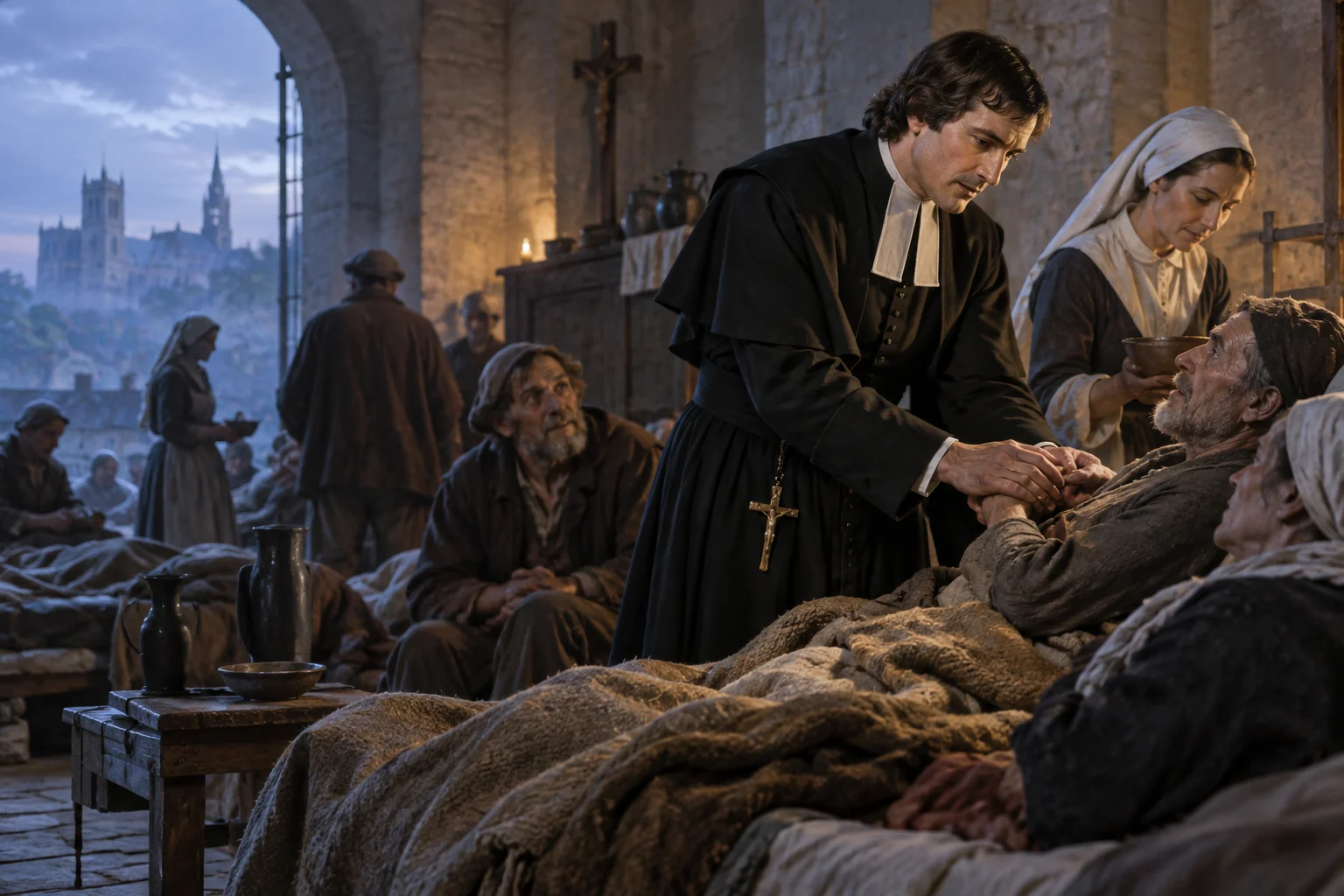
He was appointed chaplain of the hospital at Poitiers, a squalid poorhouse sheltering thousands of beggars, disabled people and prostitutes. There he threw himself into service, washing and bandaging the patients with his own hands. He gathered a group of devout young women, some of them sick themselves, among them Blessed Marie-Louise Trichet, and with them founded the Daughters of Wisdom to care for the poor. Marie-Louise stayed with the congregation all her life, and by a moving coincidence she died on April 28, around eight in the evening, on the same date and at the same hour as Father Montfort, forty-three years after him.
But his fiery zeal ran into fierce opposition from the Jansenists, whose errors were then spreading through the Church in France. They favored a cold, excessive rigor and looked down on devotion to Our Lady and frequent Communion as frivolous. They slandered Father Montfort as a fanatic and a troublemaker.
Many bishops forbade him to preach or say Mass in their dioceses.
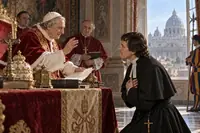
Driven out wherever he went, in 1706 Father Montfort decided to walk all the way to Rome to ask for an audience with Pope Clement XI and seek his guidance.
The Pope listened to him kindly, recognized the Spirit of God in the poor priest, and gave him the title “Apostolic Missionary”. The Holy Father told him:
“Go back to France, to the poor, remote villages of Brittany and the Vendée, and renew the faith of the faithful by having them renew their baptismal promises!”
With the Pope’s blessing, Father Montfort went home like a blazing torch.
Chapter 3 of 6
Fiery missions and the Calvary of Pontchâteau
For the next ten years, from 1706 to 1716, Father Montfort preached more than two hundred missions throughout the dioceses of western France.
His way of preaching a mission was lively and went straight to the hearts of ordinary people:
- he organized solemn processions of the Blessed Sacrament and of statues of Our Lady around the villages;
- he used cheerful folk melodies to write popular catechism hymns that everyone could learn by heart and sing while working;
- he set up huge crosses at crossroads to remind people of salvation;
- he urged the faithful to renew their baptismal profession of faith, renounce the devil and commit themselves to a holy life;
- and he spread far and wide the daily praying of the Rosary.
His preaching had a remarkable power to change lives: gangs of robbers reformed, disreputable taverns closed, and family feuds going back generations were healed.
In 1709, at Pontchâteau, Father Montfort began a great work of faith: he called on thousands of people, peasants, soldiers and nobles alike, to come with shovels and hoes and carry earth and stones for fifteen long months to build a huge artificial hill, crowned with three great crosses to recreate Calvary.
But just before the day of its solemn blessing, jealous enemies told the court of King Louis XIV that the Calvary was really a fortress for rebels.
The king at once forbade the blessing and ordered the hill leveled.
Seeing the work of tens of thousands of the faithful, soaked in their sweat and tears, brought to nothing, Father Montfort calmly knelt to thank God and said:
“We wanted to build a Calvary here; then let us build that Calvary in our own hearts!”
Chapter 4 of 6
The secret of a buried book
In 1712, in the silence of a retreat, Father Montfort took up his pen and wrote his theological masterpiece: “True Devotion to Mary”.
In the book he wrote these prophetic words:
“I clearly foresee that raging beasts of hell will come in fury to tear to pieces this little book, or at least to hide it in the darkness of a chest, so that it may not appear... But one day this book will come to light!”
And so it happened. After his death the handwritten manuscript lay forgotten in an old chest for one hundred and twenty-six years. Only in 1842 was it found by chance; once published, it quickly set off a worldwide wave of devotion to Our Lady.
Saint Montfort’s spirituality is summed up in the principle: “To Jesus through Mary”, Ad Jesum per Mariam. Mary is the most beautiful, humble and perfect of creatures, the one God chose so that the Word might become flesh. Since Jesus began the work of salvation through Mary, He will also complete it through Mary. Consecration to Mary does not mean stopping at her, but placing our whole life in her hands, so that she may purify it and offer it wholly to Jesus in the surest and most perfect way.
He founded the Company of Mary, the Montfort Missionaries, and the Brothers of Saint Gabriel, devoted to educating young people.
Chapter 5 of 6
His last breath on the mission field
Thousands of kilometers on foot, winter nights sleeping on the cold ground, beatings from his enemies and two poisonings had worn out the missionary’s body by the age of forty-three.
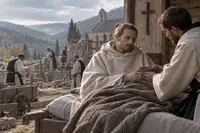
In April 1716, while preaching a mission at Saint-Laurent-sur-Sèvre, Father Montfort collapsed with acute pneumonia. Lying on a straw bed in the poor presbytery, he clutched his mission crucifix and a small statue of Our Lady.
On the evening of April 28, 1716, he opened his eyes and stared into the empty air, as if fighting a last battle with the devil, and cried out firmly:
“You attack me in vain! I am between Jesus and Mary! Thanks be to God and Mary, my race is finished; I shall sin no more!”
Then he died peacefully, at the age of forty-three.
More than ten thousand of the faithful came to mourn the holy priest. He was buried in the parish church of Saint-Laurent-sur-Sèvre. A basilica built there later and consecrated in 1962 now holds his relics, as well as the tomb of Marie-Louise Trichet, his first spiritual daughter and closest companion in his mission.
Chapter 6 of 6
A saint of the reign of Mary
Pope Leo XIII beatified him in 1888, and on July 20, 1947, Pope Pius XII solemnly canonized Louis-Marie Grignion de Montfort. The Church celebrates him on April 28 each year.
Pope Saint John Paul II took Saint Montfort’s own motto as the motto of his pontificate: “Totus Tuus”, “Totally yours”. He said many times that Saint Montfort’s “True Devotion to Mary” had been the decisive turning point of his life. In 1996 he made a pilgrimage to Saint-Laurent-sur-Sèvre to pray at the tomb of the saint he regarded as his lifelong spiritual teacher.
In Vietnam, consecration to Mary in the spirit of Saint Montfort has shaped the faith of movements such as the Legion of Mary (Legio Mariae) and of millions of believers.
Saint Louis-Marie de Montfort leaves us a road to follow, and there is nothing complicated or lofty about it.
It is holding tight to Mary’s hand every day through the Rosary, so that she may lead us past every snare of the world and bring us straight into the merciful Heart of Jesus.
The end of the story
You have walked with Saint Louis-Marie Grignion de Montfort to the end of the story.
You can still picture that missionary:
On the walk of more than three hundred kilometers from Rennes to Paris, he gave all his benefactor’s money to beggars and exchanged his good clothes for a beggar’s rags.
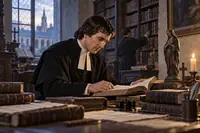
For fifteen months, thousands of people built an artificial Calvary hill at Pontchâteau, only for the king to order it leveled just before its blessing, after enemies slandered it as a rebel fortress.
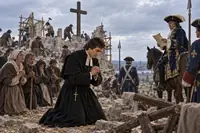
The manuscript of "True Devotion to Mary" lay buried in an old chest for one hundred and twenty-six years, just as he himself had foretold.
Stay in silence
And you learn this: when the work we have built collapses, there is still one place no one can tear down, where it can be built again: our own heart.
We wanted to build a Calvary here; then let us build that Calvary in our own hearts!
Let us pray
Saint Louis-Marie Grignion de Montfort,
you exchanged your good clothes for a beggar’s rags, and when the work you built was leveled, you did not lose heart.
Teach me to give myself wholly to Jesus through Mary’s hands, as you taught.
When what I build falls apart, help me trust that God can still build it again in my heart.
Amen.
Sources
- Feast dayAuthor’s edited profile
- Patron ofPatronages and symbols, version 1.1
- Often depicted withPatronages and symbols, version 1.1
- Reflectionmontfort.org.uk
- Reflectioncausesanti.va
Meet the next one
 Journey 5