

Journey 5 · Seeking God in Silence
Saint Bernard of Clairvaux
A blazing torch of love and renewal
Feast day August 20
Tap to step inside
Saint Bernard of Clairvaux
A blazing torch of love and renewal
Map of a life
This life told in 5 chapters
Begin the journey

Feast day
Saint Bernard of Clairvaux
Some places may celebrate on a slightly different day.
August 20
Patron of
- The Cistercians
- Beekeepers and candlemakers
- Gibraltar
Often depicted with
- A beehive
- A white dog
- The white Cistercian habit
Opening
Opening
In the twelfth century, as Europe stirred with new schools, sharp philosophical debates and growing, prosperous cities, one of the most gifted and handsome young noblemen of Burgundy did something that shocked the high society of his day. He left his comfortable home to enter the poor, muddy monastery of Cîteaux, and he brought thirty of his brothers, uncles and noble friends with him to give themselves to God.
That young man was Bernard of Clairvaux.
With his burning love for Christ and Mary, he breathed new life into the Cistercian Order and made this reformed order one of the great spiritual forces of the Middle Ages.
He was called the “Mellifluous Doctor”, Doctor Mellifluus, because his words on the love of God, spoken and written, flowed as sweet as honey, softening cold, dry hearts and leading thousands into union with God.
Chapter 1 of 5
The dashing nobleman of Fontaine-lès-Dijon
Bernard was born in 1090 at the castle of Fontaine-lès-Dijon, near the city of Dijon in eastern France. His father, Tescelin le Roux, was a brave and distinguished knight; his mother, Aleth de Montbard, was a deeply devout noblewoman. He was the third of seven children in a noble family.
From his youth, Bernard received a thorough education in letters, rhetoric and Scripture at the school of the canons at Châtillon-sur-Seine. He was handsome and brilliant, a spellbinding speaker with a soul alive to the beauty of poetry.
Yet the lavish world of the court, with its banquets, romances and fame, could not satisfy the thirst of his soul. In 1107 his gentle mother Aleth died. The loss struck the seventeen-year-old hard and set him thinking about how fleeting human life is.
One day, riding across the fields to an army camp, Bernard stopped at a small roadside church and threw himself down in prayer, weeping.
He felt God’s clear call to give up all wealth and honor and choose a life of complete poverty.
Bernard was so persuasive and so on fire that he won over, one after another, four of his own brothers, his uncles and like-minded friends. It is even said that mothers with sons, and young women with sweethearts, grew nervous whenever Bernard appeared, in case he talked their loved ones into leaving home for the monastery.
In 1113, at twenty-three, Bernard led a group of thirty-one young noblemen to knock at the door of the Abbey of Cîteaux, where the first monks under the holy Abbot Stephen Harding were living in extreme poverty and on the verge of closing for lack of vocations. The arrival of Bernard and his young companions brought the whole monastery back to life.
Chapter 2 of 5
Clairvaux, the Valley of Light
Only two years after he entered, recognizing Bernard’s holiness and outstanding gift for leadership, Abbot Stephen Harding gave him an abbot’s staff and sent him with twelve monks to found a new monastery.
They settled in a wild, overgrown valley in Champagne, infested with robbers, which the local people called the “Valley of Wormwood” or the “Valley of Darkness”. By clearing the land and praying the Divine Office day and night, Bernard and his monks turned that dark valley into Clairvaux, Clara Vallis, the “Valley of Light”.
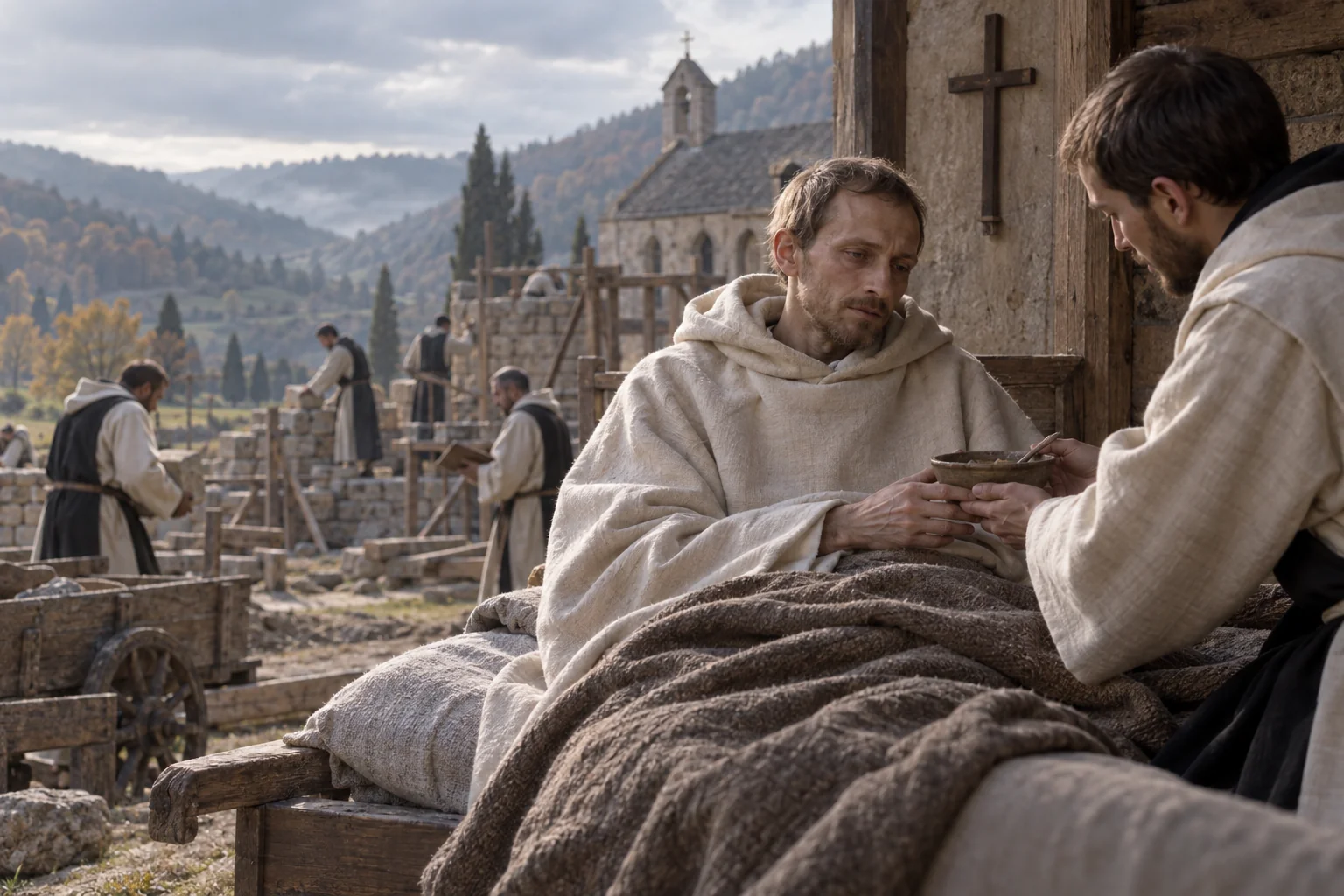
At Clairvaux, Bernard was blessed as abbot at twenty-five. He lived a very austere life: he ate the plainest food (wild greens boiled with salt, black bread), slept very little on hard boards, and worked with his hands as hard as any poor peasant. The excessive penances of his early years ruined his digestion, and he suffered stomach pains for the rest of his life.
Yet out of that austerity grew a love as tender as a mother’s. He taught the monks a lesson in balance: no one was to undertake penances beyond their strength without the superior’s permission, and the foundation of all asceticism must be brotherly charity.
The fame of Clairvaux spread throughout Europe. Thousands of young men from every walk of life came asking to enter. From 1135, a large building project turned Clairvaux into a vast monastic complex, at times home to as many as nine hundred monks and lay brothers. In thirty-eight years as abbot, Saint Bernard himself founded sixty-eight daughter houses, and when he died the Cistercian Order had more than three hundred and forty monasteries across Europe, bringing great spiritual and economic renewal to medieval Europe.
Chapter 3 of 5
A servant of the Church amid the storms
Though all his life he dearly loved the silence of his cell at Clairvaux, Bernard never shirked his duty when the Church was being tested. Again and again he was drawn out of the monastery to mediate in the greatest political and religious conflicts of his age.
In 1130, a painful schism broke out in Rome when two Popes were elected: Innocent II and Anacletus II. Bernard put all his moral authority and eloquence to work, traveling across France, Germany and Italy to persuade emperors, kings and the faithful to return to communion with the legitimate Pope, Innocent II, and so kept the Church from splitting apart.
In 1140, at the Council of Sens, he stood up to debate and refute the dangerous rationalism of Peter Abelard, who tried to explain the supernatural mysteries of faith by human reason alone and so reduced them.
In 1146, at the command of Pope Eugene III, his former disciple and once a monk at Clairvaux, Bernard set out to preach the Second Crusade at Vézelay. His fiery voice moved tens of thousands of knights and common people to tears, crying with one voice: “God wills it!” When the Crusade later ended in disaster through the quarrels and greed of its commanders, Bernard patiently bore the bitter criticism that followed, accepting it as a cup of penance for the sins of the world.
Chapter 4 of 5
A song of the Song of Songs and of Mary
Saint Bernard’s greatest gift to the Church is his mystical writing, full of poetry and the fire of love.
In his famous Eighty-Six Sermons on the Song of Songs (Sermones in Cantica Canticorum), he carried the theology of God’s love to great heights: the bond between God and the soul is not that of a tyrant and a frightened slave, but the ardent love of Bridegroom and Bride. He set out four degrees of love: beginning with selfish love, loving oneself for one’s own sake; rising to self-interested love, loving God for His gifts; entering pure love, loving God for His own sake; and reaching the summit, loving oneself and all creatures only for God’s sake.
Above all, Saint Bernard is one of the greatest singers of Mary’s praises in history. He loved her with the whole heart of a devoted son.
He left us unforgettable words praising her as the “Star of the Sea”, Stella Maris:
“When the storms of life toss you about, when you are driven among the rocks of trial and temptation, look to the Star, call upon Mary! With her guiding you, you will not go astray; with her protecting you, you will not fear; with her supporting you, you will not grow weary; and with her blessing, you will reach the harbor in peace!”
It was he who added the last three tender cries to the Salve Regina:
“O clement, O loving, O sweet, holy Mary, ever virgin!”
Chapter 5 of 5
His rest and the title of Doctor
In the summer of 1153, worn out by his travels and his illnesses, Abbot Bernard lay on a simple wooden bed at Clairvaux. Around him, hundreds of monks knelt sobbing, begging God to keep him with them.
Seeing the tears of his spiritual children, Bernard was deeply moved and said:
“I am torn between two longings: on one side the desire to go to Jesus, on the other my boundless love for you, my brothers... May God’s will be done!”
On the morning of August 20, 1153, the great abbot died peacefully at the age of sixty-three. He was buried in the abbey church of Clairvaux, where his relics rested for more than six hundred years until the French Revolution broke out: the monks were expelled from Clairvaux in 1791, the abbey was dissolved, and from 1808 it was turned into a high-security prison, an irony that lasted until 2023. Fortunately, his relics had been moved to the nearby Cathedral of Troyes, where part of his skull is still kept with honor in the cathedral treasury, along with finely carved wooden choir stalls that originally belonged to the Abbey of Clairvaux itself.
On January 18, 1174, Pope Alexander III solemnly canonized Bernard of Clairvaux. In 1830, Pope Pius VIII declared him a Doctor of the Church with the title “Mellifluous Doctor”. The Church celebrates him on August 20 each year.
In Vietnam, Saint Bernard’s contemplative monastic spirit is vividly present in the Cistercian monasteries of the Holy Mother congregation such as Phước Sơn, Châu Sơn, Khiết Tâm and Mỹ Ca, where hundreds of monks quietly pray and work day and night in the remote countryside.
Saint Bernard of Clairvaux teaches us that true knowledge of God does not come from proud argument. We reach it only on our knees, in humble prayer, with a heart in love.
He invites each of us to let the word of God turn our souls into a stream sweet with charity, and to look always to Mary, the Star of the Sea, to guide us through every storm of life.
The end of the story
You have walked with Saint Bernard of Clairvaux to the end of the story.
Three scenes you will want to see again:
At twenty-three, he brought thirty relatives and noble friends with him to knock at the door of the abbey of Cîteaux, which was about to close for lack of vocations.

By clearing the land and praying the Office day and night, he turned the robber-infested "Valley of Darkness" into Clairvaux, the Valley of Light.

He traveled all over Europe to heal a schism between two popes, then stood up to refute the rationalism of Peter Abelard at the Council of Sens.
Stay in silence
And you see one more thing: a person can dearly love the silence of the cell and still bravely step out into the greatest storms of the Church of their time.
Look to the Star of the Sea, call upon Mary!
Let us pray
Saint Bernard,
at twenty-three you brought thirty relatives and friends with you into the monastery, and turned a dark valley into the "Valley of Light".
Teach me to love silence and prayer, yet bravely give myself when the Church needs me.
Help me draw my loved ones to God by my own life.
And may I always run to Mary, as you taught: "Look to the Star, call upon Mary."
Amen.
Sources
- Feast dayAuthor’s edited profile
- Patron ofPatronages and symbols, version 1.1
- Often depicted withPatronages and symbols, version 1.1
- Reflectionculture.gouv.fr
- Reflectionvatican.va
Meet the next one
 Journey 5