

Journey 7 · Going Far, Standing Firm
Saint Lorenzo Ruiz
A poor family man and a steadfast profession of faith
Feast day September 28
Tap to step inside
Saint Lorenzo Ruiz
A poor family man and a steadfast profession of faith
Map of a life
This life told in 5 chapters
Begin the journey OpeningOpening1 min
 Chapter 1 of 5A poor clerk of the Binondo quarter1 min
 Chapter 2 of 5A false accusation and an unwilling voyage1 min
 Chapter 3 of 5The prison of Nagasaki and the water torture1 min
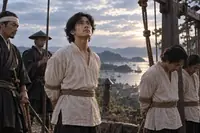 Chapter 4 of 5A hero’s death at the bottom of the pit1 min
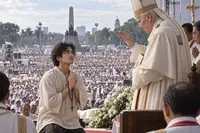 Chapter 5 of 5The first lay saint of the Philippines1 min
Feast day
Saint Lorenzo Ruiz
Some places may celebrate on a slightly different day.
September 28
Patron of
- The Philippines
- Filipinos working far from home
- Young people
Often depicted with
- A rosary
- A Filipino barong
Opening
Opening
On a stormy afternoon in September 1637, on Nishizaka hill in Nagasaki, Japan, where forty years earlier Saint Paul Miki and his companions had shed their blood, a savage execution known as “the Pit” (ana-tsurushi) was under way.
A small, dark-skinned man of about thirty, a poor husband and father from the Philippines, had his hands tied behind his back and his legs bound with heavy rope, and was hung head down in a deep pit full of refuse and excrement. The upper half of his body, from the waist up, was sealed underground by wooden boards cut with half-moon holes fitted tightly around his waist, with stones piled on top to add pressure. The executioners made small cuts in his forehead so that blood would ooze out slowly, easing the pressure in his head; this kept him from dying quickly and drew out his agony for days and nights.
The judge, sitting at the edge of the pit, called down: “If you deny the Christian religion, we will pull you up at once and spare your life so you can go home to your wife and children!” From the dark, suffocating depths of the pit, the man answered firmly:
“I am a Catholic, and I am wholeheartedly faithful to the Catholic faith to my last breath! I offer my whole life to God! Even if I had a thousand lives, I would gladly offer them all to Him!”
The man at the bottom of that pit was Lorenzo Ruiz, the protomartyr of the Philippines. He was not a priest or a monk; he was an ordinary layman, a husband who loved his wife dearly and the father of three young children. By his heroic death in a foreign land, he showed the world that holiness and the courage of martyrdom do not belong to the clergy alone. A lay person in everyday life, with a family to love and a living to earn, can reach the very summit of faith and give glory to God.
Chapter 1 of 5
A poor clerk of the Binondo quarter
Lorenzo Ruiz was born around 1600 or 1610 in the Binondo quarter, on the edge of Manila, capital of the Philippines, an area that early on became home to Chinese immigrants and is still the heart of Manila’s Chinese community today. His father was a poor Chinese immigrant; his mother was a devout Tagalog woman.
He grew up where cultures met: his father taught him Chinese and his mother Tagalog. He was raised and educated by the Dominican friars at the convent of Santo Domingo in Binondo. That church, rebuilt many times, still stands and is now a basilica and national shrine bearing his name. Young Lorenzo served faithfully at Mass, spoke fluent Spanish and wrote a beautiful hand, as neat as print.
When he grew up, he worked as a clerk and copyist (an escribano) for the Dominican friars at the parish church of Binondo. He joined the Confraternity of the Holy Rosary, the lay Dominican Third Order, went to Mass every day and prayed the Rosary faithfully. He married a devout native woman named Rosario. Their home was poor but full of laughter and peace. The couple had three children: two sons and a daughter.
Lorenzo was a model husband and father. He copied page after page by hand, earning every coin honestly to feed his family; he taught his children their evening prayers and lived at peace with his neighbors. In the evening, after setting aside his pen and the stacks of papers still smelling of ink, he would sit down with his children and show them their Tagalog letters and the lines of the Hail Mary before the family gathered for their simple meal. No one in Binondo could have imagined that this gentle, soft-spoken clerk was about to set out on a journey that would carry his name far beyond the Philippine islands. His life passed quietly, like that of so many working people in Manila, until a day in 1636 tore all his peaceful plans apart.
Chapter 2 of 5
A false accusation and an unwilling voyage
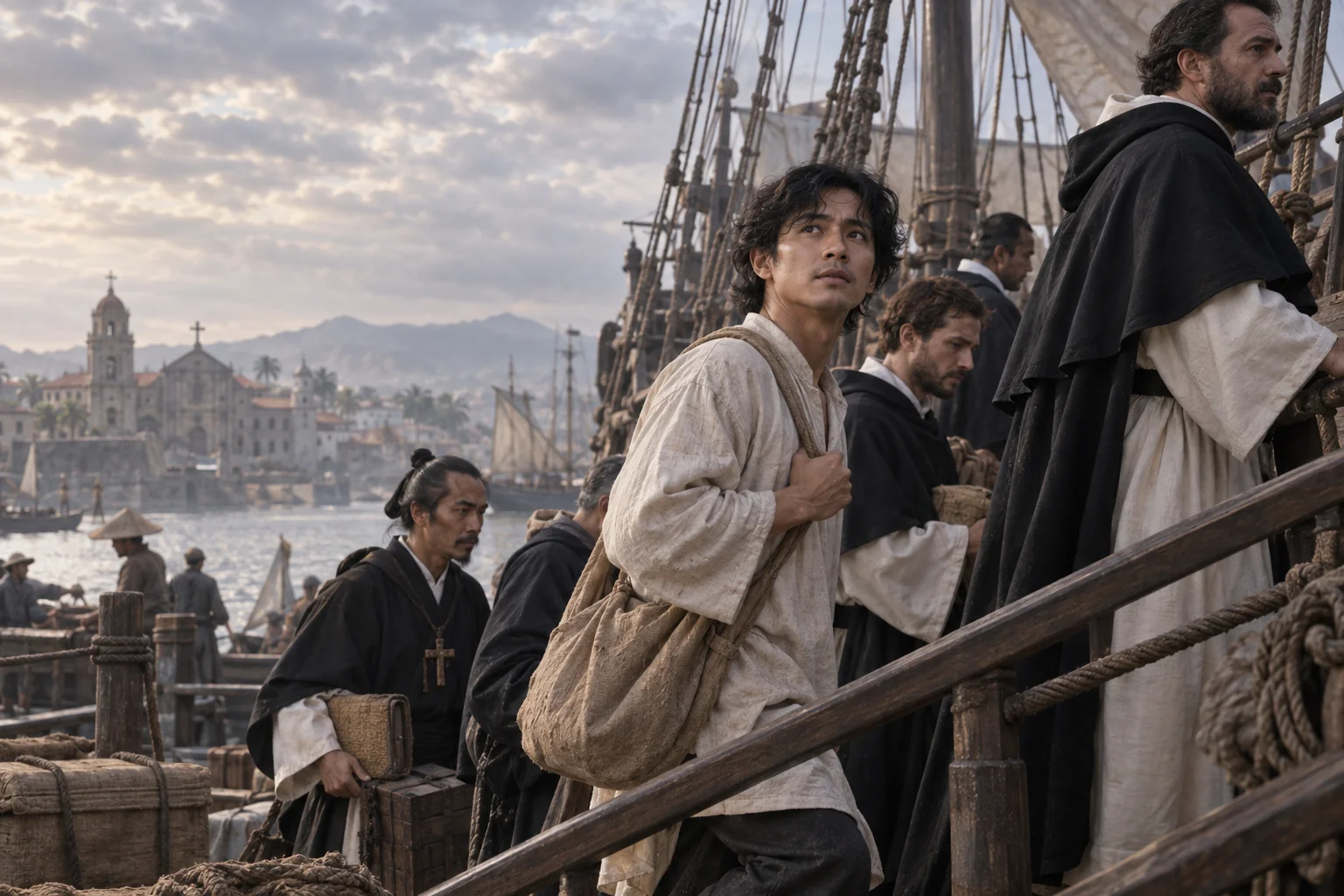
In 1636 disaster struck and turned his life upside down: a Spaniard was involved in a killing in Binondo, and the Spanish colonial authorities falsely accused Lorenzo Ruiz of taking part. In those days a poor man of mixed blood brought before a colonial court could expect to be sentenced to death or brutally tortured, with no chance to clear his name.
Desperate to save his life for his family’s sake, Lorenzo turned to the Dominican priests for protection. Just then a secret missionary party was preparing to sail for Japan to help the underground Church there, which was suffering cruel persecution: three Dominican priests, Father Antonio González, Father Guillaume Courtet and Father Miguel de Aozaraza, with the deacon Vicente Shiwozuka and a lay leper named Lázaro of Kyoto.
The priests agreed to let Lorenzo board the ship to escape. At first Lorenzo assumed the ship would take him to hide on some safe island offshore, perhaps for a few weeks, until the case in Binondo died down, and then he would find his way back to his wife and children. Only when the ship was far out at sea and the Manila coast had faded into the mist did he learn, to his horror, that they were bound for Japan, where any Christian who set foot faced the most savage death. With no way to turn back in the middle of the open sea, the poor clerk must have spent long nights at the ship’s rail, gazing at the horizon, heartsick at the thought of his good wife Rosario and his three young children waiting for him to come home, with no idea that their father was sailing toward a land of death.
Lorenzo did not bemoan what could not be undone. He knelt and entrusted himself, his wife and his three children at home to God’s providence. He willingly made himself the missionaries’ helper, working in the galley and carrying baggage, and in his rare free moments on board he prayed the Rosary he had brought from Binondo.
Chapter 3 of 5
The prison of Nagasaki and the water torture
On July 10, 1636, the ship secretly reached the island of Okinawa. But soon after landing, the whole party was discovered and arrested by the Tokugawa shogunate. They were taken under guard to Nagasaki, the center of the persecution.
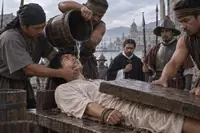
There Lorenzo Ruiz and his companions were thrown into a dark prison for more than a year. The Japanese authorities used the most savage tortures to break their will. Lorenzo was given the “water torture”: water was poured down his throat until his belly swelled, then soldiers laid a board across his belly and jumped on it, so that the water gushed back out of his nose, mouth and ears, mixed with blood. Sharp bamboo needles were driven under his fingernails, and then his fingers were broken.
Under that torture there were moments when human weakness, and the thought of his wife and three children at home, shook his heart. At one interrogation, Lorenzo weakly asked the interpreter: “If I deny the faith, will my life be spared so that I can go home?” But then, strengthened by Father Antonio González, chained beside him, and by the light of the Holy Spirit, Lorenzo came to himself. He beat his breast in repentance for that moment of wavering, raised his head and declared firmly before the judge:
“I take back the question I just asked! I am a Christian, and I am ready to die for God! Even if I had to die a hundred thousand deaths, I would never deny my faith!”
Chapter 4 of 5
A hero’s death at the bottom of the pit
On September 27, 1637, the death sentence of “the Pit” was carried out on the Nishizaka hill. Lorenzo Ruiz and his companions were tied up and hung head down in a deep pit. The shogunate had designed this tsurushi punishment as a slow torture, calculated in every detail to make the condemned suffer as long as possible before dying, unlike the quicker deaths of earlier martyrs.
For three days and nights in the dark, stinking pit, half suffocated, the blood pounding in his head and his bones on fire with pain, the poor family man of Binondo never stopped whispering his prayers. He united the last drops of his blood with the Passion of Jesus. On September 29, 1637, Lorenzo Ruiz died in the pit of suffocation and exhaustion. The soldiers pulled up his body, burned it to ashes along with the bodies of his companion martyrs, and scattered the ashes in the bay of Nagasaki to keep the faithful from gathering relics.
Chapter 5 of 5
The first lay saint of the Philippines
The heroic sacrifice of this poor family man brought glory to the whole Filipino people and to the Church in Asia. On February 18, 1981, during his historic pastoral visit to Manila, Pope Saint John Paul II beatified Lorenzo Ruiz and his companion martyrs in Rizal Park before more than two million Filipinos. It was the first beatification in history held outside Rome.
On October 18, 1987, John Paul II canonized Lorenzo Ruiz in Saint Peter’s Square. He became the first saint of the Philippines. The Church celebrates him and his companion martyrs on September 28 each year.
Saint Lorenzo Ruiz has a lesson for every lay person and every parent today:
“The call to holiness is not something remote reserved for religious in monasteries; the call to holiness lies right in family life, in the hard daily work of earning a living!”
A poor clerk swept into a journey he never chose, he became an unyielding witness at the bottom of a pit. He teaches us that however life may corner us or treat us unjustly, we should stay honest, love our families through quiet sacrifice, and remain faithful to God to the end, because God can make the brightest saints out of the most ordinary lives.
The end of the story
You have walked with Saint Lorenzo Ruiz to the end of the story.
Three moments in his life stay with you:
Falsely accused in Manila, a poor family man boarded a ship meaning only to hide for a while, not knowing its destination was Japan, a land of death.
Under torture, there was a moment when he weakly asked whether denying the faith would spare him, but at once he beat his breast, took back his words and professed his faith more firmly than ever.
Hung head down in a pit for three days and nights, he still answered the judge firmly: "Even if I had a thousand lives, I would gladly offer them all to Him!"
Stay in silence
You understand why the Church calls him a lay saint: an ordinary husband and father in everyday life can reach the very summit of faith like any other martyr.
I am a Catholic, and I am wholeheartedly faithful to the Catholic faith to my last breath!
Let us pray
Saint Lorenzo Ruiz,
you were an ordinary husband and father. Under torture there was a moment when you weakened, but then you beat your breast, took back your words and professed your faith more strongly.
Pray for fathers who must be far from their families to earn a living.
When I am weak, help me not to despair of myself, but to get up again and stay faithful to God to the end.
Amen.
Sources
- Feast dayAuthor’s edited profile
- Patron ofPatronages and symbols, version 1.1
- Often depicted withPatronages and symbols, version 1.1
- Reflectionvaticannews.va
- Reflectioncausesanti.va