

Journey 3 · Young Lives Freely Given
Saint John Berchmans
Holiness in the most ordinary things
Feast day August 13
Tap to step inside
Saint John Berchmans
Holiness in the most ordinary things
Map of a life
This life told in 6 chapters
Begin the journey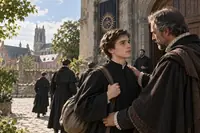 OpeningOpening1 min
 Chapter 1 of 6The devoted son of a shoemaker of Diest1 min
 Chapter 2 of 6The turning point of a Jesuit vocation1 min
 Chapter 3 of 6Three treasures of religious life1 min
 Chapter 4 of 6His last years in Rome1 min
 Chapter 5 of 6A song of triumph at twenty-two1 min
- Chapter 6 of 6Patron of those who serve at the altar1 min
Feast day
Saint John Berchmans
Some places may celebrate on a slightly different day.
August 13
Patron of
- Altar servers
- Students
Often depicted with
- A crucifix and rosary
- The book of the Rule held to his chest
Opening
Opening
When many young people think of holiness, they imagine something extraordinary: spectacular miracles that astonish crowds, sermons that move tens of thousands, or horrifying torments in a faraway mission field.
Yet the life of John Berchmans points to a completely different road. He worked no visible miracles in his lifetime, never set foot in a distant mission, and never held any important position in the Church.
Everything he left us comes down to one simple resolution: to do the most ordinary things with extraordinary care and with all his love for God.
He went through the daily duties of a young Jesuit student: studying, sweeping, praying the Rosary, smiling at his friends. It was his complete faithfulness in every small thing that made his brief twenty-two years shine among the saints.
Chapter 1 of 6
The devoted son of a shoemaker of Diest
Jan Berchmans, known in English as John Berchmans, was born on March 13, 1599, in the town of Diest, in Flanders, in present-day Belgium. It is an old town of red-brick houses reflected in its canals, and on the little street now named after him still stands the house where he was born, with its sign “Gulden Maan” (the Golden Moon). His father, John Charles Berchmans, was a poor shoemaker and tanner; his mother, Elizabeth van den Hove, was a devout, orderly woman. The family had five children and lived by hard work from early morning until late at night.
From early childhood, John carried a heavy load at home: his gentle mother was stricken with a paralyzing illness and lay bedridden for many years. Young John went faithfully to the village school and also became his father’s right hand. He sat by his mother’s bed, washing her and feeding her spoonful by spoonful, looked after the younger children, and did odd jobs in his father’s shoe workshop.
The family was so poor that his father once thought of taking John out of school early to learn a trade and earn money for the family. But the boy’s longing to give himself to God as a priest touched the local clergy. They found ways to help: he worked in a priest’s household in the city of Mechelen and tutored the children of well-off families there, in exchange for the chance to go on studying.
John grew up not pampered and protected, but shaped by poverty and self-reliance. He was never ashamed of being a poor shoemaker’s son; to him, hard work, honesty and love for his parents were what made a life beautiful.
Chapter 2 of 6
The turning point of a Jesuit vocation
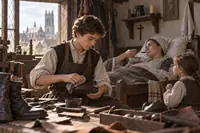
In 1615, the Jesuits opened a new college in Mechelen. John Berchmans enrolled and quickly became an excellent student, well loved by classmates and teachers for his sharp mind, his cheerful, humble nature and his readiness to help weaker students.
At this school he read a life of the young Polish saint Stanislaus Kostka, who had died only a few decades earlier, and the desire for religious life caught fire in him. He knew that God was calling him to follow Saint Ignatius of Loyola in the Society of Jesus.
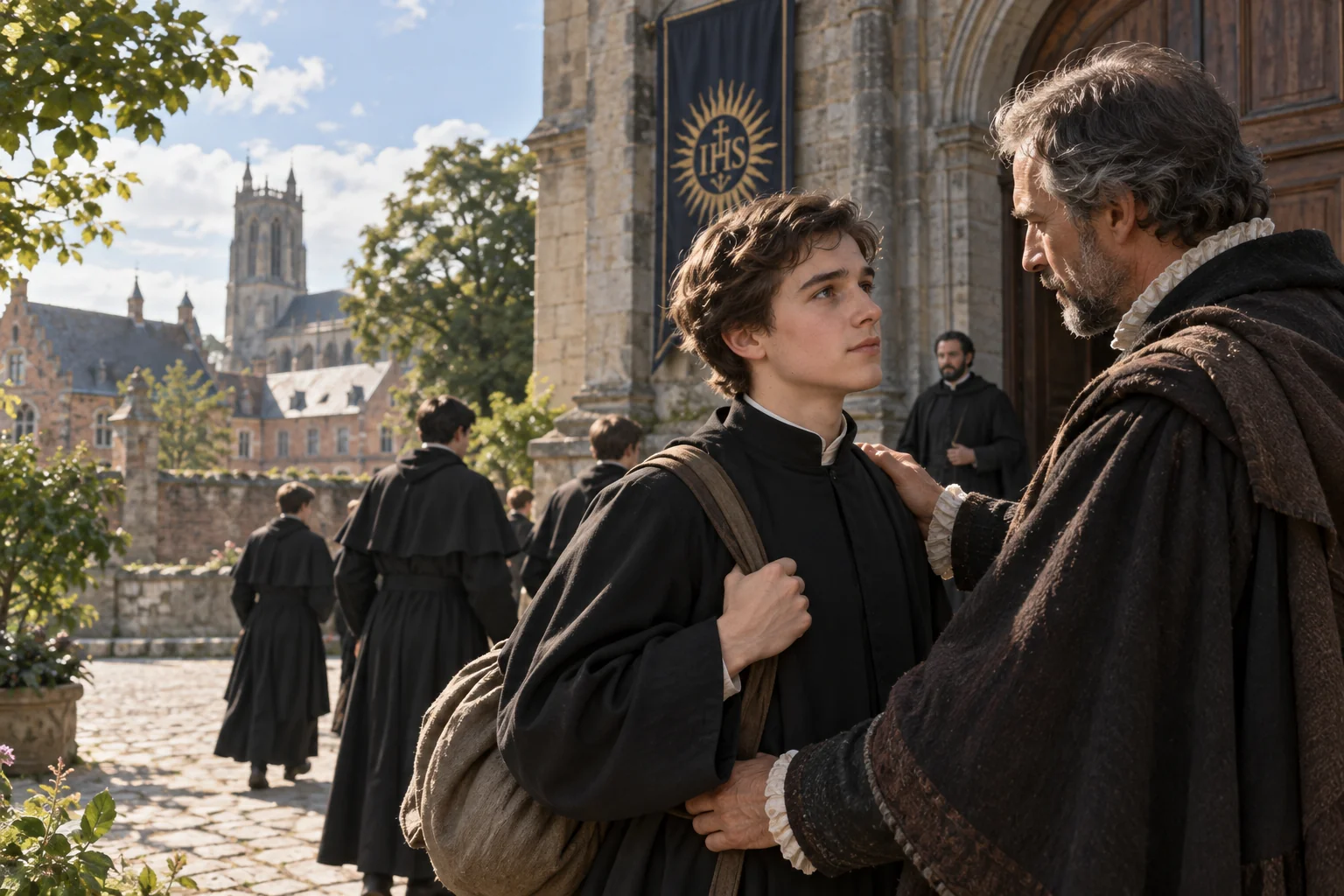
When he told his family, his father was fiercely against it. He had hoped that his son, as a diocesan priest, would have a steady parish income to help the family, which was drowning in debt. He could not accept his son joining a poor religious order and giving up any chance of supporting them. He even traveled all the way to the school, trying both fatherly affection and harsh reproaches to change his son’s mind.
Torn between his duty as a son and God’s call, John knelt, embraced his father’s feet and said softly through his tears:
“Father, I love you and our family with all my heart, but I must listen to God’s voice first of all. Believe me, I am entering religious life to pray for you and for our whole family to be saved forever!”
Moved by a firmness so full of love, his father wiped away his tears and gave his blessing. On September 24, 1616, John Berchmans entered the Jesuit novitiate in Mechelen.
Chapter 3 of 6
Three treasures of religious life
In the spiritual notebook where he recorded his resolutions on the day of his first vows in 1618, the nineteen-year-old wrote a simple, searching line:
“If I do not become a saint while I am young, I will never become one!”
Yet his road to holiness involved no extraordinary bodily penances. He understood that God was not asking him to do things beyond his strength, only to keep every small rule of the order faithfully and with love. He once said words that are still quoted:
“My greatest penance is common life.”
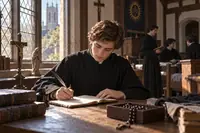
John always carried three priceless “treasures” with him, which he called the pillars of his religious life:
- a small crucifix reminding him of the boundless self-giving love of Jesus;
- the book of the Jesuit Rule, which he always treasured and carried out down to the smallest detail;
- and the rosary, symbol of his complete filial devotion to Mary.
He said:
“With these three, I can live a holy life and die in peace anywhere on earth!”
For him, obedience was not a grudging burden but the joy of doing God’s will through his superiors. He gladly swept the stairs, washed dishes in the kitchen and wiped the tables. Whatever he was doing, his face wore a bright, peaceful smile, as if he were waiting on Christ Himself and the Apostles.
Chapter 4 of 6
His last years in Rome
In the autumn of 1618, seeing John Berchmans’s outstanding gifts and virtue, his superiors sent him with a fellow student to Rome to study philosophy at the renowned Roman College, the Collegio Romano.
The two young Jesuits walked more than a thousand kilometers, over the snow-covered Alps. In Rome he studied philosophy and theology tirelessly and excelled in the academic disputations.
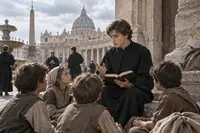
Yet among that elite company John stayed completely humble. He volunteered to teach catechism to poor children in the streets, visited the sick in hospitals and lovingly looked after the old and sick religious in the house.
His open nature, tireless kindness and good cheer led everyone at the college to call him fondly “the angel of the community.” He had a gift for turning recreation, at table or between classes, into moments of holy joy and brotherly warmth.
Chapter 5 of 6
A song of triumph at twenty-two
In the summer of 1621, after brilliantly completing his final philosophy examinations and being chosen to represent the college in a major theological disputation, John Berchmans’s health suddenly broke down. The stifling heat of the Roman summer and a violent lung fever wore the young man’s body down.
On August 7, 1621, he was taken to the house infirmary. He grew worse each day, and the doctors shook their heads, helpless. John was not afraid of death at all. His face still shone with a pure peace.
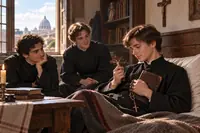
As his fellow students knelt around his bed weeping, John took his crucifix, the book of the Rule and his rosary and pressed them to his chest. He whispered to his brothers:
“These are my three dearest treasures; with them I am glad to die!”
Early in the morning of August 13, 1621, after receiving Viaticum with great devotion, his eyes fixed on heaven and softly speaking the holy names
“Jesus... Mary...”
, he died peacefully with a smile on his face. He was just twenty-two years and five months old.
When news of his death spread, all the professors and students of the Roman College and great crowds came to pay their respects. They did not come to pray for a soul in purgatory, but to touch their handkerchiefs and rosaries to the body of a young saint who had lived every moment of his life to the full. His body was later buried in the church of Saint Ignatius in Campo Marzio, in the heart of Rome, while his heart, according to the custom of the time, was taken to be kept in the Jesuit church in Leuven, in his native Flanders.
Chapter 6 of 6
Patron of those who serve at the altar
Pope Pius IX beatified John Berchmans in 1865, and Pope Leo XIII solemnly canonized him on January 15, 1888. The Church celebrates him on August 13 each year; the Jesuits keep November 26.
Together with Saint Aloysius Gonzaga and Saint Stanislaus Kostka, Saint John Berchmans is one of the three great young saints of the Society of Jesus. He is the patron of altar servers, students and Catholic youth.
For young Vietnamese Catholics today, the life of Saint John Berchmans holds a lesson worth its weight in gold: never look down on small daily duties. We do not need to wait for great works in order to work for God.
A lesson carefully prepared before class; a room swept clean; loving care for a sick mother; a kind word to a friend in trouble... all those simple things, done with love for God, are steps that lead the soul straight into the Kingdom of Heaven.
The end of the story
You have walked with Saint John Berchmans to the end of the story.
You surely still remember:
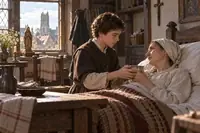
From childhood he cared for his paralyzed mother, learning his letters while helping in his father’s shoe workshop.
He wrote in his notebook: "My greatest penance is common life."
In his last moments, he held tight his three treasures: the crucifix, the book of the Rule, and the rosary.
Stay in silence
You see it clearly: he worked not a single miracle in his lifetime, only lived a life of complete faithfulness in the smallest duties of each day.
We do not need to wait for great works in order to work for God: a room swept clean can also be a prayer.
Let us pray
Saint John Berchmans,
from childhood you cared for your paralyzed mother, studying while you helped in your father’s shoe workshop. You said your greatest penance was the common life of your community.
Teach me to carry out the small duties of each day: studying, housework, living peaceably with everyone.
Pray for students and young religious, that they may be faithful in the most ordinary things.
Amen.
Sources
- Feast dayAuthor’s edited profile
- Patron ofPatronages and symbols, version 1.1
- Often depicted withPatronages and symbols, version 1.1
- Reflectionjesuits.global
- Reflectionnewadvent.org
Meet the next one
 Journey 3