

Journey 2 · Holiness Under One Roof
Saint Frances of Rome
The wife who left her prayers unfinished to tend her home
Feast day March 9
Tap to step inside
Saint Frances of Rome
The wife who left her prayers unfinished to tend her home
Map of a life
This life told in 11 chapters
Begin the journey OpeningOpening1 min
 Chapter 1 of 11A twelve-year-old bride1 min
 Chapter 2 of 11Two sisters-in-law1 min
 Chapter 3 of 11A house turned into a hospital1 min
 Chapter 4 of 11Her son departs, an angel stays1 min
 Chapter 5 of 11Patron of drivers1 min
 Chapter 6 of 11When everything collapsed1 min
 Chapter 7 of 11A religious house without walls1 min
 Chapter 8 of 11The son who came to call his mother home1 min
 Chapter 9 of 11A church on the Forum1 min
- Chapter 10 of 11Rome in the time of three popes1 min
 Chapter 11 of 11Becoming holy in one’s own kitchen1 min
Feast day
Saint Frances of Rome
Some places may celebrate on a slightly different day.
March 9
Patron of
- Drivers (proclaimed by Pius XI in 1925)
- Widows
Often depicted with
- A guardian angel at her side
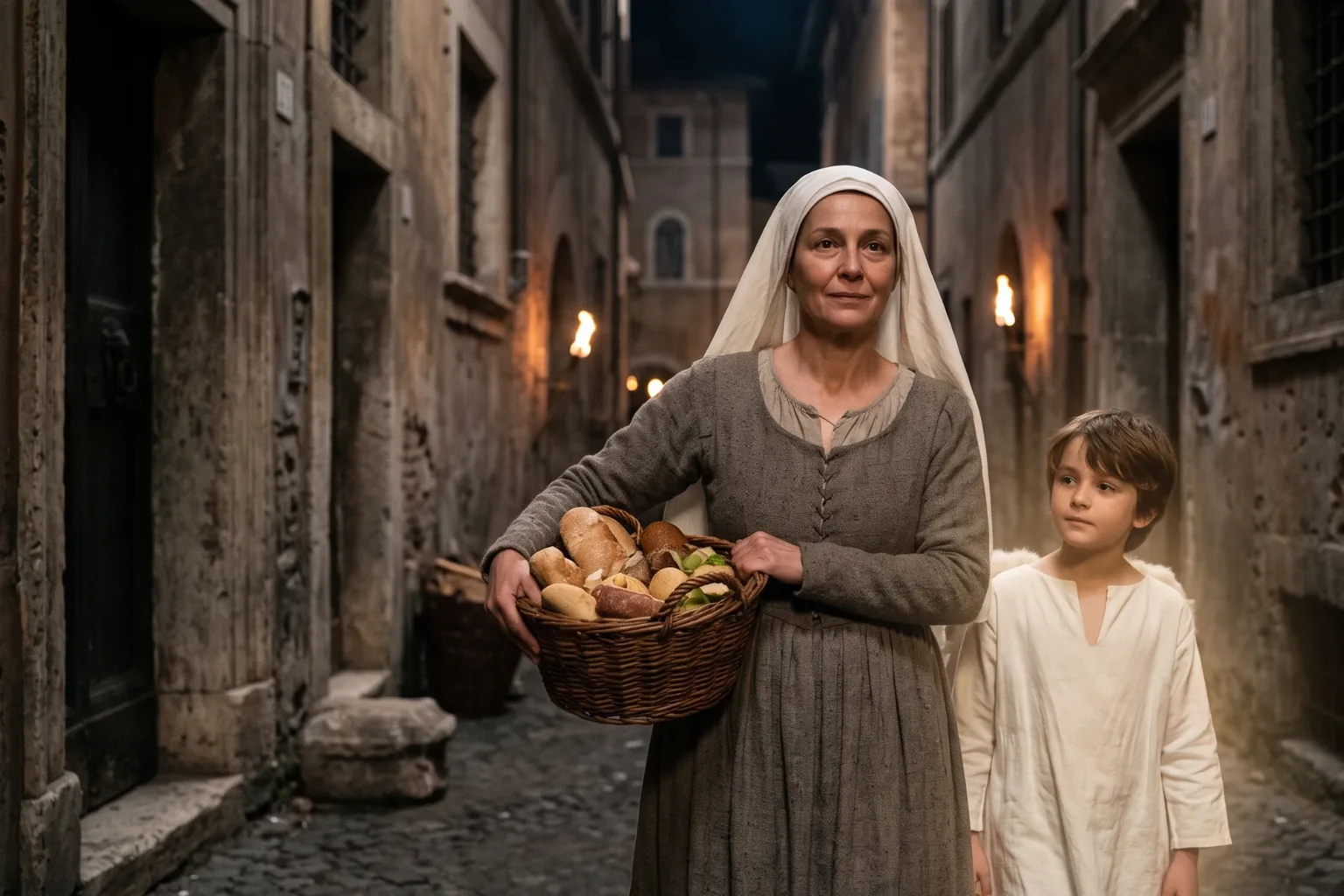
- A basket of bread
Opening
Opening
There is a small story about Saint Frances of Rome that Catholic mothers in Italy still tell their daughters.
One morning she was sitting and praying the Divine Office, the common prayer of the Church. Before she had finished a single verse, someone called: her husband needed her. She closed the book, got up and went. When the task was done, she came back, opened the book and continued that verse. Again someone called: a member of the household needed her. Again she closed the book. This happened four times, the same verse, still unfinished. The fifth time, when she returned, tradition says that the words of the unfinished verse had turned to gold on the page.
Whether the story is true, no one can verify. But the saying attributed to her has stayed with generations of women: “A married woman must, when called upon, leave God at the altar to find Him in her household care.”
Frances lived in fifteenth-century Rome, amid war, plague, famine and a schism that split the Church apart. For forty years she was a wife, a mother, and a daughter-in-law in a noble family. She had wanted to enter religious life from the age of eleven, but she was only able to enter a religious house once she was widowed, four years before she died. And the Church honors her as a saint not in spite of her married life, but precisely because of the way she lived that family life.
Chapter 1 of 11
A twelve-year-old bride
Frances was born in 1384 in Rome, into the noble Bussa de' Leoni family, near Piazza Navona. From childhood the little girl loved to pray and to go to church, and at eleven she asked her parents to let her enter a convent.
Her father refused. By the noble custom of the time, daughters were for marrying, for forming alliances with powerful families. At twelve, Frances was married to Lorenzo Ponziani, a rich young nobleman of the Trastevere district, on the other side of the Tiber.
The young bride fell into a crisis. Not long after the wedding she fell seriously ill and was bedridden for many months; no doctor could cure her. Tradition says that during her illness she saw Saint Alexis appear and ask whether she wanted to be healed. She answered: “As God wills.” And she was healed.
From then on, Frances understood something that the twelve-year-old girl perhaps had not understood at her wedding: God was not calling her into a convent, but calling her to become holy right in this house, with this husband, in this family.
Lorenzo was a good husband. He loved his wife, respected her devotion, and in forty years of life together never hindered her works of charity. The biographies say the couple never quarreled.
Chapter 2 of 11
Two sisters-in-law
In the Ponziani household there was another woman who had also just married into the family: Vannozza, the wife of Lorenzo’s older brother. The two young women quickly became close friends. One day Vannozza found Frances weeping alone in the garden and asked why. Frances confessed her sorrow at not being able to enter religious life. Vannozza confessed too: she had once dreamed the same thing.
From then on, the two sisters-in-law made a pact. If they could not enter religious life, they would live like religious right in their own home: rising early to pray, fulfilling their duties to their husbands, children and in-laws, and then spending the rest of their time visiting the poor and the sick of Rome. They set up a small chapel in an empty room upstairs, and went together to Mass and to visit the hospitals, dressed simply.
Their mother-in-law, a noblewoman who cared for appearances, was not at all pleased. She reproached her two daughters-in-law for shaming the family by mixing with the poor and dressing so plainly. But their father-in-law was fond of them and let them be.
When the mother-in-law died, the whole family wanted Vannozza, the elder daughter-in-law, to take charge of the Ponziani household. Vannozza declined and proposed Frances. So Frances, the younger of the two and just sixteen, became mistress of a great noble household with dozens of servants. She ran the house with care, and treated the servants as brothers and sisters, looking after their health and their practice of the faith.
Chapter 3 of 11
A house turned into a hospital
The first years of the fifteenth century were terrible years for Rome. The Church was in the Great Western Schism: at times two, then three men claimed to be pope at once. The city was occupied and plundered by the troops of King Ladislaus of Naples. Then came famine, then plague.
Frances opened the Ponziani granary and gave grain to the hungry. When it was empty, her father-in-law, in anger, locked the granary and hid the key. Tradition says that Frances and Vannozza went into the granary, scraped up a few handfuls of grain left on the floor, and prayed; when the father-in-law opened the granary, he found it full of grain again. There is also a story that a wine cask that had run dry after she gave its wine to the poor was filled again with good wine. From then on, the stern father-in-law handed the keys over to his daughter-in-law for good.
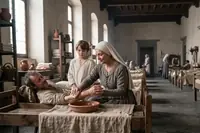
When the plague came, Frances turned part of the house into an infirmary. She cared for the sick with her own hands, washing the sores that others shrank from. When the money ran out, she begged in the streets for the sick, gathered firewood in the countryside outside the city and carried it back on her back, leading a donkey loaded with wood through the streets of Rome. It is said that nobles who had known her looked at her as if she were mad.
Chapter 4 of 11
Her son departs, an angel stays
Frances had three children: Battista, Evangelista and Agnese. Evangelista was the child she loved most, a good little boy who learned to pray early. In 1411 the plague took the boy when he was only nine. Not long after, little Agnese died too.
Tradition says that exactly one year after Evangelista’s death, while Frances was praying, the boy appeared to his mother, radiant, accompanied by an angel. He told her that his sister Agnese would soon join him in heaven, and that God would comfort his mother by letting an archangel stay beside her from then on.
From then on, according to what Frances told her confessor, she saw that angel beside her for the rest of her life. The angel looked like a child of about nine, like her son, dressed in white, and gave off a soft light. She said that this light was enough for her to read by in the middle of the night, and lit her way as she went through the dark streets of Rome late at night to reach the sick.
Chapter 5 of 11
Patron of drivers
In 1925 Pope Pius XI made Saint Frances of Rome the patron of drivers. The reason sounds both strange and charming: because tradition says her angel lit her way through the night, like the headlights of a car.
Since then, every year on March 9, in front of the church of Saint Frances of Rome, which stands right in the ancient Forum of Rome where her remains are buried, people line up cars, motorbikes, buses, taxis, even ambulances, to have them blessed. The sight of gleaming modern vehicles parked among two-thousand-year-old Roman columns, waiting for a priest to sprinkle holy water, is one of those strange scenes that visitors who happen to be in Rome that day never forget.
A fifteenth-century woman who never saw a car is now invoked by drivers all over the world before every long journey.
Chapter 6 of 11
When everything collapsed
In 1408, the troops of Naples took Rome. Lorenzo, her husband, who sided with the Pope, was stabbed and gravely wounded by the enemy and carried home near death. Frances nursed him, and he survived. But then he had to flee Rome. Their eldest son, Battista, was taken hostage. The Ponziani house was plundered, its property confiscated, its fields burned and its livestock killed.
Frances, with Vannozza and the remaining children, lived in one corner of the ruined house. She kept going out to care for the poor, even though she herself was now poor. Tradition says that when the enemy demanded that she hand over her son Battista as a hostage, she took him to the church of Aracoeli, set him at the foot of the image of Our Lady, and entrusted him to her. Later Battista was released.
In 1414, when the war died down for a time, Lorenzo returned, gray-haired, his strength spent, his spirit broken. Frances cared for her husband in his last years with the tenderness of their early married days. And he, according to the biographies, as he grew older treasured all the more the wife he called a saint.
Chapter 7 of 11
A religious house without walls
In her years of caring for the poor, Frances gathered around her a group of women of Rome, married and unmarried, who likewise wanted to live their faith deeply while remaining in the world. In 1425 she founded a community of sisters, the “Oblates of Mary”, attached to the Olivetan Benedictine monastery. They did not live in an enclosed convent or take solemn vows like nuns, but offered themselves to God to serve the poor, right in the middle of the city.
In 1433 the community moved into a house in the Tor de' Specchi district, at the foot of the Capitoline Hill. Frances still did not go to live with the sisters, because her husband was still alive, and she still held her duty as a wife above all.
In 1436 Lorenzo died. Frances, fifty-two years old, came and knocked at the door of the house at Tor de' Specchi, barefoot, a rope around her neck, like a lowly person begging to be taken in. The sisters welcomed her and immediately elected her their superior.
That community still exists today. Nearly six hundred years later, the Oblates still live in the very same house at Tor de' Specchi, and every year on March 9 they open its doors to visitors to see the rooms where Frances lived and prayed, with fifteenth-century frescoes telling the story of her life.
Chapter 8 of 11
The son who came to call his mother home
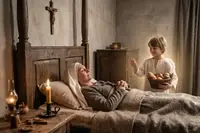
In March 1440, Frances heard that her son Battista was seriously ill. Though she herself was weak, she left the religious house to visit him. There she fell ill, and was never able to return to the house.
She died on March 9, 1440, in the very Ponziani house she had come to as a bride at twelve. Those present said her last words were: “The angel has finished his task. He beckons me to follow.”
All Rome mourned her. People called her by the title “Advocata Urbis”, Advocate of the City. She was buried in the church of Santa Maria Nova in the Forum, which the Romans later came to call simply the church of Saint Frances of Rome. In 1608, Pope Paul V canonized her.
Chapter 9 of 11
A church on the Forum
If you go to Rome today and walk through the ancient Forum, among the ruined stone columns of the Roman Empire, you will see a small church with a twelfth-century Romanesque bell tower, decorated with green ceramic discs. That is the church of Saint Frances of Rome, formerly called Santa Maria Nova.
The church was built on part of the foundations of the temple of the goddesses Venus and Roma, the largest temple of ancient Rome. As in so many places in this city, the Christian faith grew up right on the foundations of the old pagan world. Inside the church is kept a stone slab that tradition says bears the imprint of the knees of Saints Peter and Paul, when the two knelt to pray here. That legend, like many others in Rome, cannot be verified, but pilgrims still stop to look.
Beneath the main altar, in the crypt, lie the remains of Saint Frances. A woman who once carried a basket through these streets to give bread to the poor now rests at the heart of the most famous archaeological site in the world, where millions of visitors pass each year. Most of them do not know who she is. But every year on March 9, the cars line up again before the door, waiting to be blessed.
Chapter 10 of 11
Rome in the time of three popes
To understand the circumstances Frances lived in, one needs to know that for nearly forty years of her life, the Church was torn in two, then in three.
In 1378, six years before Frances was born, the papal election in Rome took place amid chaos. Some cardinals afterward declared that election invalid and elected another man, who set up his see at Avignon in France. From then on the Church had two popes, each with his own kings and princes, dioceses and religious orders supporting him. In 1409 a council at Pisa, wanting to end this situation, deposed both and elected a third; but the other two refused to resign, and so there were three men all claiming to be pope.
The Great Schism ended only in 1417, at the Council of Constance. Throughout those years, Rome was neglected, fought over by factions, and occupied by foreign armies. It was in a divided Church and a ruined city that one woman quietly kept the faith alive, not through theological debates, but through bowls of porridge, bundles of firewood, and nights spent awake caring for the sick.
Chapter 11 of 11
Becoming holy in one’s own kitchen
In Vietnam, Frances is a fairly common baptismal name among women and mothers. Many take Saint Frances of Rome as their patron and celebrate her feast on March 9.
Perhaps no woman saint is closer to Vietnamese mothers than Frances of Rome. She did not go on distant missions, did not suffer martyrdom, had no great visions that changed the Church. She was a daughter-in-law, a wife, a mother. She cared for a difficult mother-in-law, cared for a wounded husband, cared for sick children, buried two of them. She ran a large household and opened her home to the poor. She knew what it was to lose everything to war. And she prayed, a great deal, but was always ready to close the book when her family needed her.
Many women think that because they are busy with children, housework and the market, they have no time to become holy. Frances answers them with her own life: housework does not take us away from God. It is in housework that we meet God. The verse left unfinished four times because a husband or child called is not lost. It turns to gold.
The end of the story
You have walked with Saint Frances of Rome to the end of the story.
Images that will stay with you:
Two sisters-in-law weeping together in the garden, then making a pact to live like religious right in their own home.
A noblewoman leading a donkey loaded with firewood through the streets of Rome, while people looked at her as if she were mad.
A verse of prayer left unfinished four times because her family called, turning to gold.
Stay in silence
As the story ends, you realize that housework does not take us away from God; it is in housework that we meet Him.
Today, if someone at home needs you while you are praying, close the book and go, with a peaceful heart.
Let us pray
Saint Frances,
you became holy as a wife, a mother and a daughter-in-law, amid the cares of a large household. Pray for mothers and wives, for all who carry the housework that few people notice.
Teach me to close my prayer book when my family needs me, while my heart stays with God. Help me to open my home to the poor, as you did.
Protect me on my journeys, as the angel lit your way through the night.
Amen.
Sources
- Feast dayArticle, version 1.1
- Patron ofPatronages and symbols, version 1.1
- Often depicted withPatronages and symbols, version 1.1