

Journey 5 · Seeking God in Silence
Saint Edith Stein
The light of philosophy at the foot of the Cross
Feast day August 9
Tap to step inside
Saint Edith Stein
The light of philosophy at the foot of the Cross
Map of a life
This life told in 6 chapters
Begin the journey OpeningOpening1 min
 Chapter 1 of 6A Jewish girl of Breslau and her years of unbelief1 min
 Chapter 2 of 6The light of the Cross and a book by Teresa of Ávila1 min
 Chapter 3 of 6An engaged intellectual and a Carmelite habit1 min
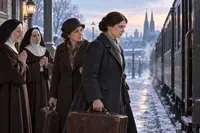 Chapter 4 of 6Flight to the Netherlands and The Science of the Cross1 min
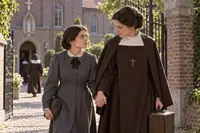 Chapter 5 of 6The gas chamber of Auschwitz and a martyr’s song1 min
- Chapter 6 of 6A woman of learning for a tragic, heroic age1 min
Feast day
Saint Edith Stein
Some places may celebrate on a slightly different day.
August 9
Patron of
- Europe (proclaimed by John Paul II in 1999)
- Those who have lost their parents
Often depicted with
- A yellow Star of David
- The Carmelite habit
- A book
Opening
Opening
On a stifling morning in August 1942, a sealed Nazi cattle train screeched to a halt at the platform of the Auschwitz-Birkenau extermination camp in Poland. The car doors were flung open, and thousands of exhausted, starving people were driven off by SS men with whips and dogs.
In the panicking crowd was a small woman in a coarse Carmelite habit, with thoughtful eyes and a strange peace about her. She held tight to the trembling hand of her sister Rosa and said gently:
“Come, Rosa, let us go for our people!”
That woman was Edith Stein, in religion Sister Teresa Benedicta of the Cross.
Her life is one of the great intellectual and spiritual stories of the twentieth century. Born into a devout Jewish family, she gave up her faith and became an atheist, rose to be one of the most brilliant phenomenologists in Germany, was won over by the truth of Christ and became a contemplative Carmelite nun, and finally gave her life in the gas chamber at Auschwitz.
She is honored as a philosopher, a martyr of our own times and a patron of all Europe.
Chapter 1 of 6
A Jewish girl of Breslau and her years of unbelief
Edith Stein was born on October 12, 1891, in the city of Breslau, then part of the German Empire, now Wrocław in Poland. She was the youngest of eleven children in a devout Jewish merchant family, the daughter of Siegfried Stein and Auguste Courant. Remarkably, Edith was born on Yom Kippur, the Day of Atonement, the holiest and most solemn day of the Jewish year.
When Edith was only two, her father died suddenly on a business trip. Her mother Auguste, a Jewish woman of iron will and steadfast faith, ran the timber business alone and raised her children to make their way in the world.
Edith was extraordinarily bright and always at the top of her class. Yet at fifteen, feeling that the traditional Jewish rituals could not answer the deep questions of her mind, she made a bold decision: she gave up prayer and declared herself an atheist.
In 1911 she began studying philosophy, psychology and history at the University of Breslau. Drawn to the new phenomenological method, in 1913 Edith transferred to the renowned University of Göttingen to study under Edmund Husserl, the greatest philosopher of the day.
She quickly became Husserl’s favorite student and closest collaborator, and one of the first women in Germany to defend a doctoral thesis in philosophy with the highest distinction, summa cum laude, in 1916.
All through those years of intense study, the longing for truth burned in her. She later wrote:
“My longing for truth was my only prayer in those years.”
Chapter 2 of 6
The light of the Cross and a book by Teresa of Ávila
Two encounters led the atheist philosopher to the Christian faith.
The first came in 1917. Adolf Reinach, a fellow philosopher, close friend and teacher Edith deeply respected, was killed in the First World War. Edith went to visit his widow, Anna, bracing herself to find her in despair.
Instead she found a young Christian woman at peace in the middle of her grief. Anna accepted her husband’s death in the light of the Cross of Christ.
Edith later confessed:
“It was my first encounter with the Cross... At that moment my unbelief collapsed, and Christ shone out radiantly in the mystery of His Cross!”
The second, decisive moment came in the summer of 1921. Staying at a friend’s farm in Bergzabern, Edith happened one free evening to pick a thick book off the shelf. It was the “Life” of Saint Teresa of Ávila.
She began to read and could not stop; she read all through the night. When she closed the book at dawn, the philosopher said from the depths of her heart:
“This is the truth!”
That very morning she went out and bought a catechism and a missal. On January 1, 1922, Edith Stein was baptized in the church of Saint Martin in Bergzabern, becoming a Catholic at the age of thirty.
When her devout Jewish mother learned that her youngest daughter had become a Catholic, she wept bitterly and felt betrayed. Edith knelt beside her, held her and wept with her, but she did not turn back.
Chapter 3 of 6
An engaged intellectual and a Carmelite habit
For the next ten years, from 1922 to 1932, on the advice of her spiritual directors, Edith did not rush to enter a convent.
She lived her faith in the middle of the world: teaching at the Dominican sisters’ school in Speyer, translating the philosophical works of Saint Thomas Aquinas and Cardinal Newman into German, and lecturing throughout Germany, Switzerland and Austria on the place and dignity of women in modern society. She became one of the most influential Catholic intellectual voices of the time. In 1932 she was appointed a lecturer at the German Institute for Scientific Pedagogy in Münster.
But in 1933 Adolf Hitler came to power in Germany and set up a brutal antisemitic regime. Because she was Jewish, Edith Stein immediately lost her right to teach.
In April 1933, foreseeing the catastrophe about to fall on her people and the Church, she bravely wrote a personal letter to Pope Pius XI, begging the Holy See to speak out publicly against the crimes of Nazism.
Sensing that God’s hour had come, Edith Stein entered the Carmel of Cologne (Köln) on October 14, 1933, at forty-two. On April 15, 1934, she received the habit and the religious name Sister Teresa Benedicta of the Cross, Teresa Benedicta a Cruce, meaning “Teresa blessed by the Cross.”
She said:
“I understood the Cross as the destiny of the Jewish people... I want to take that Cross on my shoulders to pray for peace in the world!”
Chapter 4 of 6
Flight to the Netherlands and The Science of the Cross
In the Cologne Carmel, the once-famous philosopher gladly did the most ordinary chores: sweeping, washing dishes and mending. At her superiors’ bidding she also kept writing, and produced a philosophical and theological masterpiece, “Finite and Eternal Being” (Endliches und Ewiges Sein), which brings Husserl’s phenomenology into conversation with the scholastic philosophy of Saint Thomas Aquinas.
After the anti-Jewish violence of Kristallnacht, the “Night of Broken Glass,” in November 1938, the Cologne Carmel was in danger from Gestapo searches. On New Year’s Eve 1938, Sister Teresa Benedicta was secretly taken across the border to the Carmel of Echt in the Netherlands. Her sister Rosa Stein, who had also become a Catholic, came there too to help at the convent.
At Echt she began her last work, a study of mystical theology: “The Science of the Cross”, Kreuzeswissenschaft, for the 400th anniversary of the birth of Saint John of the Cross.
She wrote:
“The science of the Cross can only be gained when one truly feels the weight of the Cross in one’s own body and soul.”
The book was never finished. Its author was taken away to die a martyr.
Chapter 5 of 6
The gas chamber of Auschwitz and a martyr’s song
In July 1942, the Catholic bishops of the Netherlands had a joint letter read in all the churches, publicly condemning Nazi brutality and the deportation of the Jews.
In retaliation, Hitler ordered all Jews in the Netherlands who had become Catholics to be hunted down and sent to the camps.
On the afternoon of August 2, 1942, two armed Gestapo officers burst into the Carmel of Echt and gave Sister Teresa Benedicta and her sister Rosa ten minutes to pack. Calmly, she took her panicking sister’s hand and walked out of the convent gate.
They were taken through the transit camps of Amersfoort and Westerbork. Survivors later remembered her with amazement: among thousands of weeping, panicking, despairing people, this Carmelite nun moved like an angel of peace. She cared for children whose mothers were too sunk in despair to look after them, washing them, combing their hair, sharing every crust of bread and listening to the prisoners’ troubles.
On August 7, 1942, she and thousands of prisoners were crammed into cattle cars bound for the Auschwitz-Birkenau extermination camp.
On August 9, 1942, as soon as they arrived at Auschwitz, Sister Teresa Benedicta of the Cross and her sister Rosa were taken straight to one of the first gas chambers at Birkenau, which the prisoners called “the little red house,” and killed with Zyklon B gas. Her body was burned and her ashes scattered over the cold, empty fields of Auschwitz. She died at the age of fifty.
Chapter 6 of 6
A woman of learning for a tragic, heroic age
On May 1, 1987, in Cologne, Pope Saint John Paul II beatified Edith Stein as a martyr.
On October 11, 1998, the same Holy Father canonized her in Saint Peter’s Square.
On October 1, 1999, John Paul II proclaimed Saint Teresa Benedicta of the Cross one of the six patron saints of Europe, together with Saint Benedict, Saint Catherine of Siena, Saint Bridget of Sweden, and Saints Cyril and Methodius. The Church celebrates her on August 9 each year. Today the Cologne Carmel where she lived has a memorial where pilgrims and visitors can stop and pray, and near the Carmel of Echt another monument recalls the last years she spent there before her arrest.
Saint Edith Stein is a bridge between two worlds: between the Christian faith and its Jewish roots, and between rigorous philosophical reasoning and deep mystical prayer.
She shows people of our time that the Cross is not failure or absurdity. It is where the Truth of God is revealed most fully, in a love that forgives and gives itself for the salvation of the world.
The end of the story
You have walked with Saint Edith Stein to the end of the story.
These three moments keep returning to your mind:
Having declared herself an atheist at fifteen, the philosopher later read Teresa of Ávila’s "Life" all through the night, then closed the book and said: "This is the truth!"
In 1933, she wrote to Pope Pius XI, begging the Holy See to speak out against the crimes of Nazism.
On the platform at Auschwitz, she held her panicking sister’s hand tight and said gently: "Come, Rosa, let us go for our people!"
Stay in silence
You see something painful and beautiful: a woman who once searched for truth by reason alone ended by bearing witness to it with her life, in the gas chamber of an extermination camp.
Come, Rosa, let us go for our people!
Let us pray
Saint Edith Stein,
you were once an atheist, then found the Truth in a single night of reading. On the platform at Auschwitz, you took your sister’s hand: "Come, let us go for our people."
Pray for those seeking truth through reason: professors, students, scientists.
Pray for the victims of hatred and racial discrimination, and for the world to live in peace.
Amen.
Sources
- Feast dayAuthor’s edited profile
- Patron ofPatronages and symbols, version 1.1
- Often depicted withPatronages and symbols, version 1.1
- Reflectionedith-stein-gesellschaft.at
- Reflectionold.edithsteincircle.com
Meet the next one
 Journey 5