

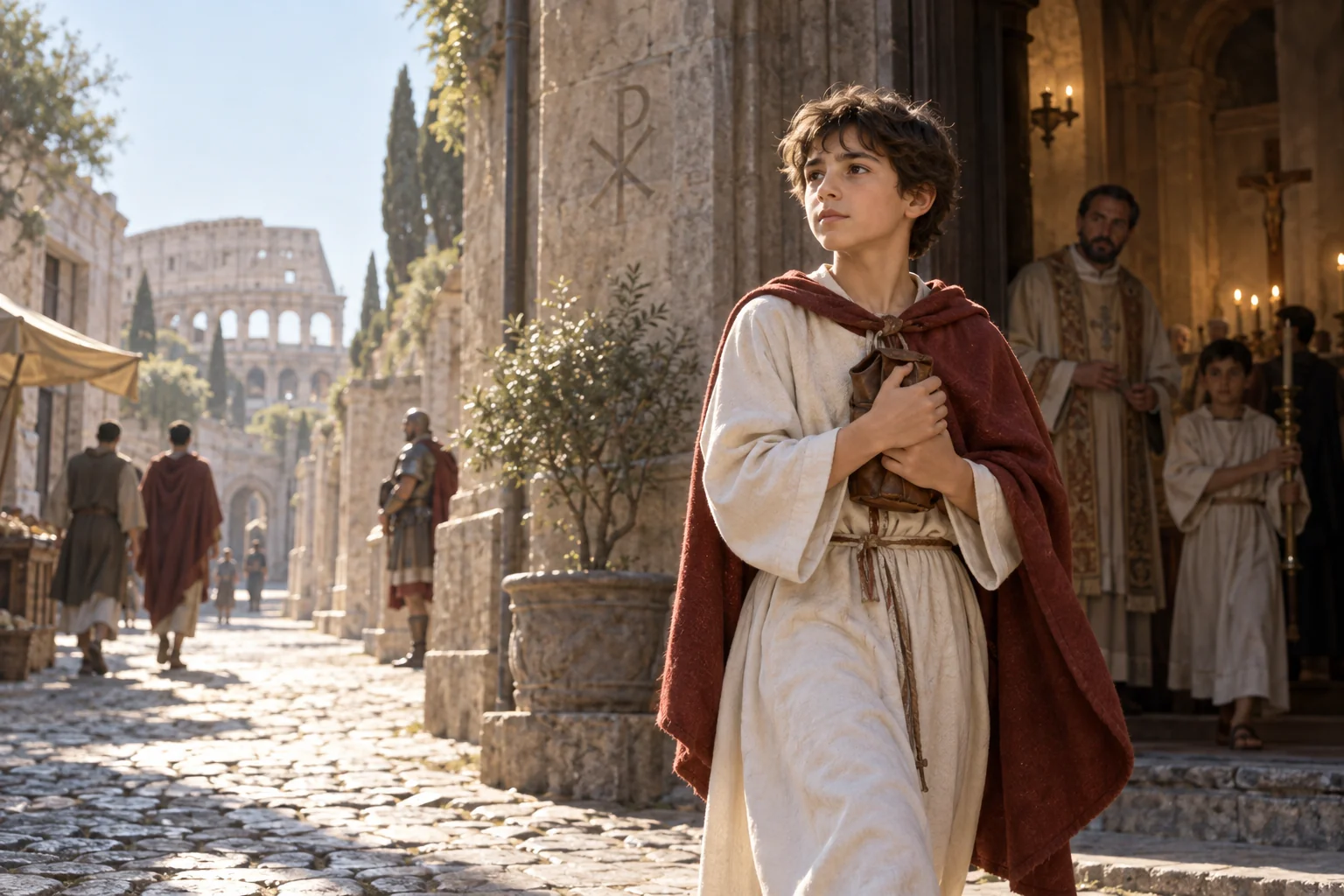
Journey 3 · Young Lives Freely Given
Saint Tarcisius
Guardian of the Bread of Life
Feast day August 15
Tap to step inside
Saint Tarcisius
Guardian of the Bread of Life
Map of a life
This life told in 4 chapters
Begin the journey

Feast day
Saint Tarcisius
Some places may celebrate on a slightly different day.
August 15
Patron of
- Altar servers
- Ministers and guardians of the Eucharist
Often depicted with
- Holding the Host against his chest
- A palm branch
Opening
Opening
Some people pass through history without leaving a learned book, a great building or a single line in their own hand. They are remembered, generation after generation, for one extraordinary act done in a moment from which there was no turning back.
Tarcisius was such a person. In ancient Rome, in the centuries of bloody persecution, he held the Blessed Sacrament tight against his chest and would not let it be trampled and profaned. A short errand, brutally cut off on a Roman stone road, became a story of courage that has never died.
Today, in Vietnamese parishes, whenever an altar server ties the cord of his robe, steps up reverently to the altar or folds his hands before the tabernacle, Tarcisius is remembered like a holy older brother. Across all those centuries, a quiet servant still teaches young people reverence before the One who dwells in the simple Bread.
Chapter 1 of 4
Footprints lost in history
His date of birth is recorded nowhere, and history has not kept the names of his parents or anything of his family. Even his exact age and his role in the early Christian community are unclear in the earliest witnesses: popular devotion usually portrays him as a young altar boy in his teens, while some scholars think he may have been a young deacon.
Yet the firmest evidence we have was set down by Pope Damasus himself in the fourth century. Throughout his reign, from 366 to 384, this Pope had a whole series of poems honoring the martyrs carved in a beautiful lettering known as “Philocalian script” (the work of the gifted engraver Furius Dionysius Filocalus), and he had the marble plaques set up in the catacombs outside Rome. In one such inscription, placed at Tarcisius’s burial place in the cemetery of Callistus on the Appian Way, the Pope recounts that Tarcisius was carefully carrying the Eucharist when a violent pagan mob blocked his way, demanding that he open his cloak and show them what he was hiding. Tarcisius chose to be crushed to death under a hail of bricks and stones rather than hand the sacred Mystery over to those who would profane it.
His martyrdom is usually dated to the third century, during the brutal persecutions under the emperor Valerian, around 257–258. The cemetery of Callistus, where he was buried, was the first official catacomb of the Church of Rome, established in the time of Pope Zephyrinus: a maze of passages dug deep underground, where thousands of Christians and many early popes lie at rest. The exact location of Tarcisius’s original tomb can no longer be identified today, but ancient pilgrim guides still record that he was once buried there.
There is no birth record for him, but the Christians of Rome never forgot him. They reverently gathered up his broken body for burial, kept his name in their hearts and handed it on to later generations as an example of faithfulness.
Sometimes history keeps the whole family tree of a royal house, and sometimes only a single gesture. With Tarcisius, one gesture, holding the Lord tight against his chest, is enough to speak of a love stronger than life.
Chapter 2 of 4
A journey toward the dark prison
According to the story that generations of believers have lovingly handed down, it all began with a very real sorrow. The Roman authorities had rounded up many Christians and thrown them into dark dungeons, where they waited for the day they would be led into the arena to be torn apart by wild beasts.
Those prisoners were cut off from the community, unable to attend Mass, not knowing what tomorrow would bring. They longed with all their hearts to receive the Body of the Lord as Viaticum, to give them strength for what lay ahead. But carrying the Eucharist from the catacombs into the prison was extremely dangerous: if priests or older deacons went, the guards would recognize and arrest them at once.
It was then that Tarcisius stepped forward. The boy told the bishop that, being young and ordinary-looking, he would draw the least suspicion, and he asked to be given this holy task.
Measured in footsteps through the streets, it was a short distance; measured in danger, and in love for those who were waiting, it was endless. The prisoners in their cold cells were wearily watching for him. To bring them the Eucharist was to bring them a sacrament and also a living sign that the Church had not forgotten them, that their brothers and sisters were praying for them always, and that Jesus Himself was entering the dark prison to share their captivity.
The night before he set out, Tarcisius surely tossed and turned like any child about to shoulder something beyond his years. He had no soldiers to escort him and no shield, only a heart that believed what he was carrying was greater than any danger in the streets. His choice was not a sudden impulse. It grew out of many days of quiet service beside the community’s pastors, where he had learned to love the Eucharist long before he risked his life for it.
Chapter 3 of 4
A cloak held tight against a hail of stones
Tarcisius wrapped the Body of the Lord in a clean white cloth, hid it carefully in the folds of his cloak against his chest, and held the holy bundle tight with both hands. He hurried along the Appian Way, the oldest and most important highway of the Roman Empire. It was paved with great slabs of basalt, and even today, after nearly two thousand three hundred years, the ruts of ancient cart wheels can still be seen on stretches that survive.
On the way, a group of pagan boys his age, playing in the street, caught sight of him. Seeing him hurry along with an odd look, his hands clutching the front of his cloak, they grew curious and ran to block his path. They teased him and demanded to know what treasure he was hiding. Tarcisius firmly refused and tried to walk on.
Their initial curiosity quickly turned to violence when someone recognized him as a Christian. A crowd of adults gathered, joining in the threats and insults and trying to snatch the bundle from his hands.
A brutal attack broke out. With clubs and sharp stones from the roadside they struck the boy again and again. Blows and stones rained down, and blood streamed over his young body. He collapsed to the ground, but his thin arms stayed locked together, clutching the front of his cloak. He would rather let the stones crush his flesh and bones than loosen his hands and let the Eucharist fall into the hands of his enemies.
Tradition says that a Roman soldier named Quadratus, secretly a Christian, passed by, saw what was happening and rushed in to scatter the violent mob. But by then it was too late. Tarcisius’s body was broken. The soldier lifted him in his arms; before he died, the boy opened his eyes, looked at his fellow believer and handed him the Eucharist, still whole and untouched. The mob had searched his body and found nothing of this world.
Chapter 4 of 4
A lesson for hands that serve at the altar
At Mass, the Holy Bread is broken to be given to many. Yet on that stone road long ago, Tarcisius had to hold that Bread tight to shield it from profaning hands. The two gestures seem opposite, but they spring from the same source: complete reverence for a Love that gives itself away.
Tarcisius did not hold on to the Lord to keep Him for himself or to show off his piety. What he carried was meant for his most suffering brothers and sisters: prisoners cut off from everyone, people at death’s door. Tarcisius’s love for the Eucharist was always joined to love for others. The road from the altar does not stop when Mass is over; it must continue on to people who are alone, people imprisoned in loneliness and fear.
In honoring Tarcisius, the Church does not teach young people to be reckless. Adults are always responsible for keeping children safe. What is worth imitating is his faithfulness.
An altar server can live Tarcisius’s spirit by coming early to prepare the candles, by handling the altar linens with care, by keeping a reverent silence in the sanctuary. An adult lives it by making time to bring Communion to an elderly person confined to bed, or by kneeling before the Lord in a quiet tabernacle.
The Church celebrates Saint Tarcisius on August 15 each year. Down the generations he has remained the beloved patron of altar servers and of all who guard the Eucharist. To Tarcisius, protecting what the Lord had entrusted to him was worth more than his own life. And thanks to faithfulness like his, the road from the Lord’s altar to suffering souls has never been closed.
The end of the story
You have walked with Saint Tarcisius to the end of the story.
You will always remember:
Asking for a dangerous task because a young, ordinary-looking boy would draw the least suspicion.

Attacked on the road, his arms stayed locked around the Eucharist, letting the stones crush his body rather than let go.

Before his last breath, he handed the Eucharist, still untouched, back to the Christian soldier.
Stay in silence
Remember this: he did not hold the Lord tight to keep Him for himself, but to bring Him to prisoners wasting away in a dark cell.
Some things are worth holding tighter than our own lives.
Let us pray
Saint Tarcisius,
young as you were, you asked to carry the Body of the Lord to the prisoners. Attacked on the road, you still held the Eucharist tight, letting your body be crushed by stones rather than let go.
Pray for altar servers and all who serve at the altar, that they may treasure Jesus in the Eucharist.
Each time I receive Communion, help me welcome the Lord with love, and carry Him to those who are lonely and suffering.
Amen.
Sources
- Feast dayAuthor’s edited profile
- Patron ofPatronages and symbols, version 1.1
- Often depicted withPatronages and symbols, version 1.1
- Reflectionnewadvent.org
- Reflectionvatican.va
Meet the next one
 Journey 3