

Journey 2 · Holiness Under One Roof
Saint Rita of Cascia
A rose beside the wound
Feast day May 22
Tap to step inside
Saint Rita of Cascia
A rose beside the wound
Map of a life
This life told in 6 chapters
Begin the journey OpeningOpening1 min
 Chapter 1 of 6A small village amid ancient feuds1 min
 Chapter 2 of 6A blood debt laid on a mother’s shoulders1 min
 Chapter 3 of 6A convent door that opened slowly1 min
 Chapter 4 of 6The thorn in her forehead, and the wound of love1 min
 Chapter 5 of 6A rose in the frozen winter1 min
- Chapter 6 of 6A friend in hopeless cases1 min
Feast day
Saint Rita of Cascia
Some places may celebrate on a slightly different day.
May 22
Patron of
- Difficult, seemingly impossible cases
- Wives in troubled marriages
- Victims of domestic violence, widows
Often depicted with
- A thorn wound on her forehead
- Roses
- Bees
Opening
Opening
Saint Rita is usually painted with a fragrant rose in her hand. But long before the rose, her life passed through wounds that tore her heart apart:
- a husband brutally murdered in an ambush by his enemies;
- two sons barely grown who died young of illness;
- and a family home suddenly left desolate and cold.
What draws ordinary people to Saint Rita, generation after generation, is not just the hope that she will untangle some knotted problem. People come to her because they see a real person of flesh and blood who tasted the bitterest things in human life, who stood among the ashes of ruin, and still found a way to keep love and forgiveness from being buried along with those losses.
Chapter 1 of 6
A small village amid ancient feuds
Rita was born around 1381 in Roccaporena, a small village perched on a rocky mountainside near the town of Cascia, in the Umbria region of Italy. Her baptismal name was Margherita Lotti. Her parents, Antonio Lotti and Amata Ferri, were simple farmers whom the villagers respectfully called “peacemakers of Christ”, because they were always the first to settle quarrels between families in the area.
Umbria at that time was lovely to look at, but it was torn apart by factional wars and age-old family feuds, the same bloody conflicts between rival factions that had engulfed all of Italy through the thirteenth and fourteenth centuries, when a whole family line could be wiped out simply for standing on the wrong side of a local power struggle. A small insult could lead to killings and revenge handed down from father to son. “Blood for blood” was seen as a sacred duty of family honor, so much so that refusing to take revenge could be thought more shameful than death itself.
Rita grew up in that stifling atmosphere. Her parents’ example taught the girl a lesson that went against the current: there must be people who dare to stand between two drawn blades, speaking words that calm the fury, so that one death does not drag countless more deaths after it.
When she grew up, Rita obeyed her parents and married Paolo Mancini, and they had two sons. The old accounts differ about her husband’s temperament, but this much is clear: they lived in a society full of violence, and in the end Paolo himself fell victim to its spiral of hatred.
Married life meant the hard daily work of a mountain wife and mother: washing, cooking, caring for the children. Most of a woman’s life is not made of great events, but of patiently sharing joys and hardships and keeping a home.
Chapter 2 of 6
A blood debt laid on a mother’s shoulders
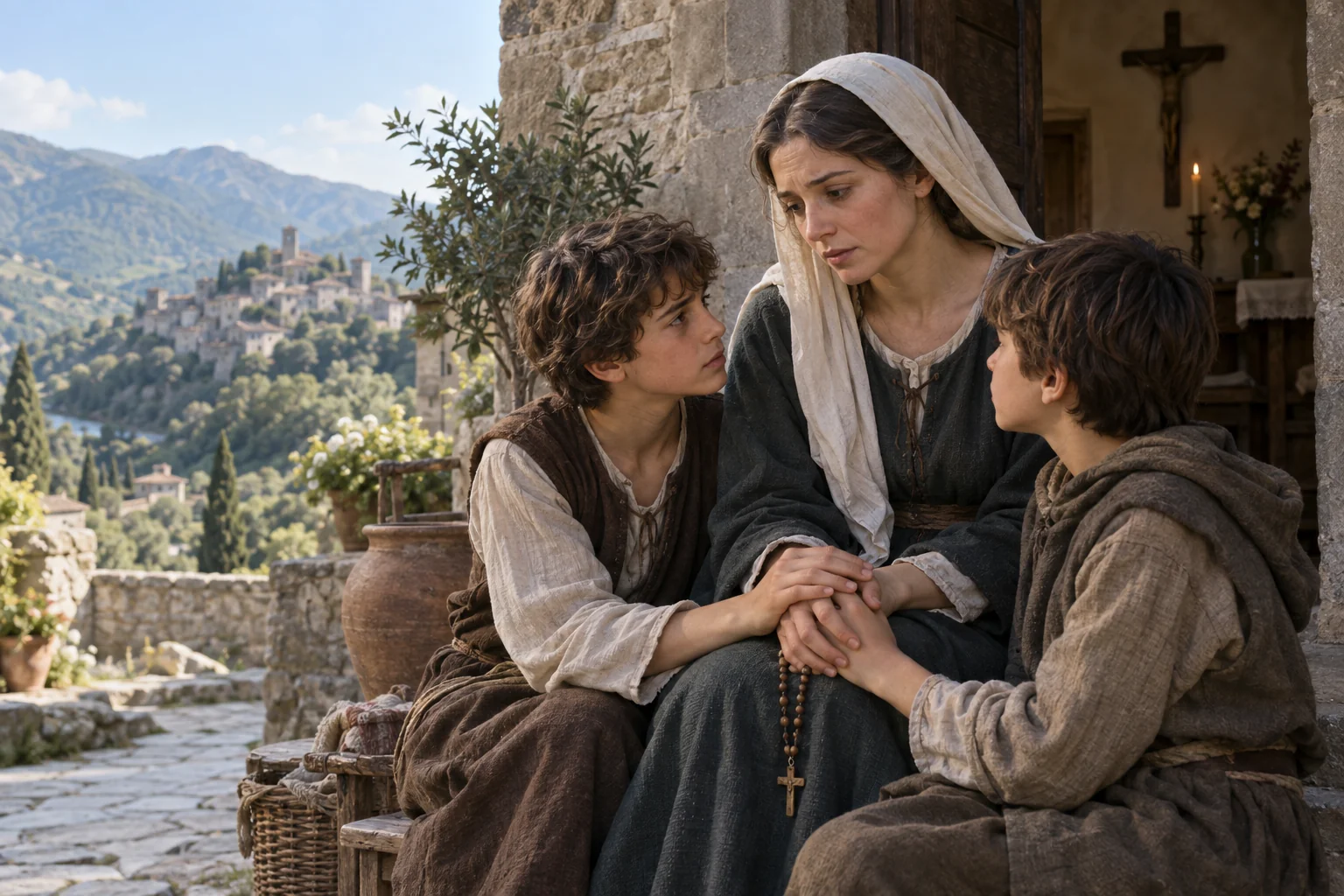
Then horror struck: Paolo was ambushed and murdered by enemies on his way home. That wound cut Rita’s life in two.
Her husband lay dead in a pool of blood. Her two growing sons were surrounded by their father’s relatives, who kept urging them to take up the sword and avenge him, to wash clean the family’s honor. Rita was caught between two terrors: on one side the grief of losing her husband, on the other the fear of seeing her two sons set out on the road to murder.
Tradition says that she did everything she could to talk her sons out of revenge. She prayed that God would take them to Himself with pure souls rather than let them become murderers and spread more bloodshed.
Not long afterwards, both sons caught a severe illness and died one after the other.
No one should twist that grief into the picture of a heartless God snatching away the lives of children. In Saint Rita we meet a mother who bore yet another heartbreaking loss: in a short time, both husband and sons were gone forever. The house still stood on the mountainside, but the beloved voices and laughter had fallen silent. Rita carried all that crushing emptiness into silent prayer.
To forgive in such painful circumstances is not to pretend the crime never happened. Forgiveness is a brave decision: refusing to let the poison of hatred rule the rest of one’s life. The wound still aches, the dead are still mourned, but the future is not handed over to revenge.
Chapter 3 of 6
A convent door that opened slowly
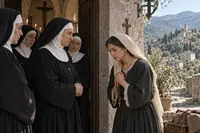
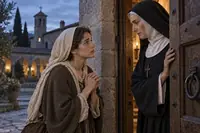
Her duties to her family done, Rita asked to enter the Augustinian convent in Cascia. But the door did not open at once. The nuns feared that a widow whose family was caught up in bloody vendettas would bring the feuds outside into the peace of the community. They required her to make peace with the men who had killed her husband before she could cross the convent threshold.
Rita did not lose heart. She patiently sought out her enemies’ family, held out her hand in forgiveness, and urged them to be reconciled with her husband’s family. A public reconciliation took place in Cascia, to everyone’s astonishment: a woman who had just lost her husband and her sons was the one who stepped forward to heal two feuding families, instead of waiting for others to come and make peace with her.
She could not flee her past behind convent walls and leave hatred raging in the streets. Her new road of consecration had to be cleared by a concrete, courageous act of reconciliation.
Early in the fifteenth century, Rita was received into the convent of Santa Maria Maddalena. She lived there as a nun for forty years, long enough for holiness to soak into every simple, repeated rhythm of the day: praying, sweeping, weaving, living with sisters whose temperaments differed from hers, learning to bear her own limits and to love people she had not chosen.
Rita had a deep love for the Passion of Jesus. Before the Crucified, her old grief for her husband and sons was not brushed aside but taken up into the vast love that saves.
Chapter 4 of 6
The thorn in her forehead, and the wound of love
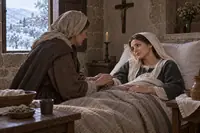
Sacred art through the centuries has portrayed Saint Rita with a deep wound on her forehead. Tradition tells that one day, as she knelt praying earnestly before the Cross, she asked to share a part of the pain of the crown of thorns Jesus wore. A thorn from the Lord’s crown seemed to fly to her and pierce deep into her forehead, leaving a bleeding, foul-smelling, painful wound for the last fifteen years of her life.
This story speaks the language of devotion. What it holds on to is Rita’s deep union with the Savior who suffered out of love. She did not seek suffering to be praised by others; that wound belonged to a life that had long since been wholly given.
People who are ill need treatment, comfort and support. Contemplating Saint Rita does not mean seeking out suffering or refusing medicine. In her, believers see that even in wounds of body or soul that cannot be healed, a person is still loved by God without limit and can still give love to the world.
Her body grew weaker with the years. Her world shrank to the four walls of a sickroom.
Chapter 5 of 6
A rose in the frozen winter
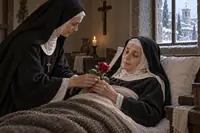
There is a beautiful story the faithful have handed down through the generations. One bitterly cold winter near the end of her life, when snow covered the hillsides, a cousin came to visit and asked whether there was anything she wished for. Rita smiled and whispered a request: would she go to the old garden at Roccaporena and pick her a rose and two figs?
Her cousin thought she was delirious, for how could anything bloom in the dead of winter? But stepping into the old garden, she was astonished to see a deep red rose opening its petals against the white snow, and two ripe figs on the branch. She picked them and brought them back, placing them in the old nun’s thin hands.
This is the rose of hope that devotion has lovingly kept. The old garden recalls the family home of long ago and the loved ones who had died. When she entered the convent, Rita never cut herself off from her life as a wife and mother, or denied it. She carried all that love with her until her last breath.
Saint Rita died on May 22, 1457, in the convent at Cascia. People from all over the region poured in to pay their respects and venerated her as a saint from the moment of her death. On May 24, 1900, Pope Leo XIII solemnly canonized her. The Church celebrates her on May 22 each year.
Chapter 6 of 6
A friend in hopeless cases
Millions of believers on every continent turn to Saint Rita as the patron of impossible cases, of situations so stuck they seem to have no way out: a marriage on the brink of breaking, a deep feud within a family, the grief of a loved one lost too suddenly.
She does not promise that a tragic past can be undone. Her husband and two sons never came back to walk again in the old house. But her life shows that people can truly learn to love again after the most desolate ruin.
A family can stop handing bitterness down to its children. An apology, a humble gesture of reconciliation, can change the whole future of a family line.
And the rose is still fragrant beside the wound. Both images stand together in Saint Rita’s portrait as a gentle reminder that however many storms life brings, even in the coldest winter of the soul, love and forgiveness can still bring forth fragrant flowers to offer to God.
The end of the story
You have walked with Saint Rita of Cascia to the end of the story.
Some scenes stay with you:
Having lost her husband to hatred, she still begged her two sons not to take revenge, preferring to lose them rather than see them become murderers.
Refused entry to the convent because her family was caught up in a feud, she went herself to make peace with the very men who had harmed her husband.
In the depths of frozen winter, a rose suddenly bloomed in the old garden, just as she had wished.
Stay in silence
And you see that she does not promise the past can be undone; she shows only that people can still learn to love again, even after the most desolate ruin.
In the coldest winter of the soul, love and forgiveness can still make a flower bloom.
Let us pray
Saint Rita,
your husband was killed out of hatred, yet you still urged your sons not to seek revenge, and went yourself to make peace with those who had harmed him.
I bring to you the quarrels in my family, the wounds that seem as if they will never heal. Pray for me, that I may learn to forgive and begin again.
You are the patron of impossible cases. May the things that seem hopeless to me bloom like a rose in the middle of winter.
Amen.
Sources
- Feast dayAuthor’s edited profile
- Patron ofPatronages and symbols, version 1.1
- Often depicted withPatronages and symbols, version 1.1
- Reflectionsantaritadacascia.org
- Reflectionsaintritashrine.org
Meet the next one
 Journey 2